
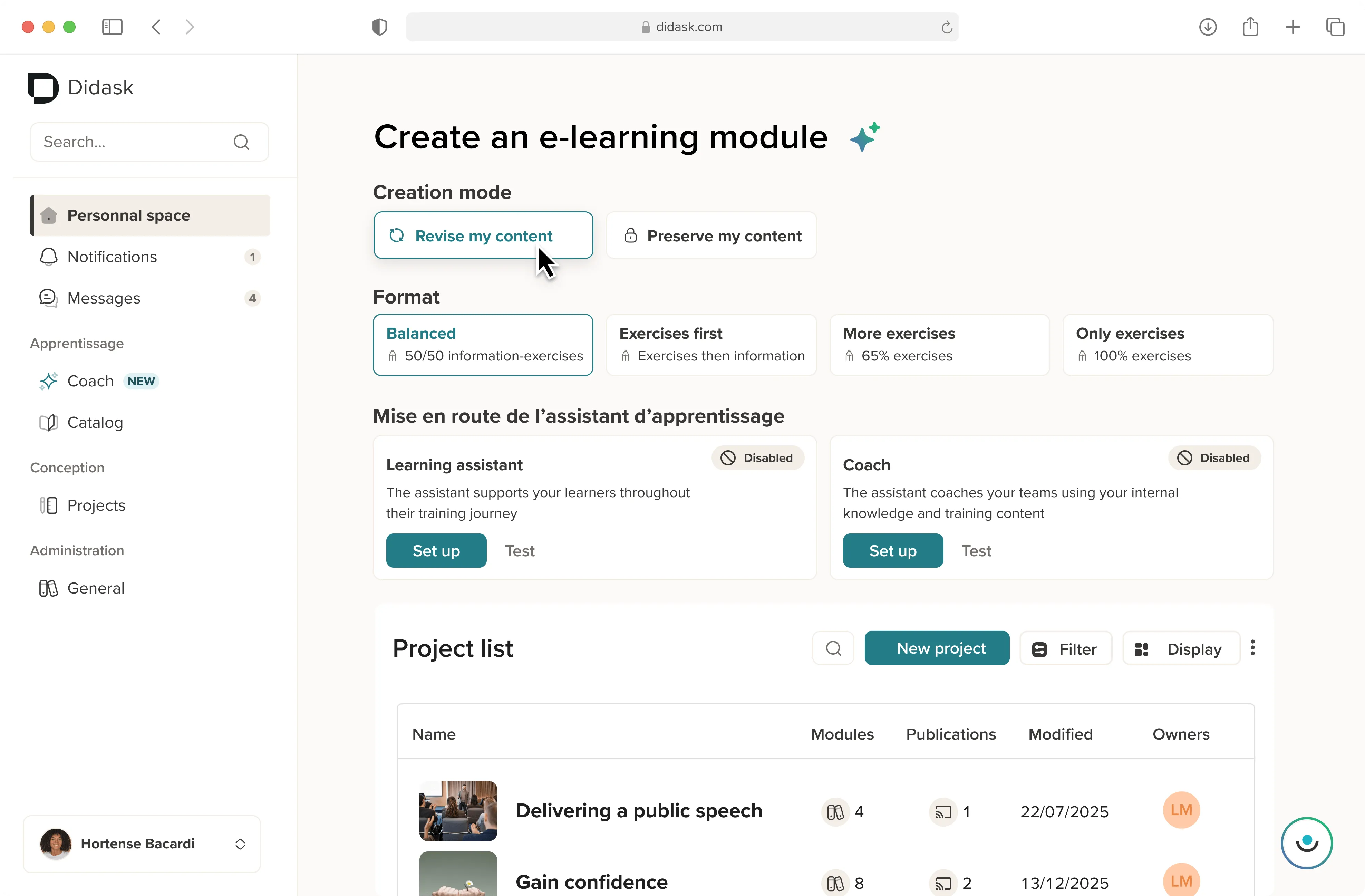
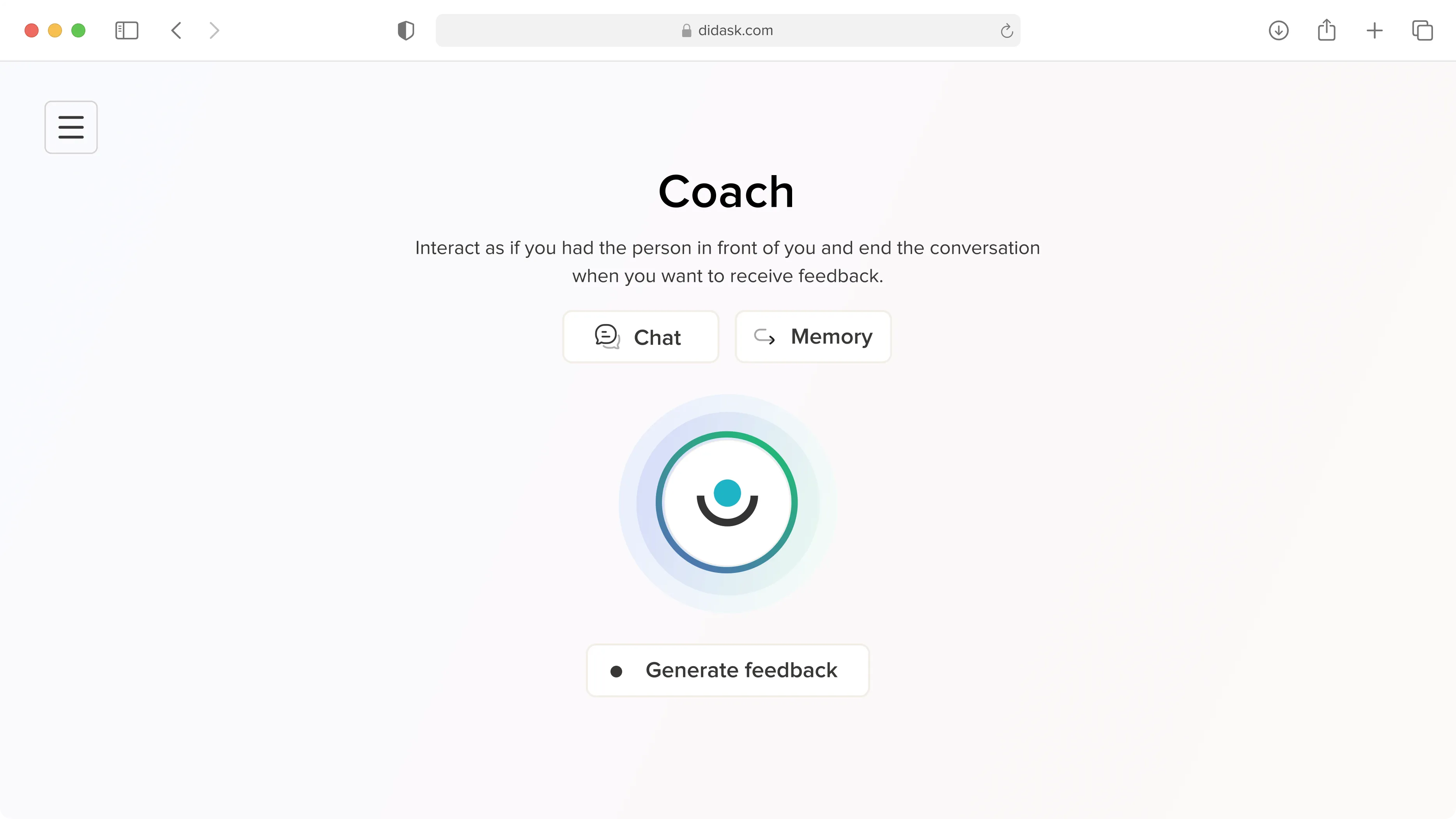


Today, the LMS is becoming a complete skills development system for organizations. The integration of artificial intelligence and cognitive science is turning these traditional platforms into genuine drivers of digital learning, and makes online training accessible to every employee. As the technology evolves, the learning management system becomes a central tool for structuring training programs, improving learner tracking and anchoring skills in daily professional practice.
What is an LMS and how does it work?
LMS definition
An LMS (Learning Management System) is a platform that lets you create courses, then manage, distribute and track training programs remotely.
The new generation of training platforms goes far beyond simply hosting content. It turns raw information into a genuine online learning experience through AI. Training platforms like Didask now include advanced adaptive learning features. They automatically personalize learning paths according to each employee's specific needs.
How a modern LMS works
An effective LMS rests on three fundamental pillars that interact constantly:
- Course administration: user registration, assignment of access rights.
- Creation and distribution of training content: module setup, integration of multimedia documents.
- The learner experience: intuitive interface, access to catalog resources.
SaaS (cloud) platforms guarantee permanent access to digital training through mobile and desktop applications. Learners connect at any time, from any device with an internet connection, to follow their online courses. Exploiting learning data represents a major shift: algorithms analyze behavior in real time to continuously optimize the training experience and simplify reporting.
What is the difference between LMS, LCMS and LXP?
The terms LMS, LCMS and LXP are often used interchangeably. They nevertheless describe systems with distinct functions in education and e-learning.
The LMS (Learning Management System) focuses mainly on the administrative management of training and gives a central role to trainers, educators and administrators in handling data.
The LCMS (Learning Content Management System) is oriented toward creating and managing instructional content for designers. This content management system makes it possible to edit and organize training materials efficiently through authoring tools.
The LXP (Learning Experience Platform) puts the learner at the center with a personalized, more exploratory approach that favors direct interactivity and collaborative learning within a community of learners.
The boundary between these systems is gradually blurring. The best modern platforms now combine the functionalities of all three categories into a unified solution: the administrative efficiency of the LMS, the creative power of the LCMS and the user engagement of the LXP, supported by native integrations.
.png)
Good to know
To go deeper on this topic and understand how to choose the right solution for your needs, read our detailed article: Everything you need to know about the difference between LMS and LCMS.
The different types of LMS
Several deployment models coexist on the market to meet the specific needs of organizations. Choosing between these families of platform depends on the level of customization you want and the resources available to you.
The SaaS model (Software as a Service) is the current reference, with its flexibility, automatic updates and predictable cost. This cloud form lets organizations access their training platform from any device without technical constraints.
Open Source solutions allow extensive customization: access to the source code lets technical teams modify the software to fit their specific needs. In exchange, editing the code and handling maintenance require in-house IT skills.
Proprietary and on-premise versions offer advanced features or total control over the server infrastructure respectively.
Industry standards
Compatibility with established standards such as SCORM (Sharable Content Object Reference Model), xAPI, LTI and cmi5 guarantees interoperability between different systems and content. The SCORM standard and the others considerably simplify the management of educational resources, and in particular make it possible to reuse existing files when changing platform.
What are the benefits of an LMS for your organization?
Centralization and efficient management of training
A modern LMS is the nerve center of your training strategy, bringing all of the company's training content together in a single space. This centralization considerably simplifies the work of HR and training teams, with every document, video and support material accessible and logically organized. Sharing content between designers saves time every day.
Administrative management becomes far more fluid, with automation of repetitive tasks such as session registration or reminder emails. The system also harmonizes training practices, offering every employee a consistent experience.
Precise tracking of progress and skills
One of the major advantages of an LMS lies in its ability to track how skills evolve. Dashboards give a clear view of individual and collective progress, allowing training managers to obtain detailed reports across the whole system. Real-time learner tracking makes steering far easier.
This tracking makes it possible to intervene in a targeted way with learners in difficulty, and to offer additional resources adapted to specific needs.
Lower costs and efficiency gains
Adopting a training management system generates significant savings on several levels: logistics (fewer travel expenses), human resources (better use of trainers' time), instructional materials (no printing costs) and productivity (less time away from the job).
The blended learning model, which combines in-person sessions in a training room with digital modules, offers an excellent compromise. It preserves human interaction while maximizing budget efficiency through distance learning. This approach simplifies training management by reducing the logistical load without sacrificing instructional effectiveness.
Simplified compliance and regulatory tracking
In many sectors, professional training is subject to strict legal obligations. An LMS makes this compliance considerably easier by automatically retaining evidence of participation and success in mandatory training, including certifications. The system can also schedule reminders for courses that need periodic renewal, reducing the risk of non-compliance through effective regulatory tracking.
From information to application: how learning platforms have evolved
The three generations of LMS
The history of learning management systems reflects the evolution of technology and instructional approaches, from the first generation (1990-2005) focused on simply digitizing content, through the second generation (2005-2020) which improved the user experience, to the current third generation with advanced personalization.
This evolution marks a fundamental change of approach, gradually moving from tools centered on top-down distribution to platforms oriented toward the real application of knowledge.
Limits of traditional LMS
Despite their progress, traditional platforms have significant shortcomings: static content, a top-down approach, superficial metrics and complex authoring. These limits explain the often disappointing engagement rates of legacy systems.
New generation training platforms answer these limits by placing real learning, rather than content alone, at the center. A platform like Didask does not merely manage resources: it turns raw information into an effective learning experience that serves genuine skills development.
What is transfer of learning?
Transfer of learning describes the ability to apply in a new situation what was learned elsewhere. It is the only indicator that really counts in professional training.
An engineer can identify a safety risk in a quiz without knowing how to handle it in the field. A salesperson can recognize a good pitch without being able to deliver it in front of a client. Moving from memorization to application requires situated exercises and feedback that explains the error rather than penalizing it.
Why cognitive science matters in digital learning
Advances in neuroscience and cognitive psychology are changing our understanding of how learning works. The core principles at play include cognitive load management, multimodal encoding, spaced retrieval and formative feedback.
Applying these scientific principles substantially strengthens the effectiveness of online training.
Which preconceptions about the LMS should you abandon?
Some buying reflexes rest on observations that were accurate a few years ago. The market has changed, and these assumptions deserve to be re-examined.
Is an LMS only there to manage training?
In practice, the LMS is often seen as a steering and cost-reduction tool. Its ability to produce lasting skills development comes second.
The reason lies in the dominant mental model: a series of theoretical slides, followed by two or three obvious questions. Against that image, the format does not look equal to the stakes.
Is e-learning limited to basic theory?
Compare two situations. An employee completes a mandatory compliance module. A self-taught learner picks up coding or knitting online. Same medium, opposite outcomes.
No technical constraint forces e-learning to stop at the first level. Online training can adapt to the starting level, offer concrete cases and provide personalized feedback.
Two conditions make this possible: suitable instructional formats within the platform, and a barrier to entry low enough for those formats to actually get produced. On this point, the levers of motivation and attention are worth understanding before you start designing.
Can an LMS capture informal day-to-day learning?
The 70/20/10 rule circulates widely: 70% of learning happens informally on the job, 20% through peers, 10% in formal training. It is regularly presented as established fact, even though its empirical basis remains fragile.
More importantly, it suggests that on-the-job learning happens spontaneously. Cognitive science shows the opposite: signals from the field are too contradictory to draw reliable lessons from, and cognitive overload prevents information from being processed.
Informal learning does work, but only under conditions. Knowledge must be accessible at the moment of need, presented gradually, illustrated with worked examples, and paired with feedback during the task itself.
That is precisely what an LMS connected to work tools now makes possible. A salesperson generates a simulation before a client meeting, then debriefs their performance with a virtual coach trained on your own documentation.
How to create and manage training effectively on an LMS
Creation steps and engagement best practices
Designing effective training on an LMS follows a structured process running from needs analysis to evaluation and optimization, via instructional design, content production, technical integration, testing and launch. With Didask Training and its AI, you automate several stages of the course creation cycle.
To sustain learner attention and motivation, it is essential to use techniques such as microlearning (short 5 to 10 minute sequences), storytelling rooted in professional reality, frequent interactivity, multimodal content and social learning that encourages discussion and exchange.
.png)
Cyrielle Lauer, Skills Development Manager at Pellenc
Didask makes instructional design easier, gives us tailor-made training that meets our needs, and brings cognitive science to bear so that information is accessible to every audience.
Resource management and performance tracking
A high-performing training platform offers advanced functionality to organize instructional resources: a centralized library, a versioning system, categorization metadata, fine-grained access rights and validation workflows before publication. As an instructional content management system, it lets you edit and share materials without starting from scratch.
Analytical dashboards support a data-driven approach to training, with quantitative and qualitative indicators, comparative analysis and dynamic visualizations that make it easier to spot trends in learning outcomes.
What AI brings to content creation
Artificial intelligence is changing the creation process on modern platforms by enabling the automatic transformation of raw documents into structured learning paths, the generation of relevant exercises, the customization of examples by sector, and continuous optimization based on behavioral analysis.
At Didask, this automation contributes to a 50 to 65% reduction in design time at equivalent learning scope (measured across 2,237 courses, October 2025), and opens up the authoring tool to subject-matter experts who want to build online courses without specific technical skills.
How do you optimize an LMS that is already deployed?
Many organizations have a platform whose usage has plateaued. Employees consult the bare minimum and never explore the additional resources.
Five levers can revive adoption without changing tools:
- Activate genuine support: beyond technical assistance, ongoing guidance unlocks the features that have been left aside.
- Connect the platform to daily work: an LMS linked to communication and productivity tools generates recurring usage, where an isolated portal stays ignored.
- Address the designer experience: an interface built only for learners slows production and makes updates rare.
- Decentralize creation: opening design up to subject-matter experts removes the e-learning specialist bottleneck.
- Go beyond completion rates: setting aside time to analyze the data is as structuring as the design work itself.
If these levers are not enough, the question of changing platform arises. It is lighter than most people assume: see how to change LMS without the headache.
How to access and get the most out of an LMS as a learner
Access, navigation and learning optimization
Access to an LMS is generally simple and secure, with dedicated credentials, multi-device access, sometimes an offline mode, and notifications about newly available content. Learning platforms favor a smooth experience where users can resume training exactly where they left off.
To get the most from online training, it helps to schedule learning sessions regularly, choose a suitable environment, take active notes, apply new concepts immediately, and take part in social exchanges to deepen understanding and anchor knowledge.
Social interactions and personalized AI assistants
Social and collaborative dimensions considerably enrich the learning experience through thematic forums, live virtual classes, collaborative work and mentoring systems that recreate a social dimension essential to anchoring what has been learned.
Beyond the training session itself, contextualized support can extend learning into the flow of work. That is the purpose of Didask Coaching, the companion to Didask Training, which provides personalized tutoring and points learners to the most relevant modules at the moment of need.
Which tools and integrations make an LMS truly effective?
Essential compatibilities and HR integrations
An LMS must fit smoothly into the company's digital ecosystem through open APIs, single sign-on (SSO), mobile compatibility and support for the main web browsers. Synchronization with the HR information system adds considerable value by enabling automated profile management, alignment of training with individual objectives, updating of qualifications and integration of results into the appraisal process.
A complete technology ecosystem
Beyond its own features, a high-performing content management system sits within a larger ecosystem including collaborative platforms, document systems, business intelligence tools and sector-specific business applications. This ecosystem dimension is what anchors training in employees' daily work.
Good to know
An LMS centralizes personal data and skills histories. Check GDPR compliance, where the hosting is located, and the vendor's commitments on subcontracting. Bring your security stakeholders in during the selection phase, not at contract signature.
How to choose the right LMS for your organization
Evaluation criteria and key questions
Selecting an LMS should rest on a rigorous analysis of several dimensions: user experience, instructional features, administrative capabilities, technical performance, data security, ease of integration, and the quality of the vendor's assistance and support.
How well an LMS fits your needs depends largely on your specific context: your strategic training objectives, the volume of users and content to manage, the digital maturity of your teams, the internal resources available, budget constraints and customization requirements.
Selection process and mistakes to avoid
A structured approach maximizes your chances of selecting the right platform: start with needs analysis and market research, then build a shortlist, organize demonstrations and product webinars, test solutions in real conditions, run a comparative analysis, and finally negotiate the commercial and legal terms with the vendor.
Several classic pitfalls regularly compromise LMS projects: prioritizing price over instructional quality, neglecting the user experience, underestimating change management needs, choosing an overly complex system, or focusing only on current needs without anticipating future use.
Why scalability and innovation matter
How well your choice holds up over time depends largely on the platform's scalability and its pace of continuous innovation. These dimensions protect the relevance of your investment in the long run and prevent your system from becoming obsolete quickly.
Didask natively integrates advances in cognitive science and AI, in an approach aligned with the future challenges of professional training, whether digital learning or blended formats.
Two platforms tick the same boxes: how do you tell them apart?
On paper, most platforms advertise the same features. The real gap lies in depth of execution, which is rarely visible in a standard demo.
Here are the five points on which to demand a concrete demonstration rather than a screenshot. The distinction is especially sharp on AI applied to instructional design.
Our advice: test every shortlisted platform in real conditions, with your own content and a non-expert user.
Conclusion
Choosing a Learning Management System is a strategic decision that will durably shape your ability to develop skills across your organization, whether you are a training provider, an education player or a company looking to train its people effectively.
Recent market developments, with the rise of AI-based training platforms, open up new ways to steer skills development. These new generation solutions are changing how effective online training systems can be.
Didask, which combines scientific rigor with technological innovation, illustrates this shift. The platform delivers on the promise of digital learning genuinely oriented toward application, making it possible to create, distribute and track high-impact training paths.
.webp)
.webp)
.webp)
.webp)




.png)