


A compliance training LMS is a learning platform that automatically assigns mandatory courses, tracks recertification deadlines and keeps proof of what each employee has actually learned.
In France, 81% of the companies surveyed by the French Anti-Corruption Agency say they have rolled out anti-corruption training. Only 40% update that training every year (AFA, Diagnostic national sur les dispositifs anticorruption dans les entreprises, October 2024 — spring 2024 survey, 550 responses, 173 fully usable).
That gap is what this article is about. Rolling out compliance training has become easy. Keeping it current with the regulation has not.
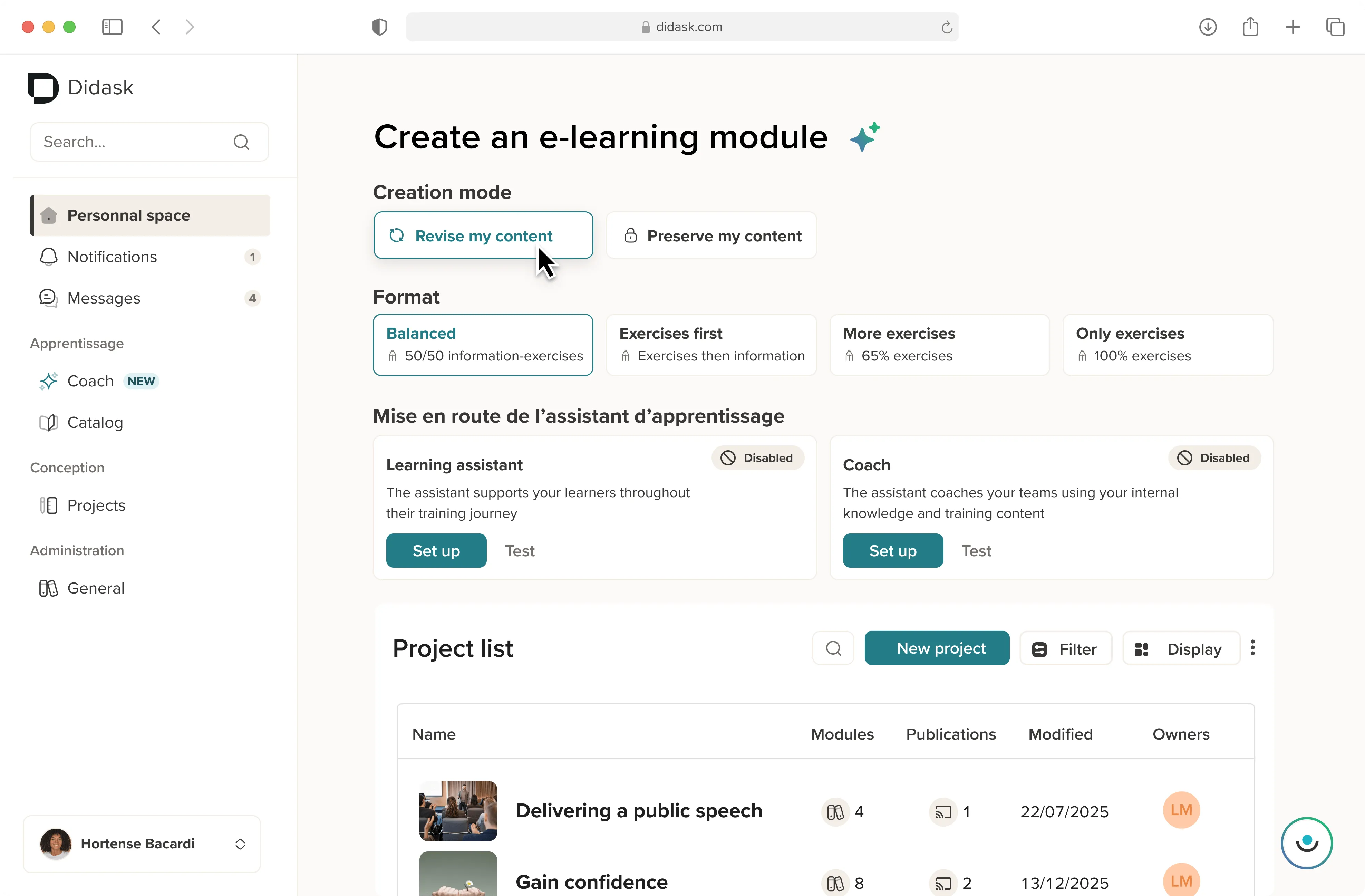
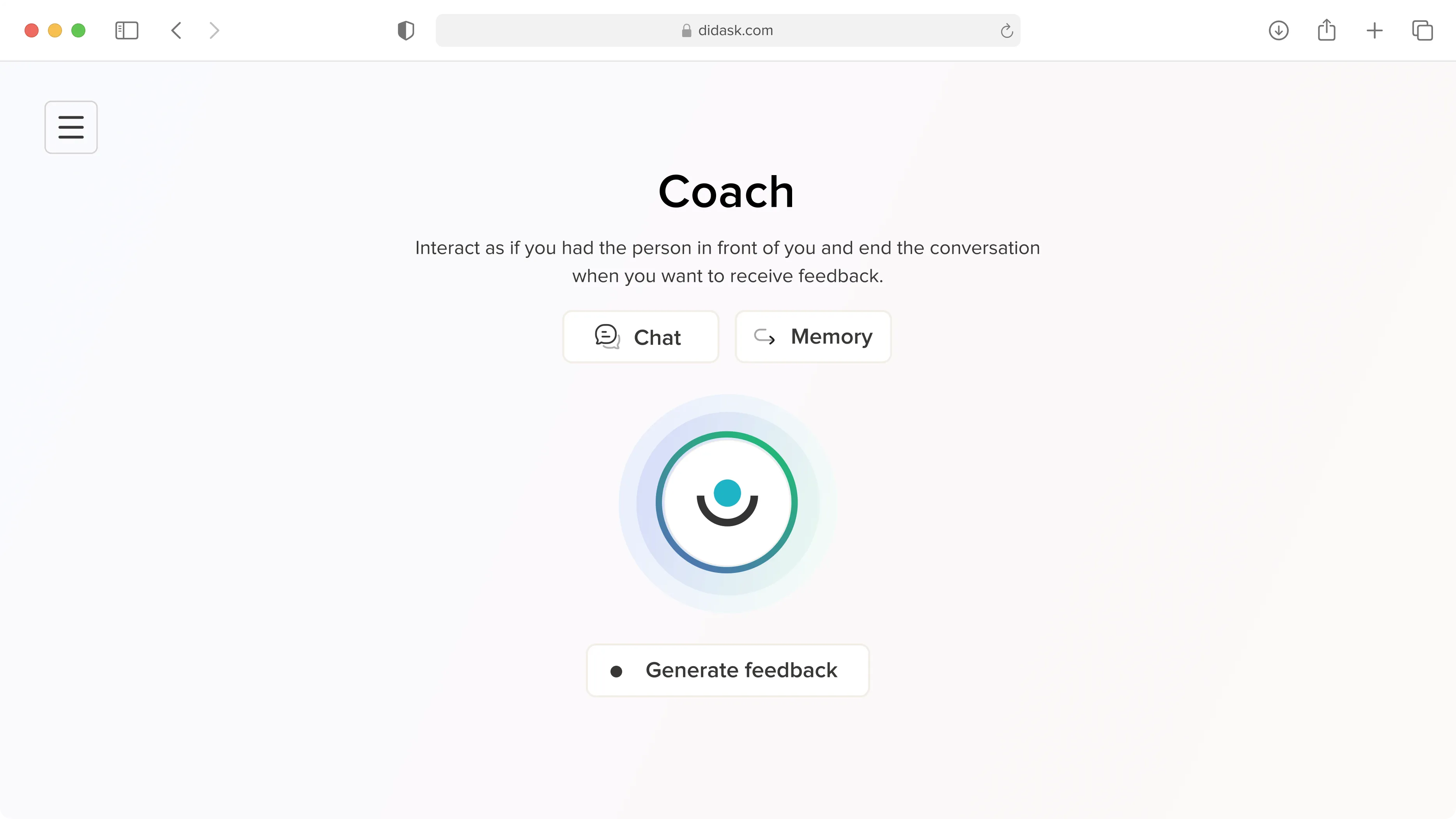
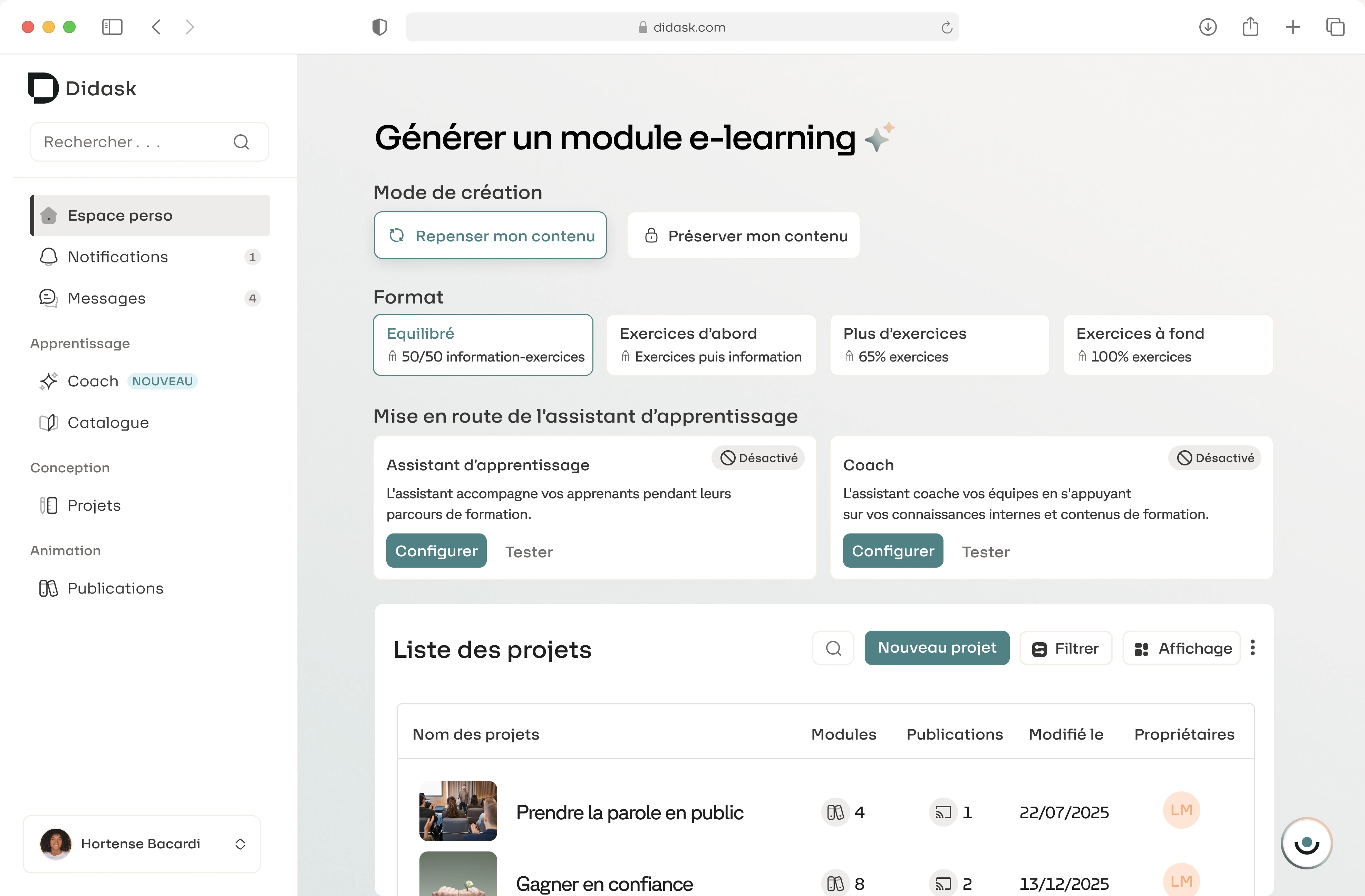
Didask is a French learning platform grounded in cognitive science that turns a regulatory text or an internal procedure into a pathway of realistic scenarios, without going through an instructional designer.
What are the 7 best compliance training LMS platforms in 2026?
The seven platforms selected are Didask, Dokeos, Cornerstone, Rise Up, Docebo, iSpring LMS and Moodle Workplace. Three of the seven vendors are European, two of them French. Didask publishes this comparison and ranks itself first.
Method: only information publicly verifiable on each vendor's own pages, as recorded on 17 September 2026.
Ratings recorded on Capterra on 17 September 2026.
1. Didask
French learning platform — authoring tool, design AI, AI coach — grounded in cognitive science.
Strengths
- The compliance expert imports their source text and gets a pathway of realistic scenarios: they keep control of the substance, the AI handles the form.
- Didask Training cuts design time by 50 to 65% (2,237 courses, October 2025), which matters most for updates: a module can be reworked in a few hours when the rule changes.
- 83% of designers had never built a module before (8,704 learners, June 2023) — the legal or HSE lead works without an L&D department.
- Pre- and post-training assessment: a starting score, a finishing score, and an exportable dashboard for an audit file.
- On the Suez group's corruption prevention module, deployed to more than 700 employees in commercial roles: over 40 practical cases and a 90% completion rate (full case study).
.webp)
They train their teams on compliance with Didask
Suez · Canal+ · Dekra · Konecta · IFCAM · Centre de formation de la profession comptable
2. Dokeos
Belgian vendor founded in 2004, positioned on regulated industries, part of the Lyvia Group since 2024.
Strengths
- The only vendor in the panel to name learner electronic signature and FDA 21 CFR Part 11 compliance on a French-language product page.
- Expiring certificates, automatic reminders and secure archiving of training records.
- Standards covered listed one by one on the product page, from GMP to GDPR.
3. Cornerstone
US vendor, talent management platform with an embedded learning module.
Strengths
- The longest list of frameworks in the panel: SOC 2 Type 2, ISO/IEC 27001:2022, 27017, 27701, 42001, with DORA explicitly listed.
- The vendor claims $7.4M in compliance savings over three years, based on a Forrester study it commissioned (2024).
4. Rise Up
French vendor founded in 2014, more than 130 employees.
Strengths
- French-language regulatory training page: automated reminders and follow-ups, with every module, quiz and certificate logged.
- The only vendor in the panel to name France's DPC scheme and the generation of reports for HAS, ARS and Qualiopi audits.
- Hosting named precisely: Scaleway, Paris. The vendor does not, however, claim France's HDS health-data certification.
5. Docebo
Vendor founded in Italy in 2005, parent company in Toronto, French subsidiary in Puteaux.
Strengths
- Certification expiry dates, renewal cycles and tracking dashboards.
- A catalogue of more than 30,000 courses available from the platform.
6. iSpring LMS
US vendor founded in 2001, formerly iSpring Learn.
Strengths
- Automatic re-enrolment of the relevant employees as soon as a certificate expires or a new version of a module is published.
- Immutable version history: the vendor lets you show exactly which version of a document an employee completed, and on what date.
7. Moodle Workplace
Australian vendor, the only open-source option in the panel, distributed solely through certified partners.
Strengths
- Automated recertification, personalised certificates and dynamic assignment rules.
- SCORM and LTI import, WCAG 2.2 AA accessibility.
.png)
What the law actually requires in terms of compliance training
In France, article 17 of the Sapin II Act requires companies with at least 500 employees and revenue above €100 million to run 'a training programme for managers and the staff most exposed to the risks of corruption and influence peddling'. The obligation targets exposed populations, not the entire workforce. The financial penalty can reach €1 million for a legal entity.
Across the EU, the DORA regulation, applicable since 17 January 2025, goes further for financial entities: article 13(6) requires ICT security awareness programmes and digital operational resilience training to be built into staff training schemes as compulsory modules, covering every employee and senior management alike, at a level of complexity matched to each role.
No LMS makes you compliant. It carries the training programme, keeps proof that it was delivered and documents the level reached.
What is a compliance LMS and how does it differ from a standard LMS?
A compliance LMS is a general-purpose LMS with three components hardened: assignment, deadline and proof.
Assignment first. Mandatory training is not offered in a catalogue: it is triggered by a criterion — entity, role, level of risk exposure — and reassigned at every new arrival.
Deadlines next. A first-aid certificate, an electrical authorisation or an anti-corruption module all have an expiry date. The LMS must carry it and follow up before, not after.
Proof last. This is where most programmes give way. A 95% completion rate proves that employees clicked to the end, not that they would know what to do when a supplier offers them a gift.
.png)
Compliance and training leaders, on what changes
'The realistic scenarios Didask offers make it possible to tackle complex subjects concretely, far more effectively than theoretical formats.'
— Delphine Bernard, Group Compliance Director, Suez
'We had a challenge that was almost insurmountable: around a hundred training days, 50 pathways, dozens of designers, thousands of participants... But thanks to the AI built into Didask, we got there.'
— Laurent Benoudiz, Vice-President of the French National Council of Chartered Accountants
'We managed to train 1,400 people who completed 8,000 training days in under six months.'
— Philippe Barré, chartered accountant, Centre de formation de la profession comptable
How do you choose an LMS for compliance training?
Six criteria are enough, and the first is not a feature: it is knowing who, in your organisation, will keep the module up to date (the questions to ask before choosing).
- Update time. Have a vendor time the editing of a module on one of your own texts, not on a prepared example. The AFA's 40% figure is what makes this criterion decisive.
- Autonomy of the compliance lead. Can the legal or compliance officer produce on their own, without a ticket to L&D or a brief to an agency?
- Proof of learning. Ask for a before score and an after score, not a completion rate. That is what an auditor or a funder asks to see.
- Deadline and authorisation management. Automatic reassignment, follow-up before expiry, history by employee and by module version.
- Access for frontline populations. Site workers, technicians, on-duty officers: with no work email address, access runs through an employee number, a code or SSO, and through short mobile sessions.
- Reversibility and real cost. SCORM export, dormant licences, catalogue modules billed separately, internal design time.
One criterion to discard: the number of ready-made regulatory modules. A generic catalogue knows nothing of your procedures, your signature delegations or your suppliers. It is the illusion of mastery scaled up to an entire programme: everyone completed the module, nobody can apply it where you work. Only realistic scenarios built on your own cases settle that doubt.
.webp)
.webp)
.webp)




.png)