OUR USAGES
retail and distribution
Your salespeople no longer just defend the price.
Your retail LMS needs to give them the pitch back.
You are one or two people responsible for training dozens, or even hundreds, of counter staff, advisors, and field sales reps spread across your stores, boutiques, and branches. Didask designs the training for you: your product experts provide the content, and artificial intelligence structures the learning path.













SOLUTIONS
What’s holding back training
in a distribution network
Your daily reality today
WITH DIDASK
Your salespeople only defend the price
Without a technical pitch, there’s no upselling and no product substitution: they just take the order.
Your sales team regains mastery of technical product knowledge.
At Ternois Fermetures, technical sales staff achieve a 78% success rate on assessments for the aluminum product line. 700 learners
PERSONALIZED LEARNING
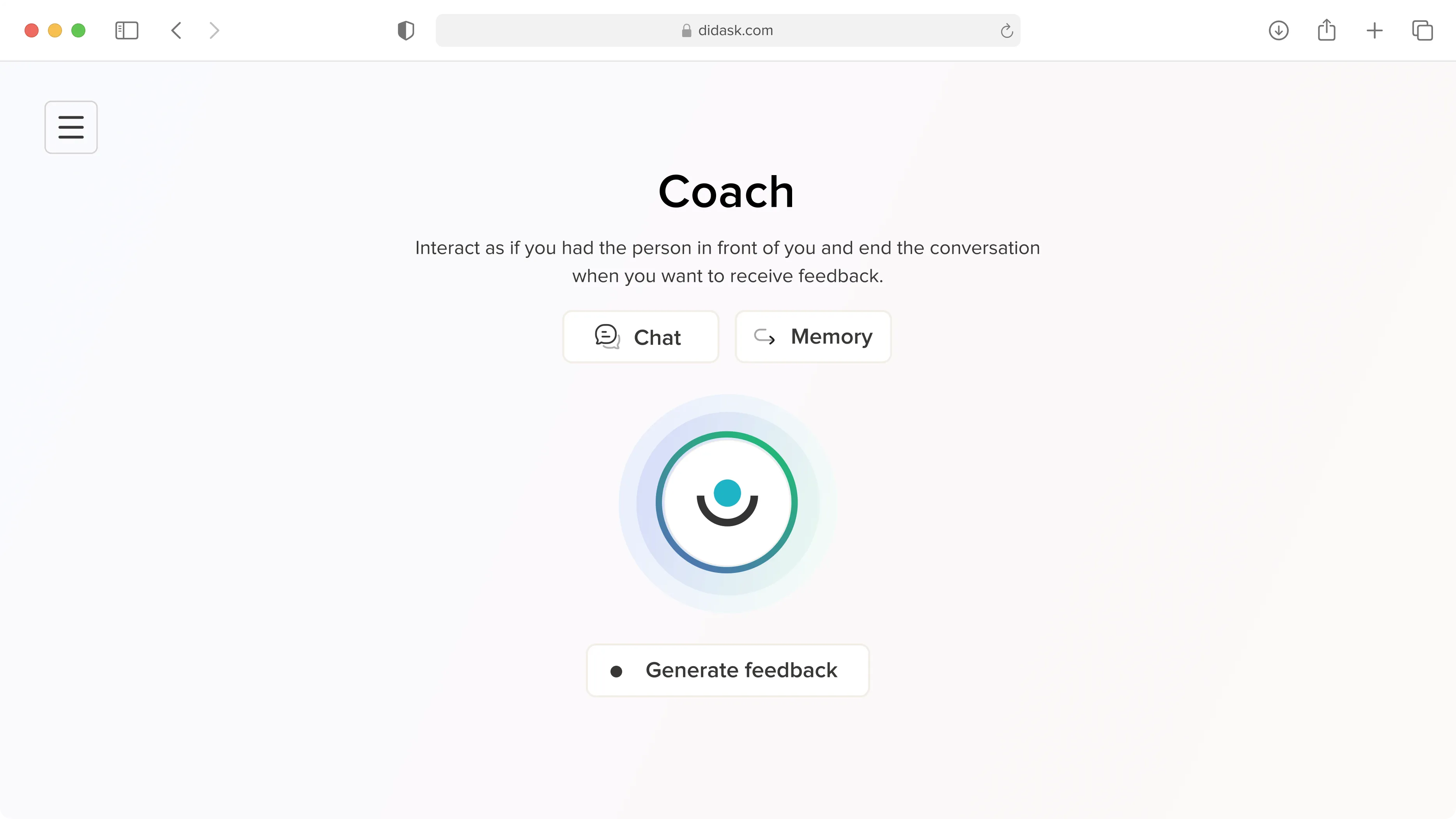
Personalized tutoring that learns from each individual, extends support beyond the session, and asks the right questions to reinforce key concepts at the right time.
Your field teams are shift-based and mobile.
They open and close the store, often without a professional email address or any dedicated time for training.
Your teams train directly from their phones.
Via 10 to 15-minute microlearning sessions, with employee ID authentication.
APPLIED PRACTICE
Targeted nudges that appear exactly when needed during the workday, directing users to the most relevant training modules.
In-person training doesn't scale across the network.
Travel, understaffed stores, and repetitive formats: you aren't standardizing anything across your locations.
In-person sessions focus on hands-on practice.
60% to 75% less training time for equivalent content.
993 learners · March 2025
993 learners · March 2025
FOCUSED ESSENTIALS
Workflow-integrated interactions that deliver the right concept in seconds, without adding to the learner's daily workload.
You design with a team of one or two people.
The project is led by marketing, HR, or management, without any instructional design expertise.
Create content 2 to 3 times faster.
50% to 65% less time spent creating each training course.
2,237 courses · October 2025
2,237 courses · October 2025
FOCUSED ESSENTIALS
Interactions integrated into the workflow that deliver the right concept in seconds, without adding to the learner's daily workload.
Your completion rates have plateaued.
Attachments skimmed over, modules endured on an existing LMS, and managers left without a dashboard.
FOCUSED ESSENTIALS
Interactions integrated into the workflow that deliver the right concept in seconds, without adding to the learner's daily workload.
Your teams are put into real-world scenarios, not just left to read.
They make their mistakes in the module rather than in front of the customer.
FOR YOU
A trainer behind every salesperson. Without hiring a single one.
In 1984, Benjamin Bloom identified a gap that has never been disproven: a learner receiving individual support with personalized feedback reaches a level of mastery unattainable in group training. Two standard deviations—this is the 2 Sigma Problem.
Retail has long operated this way. The area manager accompanying a salesperson on a client visit, the senior seller training a new recruit at the counter: this was individual tutoring, but the scale of modern networks has made it nearly impossible to maintain. No brand can put a trainer behind every salesperson. Didask makes this tutoring scalable again through cognitive science: the path adjusts to each person's actual level, from novice to seasoned technical sales rep, corrects errors the moment they happen, and reinforces concepts at the right intervals. The Didask Coaching offer extends this tutoring to the sales floor, answering product questions exactly when the customer asks them.
"Most platforms use AI to produce content faster. Didask uses it to make learning more effective. This isn't productivity AI; it's pedagogical AI rooted in cognitive science."
Retail has long operated this way. The area manager accompanying a salesperson on a client visit, the senior seller training a new recruit at the counter: this was individual tutoring, but the scale of modern networks has made it nearly impossible to maintain. No brand can put a trainer behind every salesperson. Didask makes this tutoring scalable again through cognitive science: the path adjusts to each person's actual level, from novice to seasoned technical sales rep, corrects errors the moment they happen, and reinforces concepts at the right intervals. The Didask Coaching offer extends this tutoring to the sales floor, answering product questions exactly when the customer asks them.
"Most platforms use AI to produce content faster. Didask uses it to make learning more effective. This isn't productivity AI; it's pedagogical AI rooted in cognitive science."

THE PLATFORM
Three solutions to common field challenges
Your product experts don't need to become instructional designers.
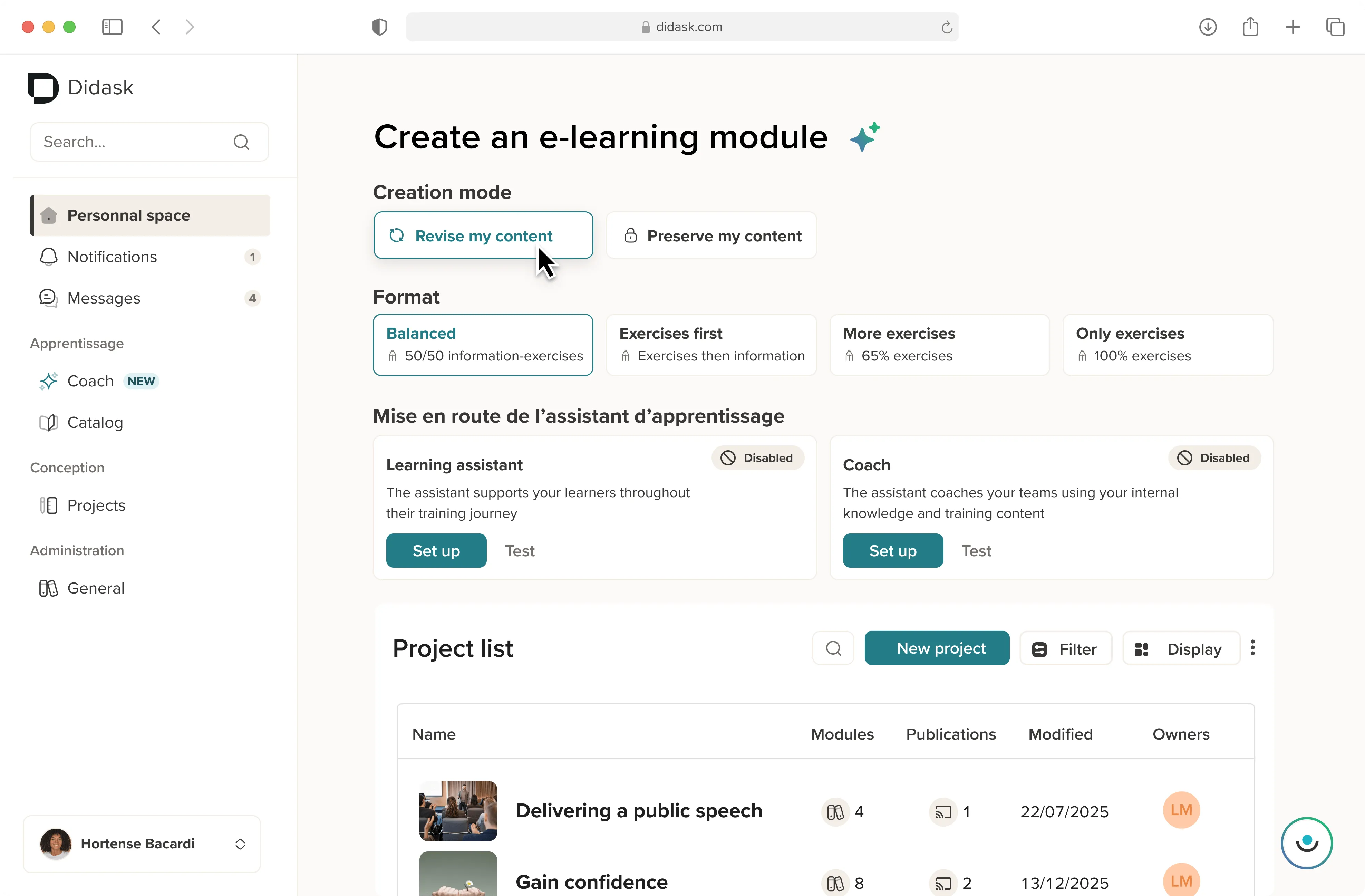
They upload what they already have: technical sheets, supplier catalogs, sales pitches, and product range presentations. The AI-assisted authoring tool turns them into a structured training path, complete with real-world scenarios from the sales floor. They review, they adjust, and you publish.
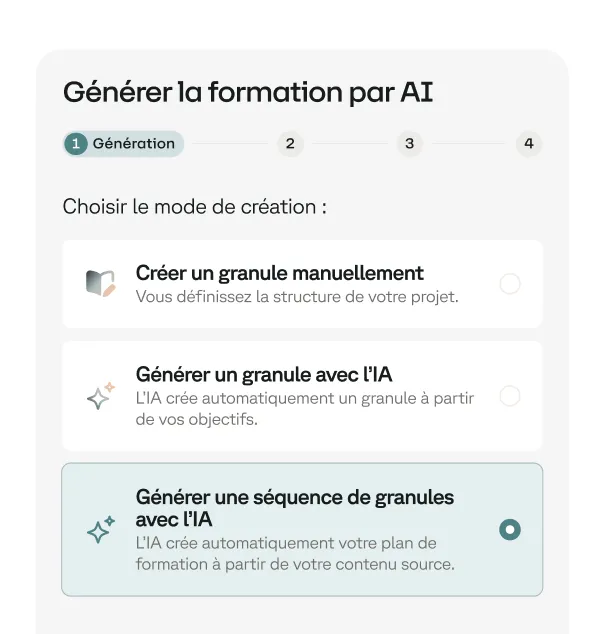
83
%
of our designers had never created a module before Didask and now work completely independently.
8,704 learners · June 2023

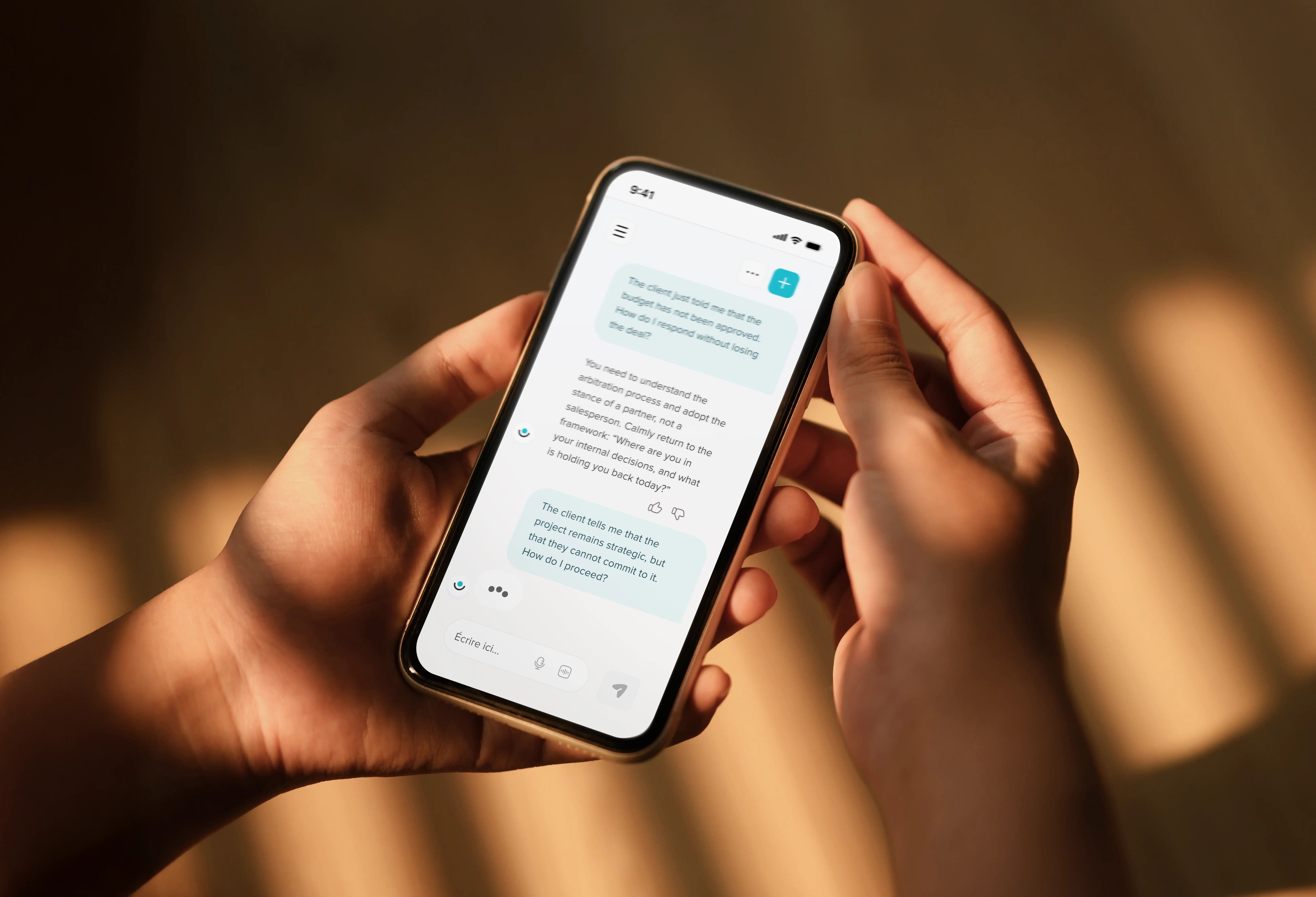
Your sales staff train on the device they already use: their phone.
Training is accessible at any time via a smartphone or tablet browser: no app to install, no work email required. Access is granted via employee ID, code, or SSO, in 10 to 15-minute micro-sessions.
-60
-75%
in training time for equivalent content: your teams get back to the sales floor faster.
993 learners · March 2025
.webp)
You train for margins, not completion rates.
Role-play scenarios focus on real-world sales challenges: price objections, upselling, and product substitution during stockouts. Sales staff practice with actual counter scenarios, not end-of-module quizzes.
Your dashboards then track success rates by store, region, or job role.
Your dashboards then track success rates by store, region, or job role.

A boundary we prefer to set: training cannot compensate for high purchase prices or stock shortages. It gives salespeople back the technical arguments they may have lost, but it does not rewrite your pricing policy.
.webp)
THE CHALLENGES
The features you expect from a healthcare LMS
RESULTS
of independent designers with no prior design experience
83
%
83
%
reduction in training time for equivalent content
−60 to −75
%
−60 to −75
%
say that the training is useful in their actual work
94
%
94
%
TESTIMONIES
How our customers turn learning
into measurable impact

The entity that markets energy to individuals and small businesses needed to train its advisors across 20 internal and external customer service centers following a migration from its previous solution.
A small team of internal designers produced 60 training projects in six months, achieving an overall satisfaction rating of 8.5/10.
“The application is much more engaging and intuitive. The visual design makes employees want to take the courses.” - Lydie Bras, Customer Journey Quality Project Manager, Customer Experience Department, ENGIE
A small team of internal designers produced 60 training projects in six months, achieving an overall satisfaction rating of 8.5/10.
“The application is much more engaging and intuitive. The visual design makes employees want to take the courses.” - Lydie Bras, Customer Journey Quality Project Manager, Customer Experience Department, ENGIE
Learners
2500+
Projects in 6 months
60

SECURITY
Enterprise-grade security
Built into every layer, protected end-to-end
DATA SECURITY
Isolated hosting, end-to-end encryption, and zero outbound data flow — ensuring your data never leaves your controlled environment.
IP PROTECTION
Your content, raw or generated, remains 100% yours. No reuse, no training, no retention by AI models, ever.
COMPLIANCE
Strict GDPR alignment and full adherence to data-governance standards throughout the entire lifecycle of your data.
SAFE AI GENERATION
A hybrid architecture and cognitive guardrails that minimize hallucinations and deliver consistently reliable, high-precision outputs.
FAQs
What is a retail LMS and how does it differ from a standard LMS?
Definition — Retail LMS: a training platform that reaches frontline store teams without professional email addresses, distributes product knowledge at the pace of the point of sale, and absorbs high turnover without needing to reopen sessions.
An LMS — Learning Management System — hosts your content, distributes it to the relevant teams, and tracks what each employee has completed. This is the general definition, applicable to all sectors.
What changes in the retail and distribution sector is not the nature of the tool, but the three constraints it must accommodate — and these apply to a network of ten shops just as much as to a group of hundreds of members. A provider that simply adds a few sales modules to its catalog meets none of these.
An LMS — Learning Management System — hosts your content, distributes it to the relevant teams, and tracks what each employee has completed. This is the general definition, applicable to all sectors.
What changes in the retail and distribution sector is not the nature of the tool, but the three constraints it must accommodate — and these apply to a network of ten shops just as much as to a group of hundreds of members. A provider that simply adds a few sales modules to its catalog meets none of these.
How do you train in-store sales staff without professional email addresses or dedicated time slots?
Access is granted via employee ID, code, or your internal directory, directly from a smartphone or tablet browser: no app to install, no professional email address required. Courses are broken down into 10 to 15-minute sessions, designed to fit between customers or before opening.
The priority criterion to address is therefore the identification method. This determines the initial login rate far more than the platform's functional richness. A salesperson who has to ask their manager for a login will not log in.
The priority criterion to address is therefore the identification method. This determines the initial login rate far more than the platform's functional richness. A salesperson who has to ask their manager for a login will not log in.
Can a retail LMS really drive upselling and increase average basket size?
It can provide the salesperson with the technical arguments they need to offer more than just a price: product ranges, standards, and alternatives. At Ternois Fermetures, technical sales staff achieved a 78% success rate in assessments on the aluminum range, and sales assistants reached 81% (700 learners).
A limit we prefer to set: these are learning results, not sales results. The link between product mastery and upselling is plausible, but it is not measured here. Furthermore, training cannot compensate for purchase prices, stock shortages, or your pricing policy.
A limit we prefer to set: these are learning results, not sales results. The link between product mastery and upselling is plausible, but it is not measured here. Furthermore, training cannot compensate for purchase prices, stock shortages, or your pricing policy.
How do you manage onboarding, turnover, and seasonal staff with a retail LMS?
The onboarding path is built once and triggers for every new arrival, without needing to reopen sessions or reschedule in-person training. Adaptive learning allows each recruit to start at their actual level, from the novice to the experienced salesperson switching brands.
On the administrative side, accounts are created and deactivated in sync with your HR system. This is crucial for short-term contracts, seasonal staff, and continuous hiring: manual access management quickly becomes the biggest time-sink for the training manager.
On the administrative side, accounts are created and deactivated in sync with your HR system. This is crucial for short-term contracts, seasonal staff, and continuous hiring: manual access management quickly becomes the biggest time-sink for the training manager.
Does Didask integrate with our tools, and do we need to replace our group LMS?
Didask Training is an all-in-one training platform: design, delivery, tracking, and traceability all in the same system. This is the deployment we recommend.
If your group or franchise LMS is mandatory, your courses can be delivered via SCORM: you gain the benefits of our design tools without having to launch a migration project. Connection is handled via SSO, employee ID, or code, and enrollments are automated based on job role, point of sale, or region.
Always ask for the list of operations actually covered by the API, not just the mention "integration available."
If your group or franchise LMS is mandatory, your courses can be delivered via SCORM: you gain the benefits of our design tools without having to launch a migration project. Connection is handled via SSO, employee ID, or code, and enrollments are automated based on job role, point of sale, or region.
Always ask for the list of operations actually covered by the API, not just the mention "integration available."
How do you choose an LMS for retail, and what should you measure afterwards?
Three criteria are deal-breakers: real access for field teams without professional email addresses, the ability to manage a common foundation across a network of autonomous points of sale, and the ability for your product experts to design content without needing to become instructional designers. Three criteria then set the leaders apart: integration with your existing tools, proof of mastery rather than just completion, and the annual cost relative to the number of salespeople actually trained. A "comprehensive" offering is not a criterion, it’s a risk: weighting all six equally is the primary cause of over-engineered and under-utilized tools.
Regarding measurement, avoid completion rates: a module watched to the end proves a connection, not a skill. Track success rates in practical scenarios, the time it takes for new hires to reach autonomy, and changes in the product mix for the ranges covered in training.
Regarding measurement, avoid completion rates: a module watched to the end proves a connection, not a skill. Track success rates in practical scenarios, the time it takes for new hires to reach autonomy, and changes in the product mix for the ranges covered in training.
What are the LMS trends in retail?
Three trends are dominating the market: mobile is becoming the primary platform rather than an option, microlearning is replacing hour-long modules, and AI is shifting from content generation to learner support. A fourth trend is more subtle: measurement is moving from completion rates to business impact—product mix, average basket size, and customer satisfaction.
Our take, for what it's worth: the trend that matters isn't AI that produces modules faster, it's AI that actually drives learning. Didask is an all-in-one training platform based on cognitive science, designed for this second category.
Our take, for what it's worth: the trend that matters isn't AI that produces modules faster, it's AI that actually drives learning. Didask is an all-in-one training platform based on cognitive science, designed for this second category.
MEET US
Get a demo!
We'd love to learn about your project
Thank you! Your submission has been received!
Oops! Something went wrong while submitting the form.
Effective learning,
made scalable
made scalable
Mobile training
Course Authoring
Microlearning
e-Learning
Authoring Tools
Authoring Tools
Learning Experience
Platform
Platform
.png)
CapTERRA — 4.9