


How do your employees really learn? In a constantly evolving professional world, traditional training methods are no longer sufficient to effectively support the Skills Development employees.
That's where The 70-20-10 model Come into play. Adopted by many companies and training organizations, this model offers a pragmatic approach, rooted in the reality of work and the lived experiences of employees.
Let's find out what the 70-20-10 model is, why it is established as The performance lever, how to implement it and how the Training platform Didask can be a powerful catalyst for this.
What is the 70-20-10 model?
Designed in the 1990s by researchers at the Center for Creative Leadership, the 70-20-10 model is based on a Empirical Breakdown of How Individuals Acquire Professional Skills :
- 70% come from experiential learning, that is to say in the field, by carrying out concrete tasks, through formative and significant experiences.
- 20% come from social interactions: feedback, mentoring, peer learning. These exchanges make it possible to compare points of view and to enrich the learning experience.
- 10% result from formal training, via courses, online modules or face-to-face training. These courses structure knowledge and serve as a basis for other forms of learning.
This model does not reject formal education, but rather that it must be integrated into A more comprehensive learning strategy, focused on action, collaboration and practice.
.webp)
Good to know
The 70-20-10 model is not a rigid rule but a flexible guide. Each company can adapt these proportions according to its sector, culture, and specific training objectives.
Deciphering the Three Pillars of the 70-20-10 Model
This Is How They Break Down Three Learning Components of the 70-20-10 Model, each playing a complementary role in the development of business skills.
70%: Learning through practice and first-hand experience
Most of the Learning Happens In the workplace, by Competing Against Concrete Problems, by testing new ways of doing things, by making decisions, by managing projects. This apprenticeship in the field makes it possible to develop Real Skills Adapted to the Company's Goals.
This Informal learning Is particularly powerful because it places the learner in situations where he must mobilize his knowledge, demonstrate adaptability, solve problems and learn from them Concrete Lessons. It also promotes initiative, autonomy and self-confidence.
Environments that value experimentation, the right to make mistakes and progress by Trial-error Are the ones that allow employees to Make Rapid Progress.
Exemples: Taking up a position, conducting meetings, managing conflicts, managing projects, etc.
20%: Learning from others
Les Social interactions Are essential: they fuel reflection, confront points of view, enrich knowledge. This involves coaching, feedback, mentoring, discussions between colleagues, learning communities, peer learning practices.
Learning from others, it is also about being inspired, modeling good practices, and sharing your successes and difficulties. These interactions can be formal (workshops, structured mentoring, co-development sessions) or informal (coffee break, instant messaging, nudges between colleagues).
The Peer learning Supported by a collaborative LMS platform Reinforces Team Cohesion And Encourages Transmission tacit knowledge.
10%: Learning through formal training
Finally, the Structured and Planned Training (face-to-face or online) complete the acquisition of skills. These are useful resources for Transmit the theoretical bases gold Meet Specific Needs.
Even though it represents only a small part of global learning, this formal component remains essential for Structure knowledge, establish a common base, certify skills.
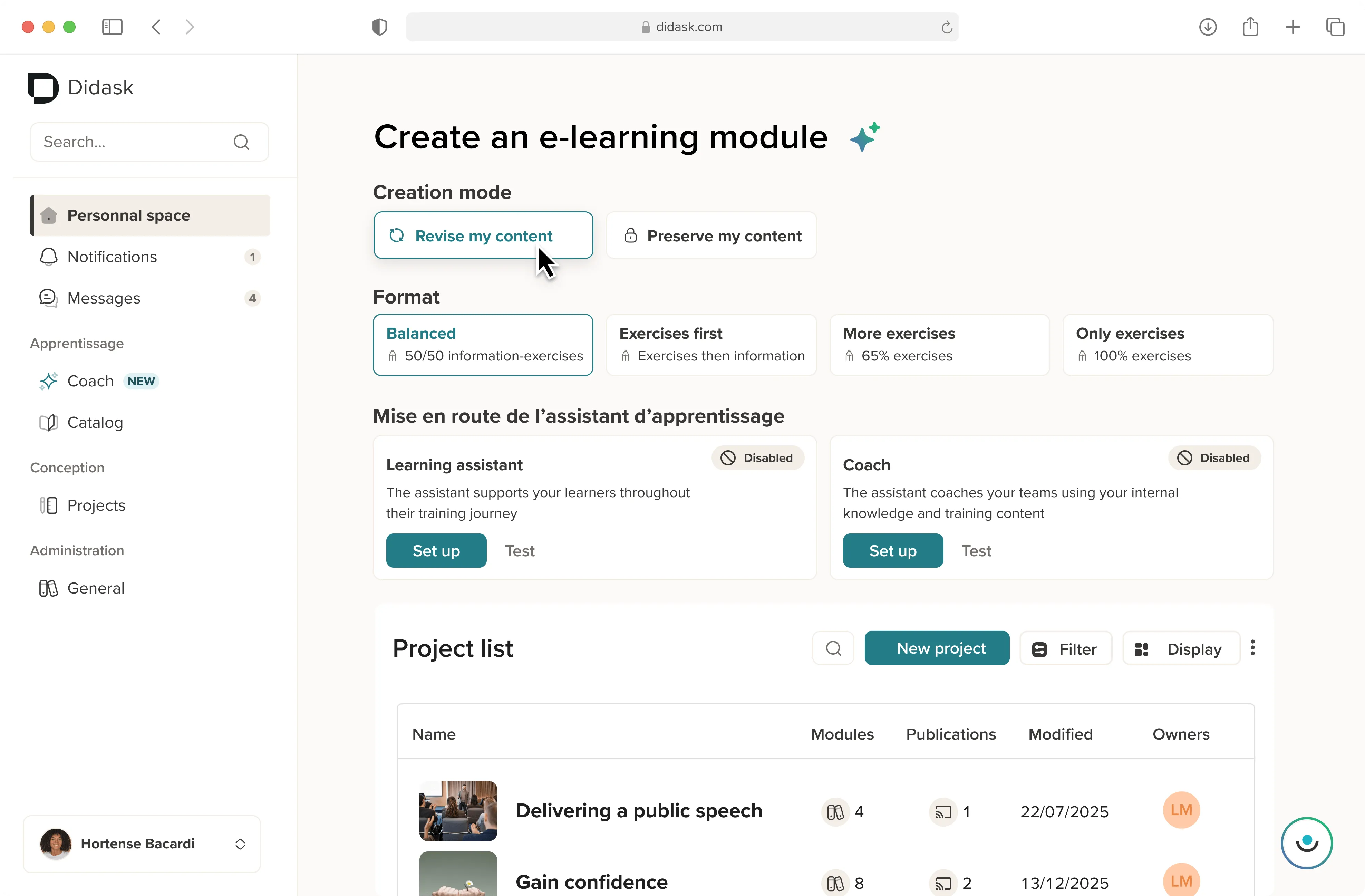
Les LMS tools like Didask Make it possible to distribute targeted, actionable modules adapted to the levels and objectives of learners. Thanks to a Author tool, it is possible to create short, contextualized content that is directly linked to situations experienced in the field, thus maximizing their effectiveness.
Why are businesses adopting the 70-20-10 model?
The success of this model is based on its Ability to Meet Real Needs Companies in terms of training and skills development. Let's explore the main benefits observed.
Skills Rooted in the Real World
This model focuses on “learning by doing”, which promotes the transferability of knowledge. The abilities acquired are directly linked to professional tasks, which Improves the Overall Effectiveness of the Team.
This approach makes it possible to shorten the time between the acquisition of knowledge and its operational implementation. Employees Learn Skills That They Use Immediately, which makes the training more useful, more relevant and better accepted.
Increased employee engagement
The learner becomes an actor in his training. By varying the formats (experiential, social, formal), we Stimulating Interest, Autonomy and Involvement. The learning experience becomes more personalized, dynamic, and motivating.
This model gives everyone the opportunity to Progress at Your Own Pace, according to its needs and context. It gives meaning to training, reinforces intrinsic motivation and creates a learning culture within the organization.
Individualized and adaptable courses
The use of tools such as adaptive learning or a AI assistant Allows you to Modulate the courses according to the needs and levels of the learners. Organizations can thus create Customized Training Programs, more efficient and less efficient.
Each learner benefits from targeted support, with content that evolves according to his answers, his objectives or his position. This allows a Rapid and Sustainable Skills Development, by avoiding standardized courses that are not very engaging.
A better link between training and performance
By Connecting Learning and Real Situations, the 70-20-10 model makes it possible to align training courses with company performance goals. Managers can monitor results, adjust practices and manage skills development.
It is a strong lever for developing team agility, supporting internal transformations, and strengthening operational excellence. The impact is visible and measurable In the short and medium term.
Please note
To maximize experiential learning, create an environment where mistakes are seen as learning opportunities. Companies that foster a right-to-fail culture see their employees progress faster.
How do you effectively deploy the 70-20-10 model?
To Go from Concept to Reality, You Still Need to Know How to activate the right levers. Here are the best practices to implement to take advantage of the three dimensions of the model.
Relying on Managers as Learning Relays
Leaders play a key role: They create the conditions for learners to test, make mistakes, and succeed. They encourage experimentation, promote good practices, organize feedback, and facilitate social learning.
But this role as a facilitator is not self-evident. It is necessary Train Managers in Their Coaching Posture, provide them with tools to animate moments of exchange, such as weekly points or project reviews. By integrating them into the learning strategy, teams are transformed into environments leading to continuous experimentation.
Integrating learning into daily activities
Instead of separating work and training, businesses can Create learning situations: transversal projects, rotating roles, case analysis, team challenges... The idea is toAnchoring training in action.
This means identifying, within each person's missions, the moments when learning can occur: a new task, a problem to solve, a method to test. Apprenticeship then becomes an integral part of the work cycle. and not a separate activity.
Digital tools, such as an LMS tool or an AI assistant, can enrich these moments of action with reminders, contextualized content, or advice in real time.
Encourage sharing between colleagues
Setting up feedback rituals, discussion spaces, or co-development sessions helps structure peer learning. The Social learning Becomes a lever for commitment and Co-construction of knowledge.
It can take the form of mentoring peers, learning communities, educational cafes or platforms for sharing best practices. By stimulating these informal interactions, we give full place to tacit knowledge and The Collective Intelligence of the Team. These exchanges must be recognized, valued and capitalized to Nurturing the learning culture.
Complement with Targeted Training
Short, actionable modules adapted to roles and business issues reinforce the impact of training. The Didask training catalog Provides access to content that is directly applicable in a professional situation.
These Formal Training meet specific needs: getting started with a tool, developing managerial skills, acquiring regulatory knowledge... By being contextualized, these courses are better retained, better used and Their effectiveness is measurable.
Didask's authoring tool allows them to be customized according to profiles and missions, to maximize their usefulness in the field.
Measuring the Impact of Learning
To manage the training strategy, it is essential to Measure results (performance indicators, feedback, self-evaluations). The Didask LMS tool makes it possible to track data and adjust actions continuously.
Assessment should not be limited to an end of module score. It can include field observations, business indicators (reduction of errors, improvement of productivity) or even qualitative feedback from managers and peers.
Thanks to adaptive learning and Educational AI by Didask, The Courses Can Evolve According to Real Needs, ensuring continuous and relevant learning.
The limitations and criticisms of the 70-20-10 model
The model, although effective, is based on an arbitrary distribution and not on a universal mechanism. Each company must adapt the dosage to its context. Another limitation: without support, the 70% of informal learning can be unequal or poorly capitalized.
In addition, some skills (technical, regulatory or strategic) require structured learning, sometimes outside the field. In addition, not all employees have the same ability to learn alone or with peers. It is therefore crucial toTooling and Structuring the Model : support for managers, monitoring tools, access to resources, valorization of knowledge sharing.
The challenge is to Create a comprehensive learning ecosystem, where each modality (formal, social, experiential) reinforces each other.
Please note
Certain critical skills (regulatory compliance, safety, technical procedures) require structured formal training. The 70-20-10 model must adapt to the specific requirements of each domain.
How does Didask integrate the 70-20-10 model into its courses?
The Didask LMS platform is designed to put the principles of the 70-20-10 model into practice.
- The Author tool allows you to create training courses adapted to the learner's context, in connection with concrete work situations. Thanks to this approach, content is no longer generic, but contextualized, and therefore immediately useful.
- The Educational AI And his AI assistant Personalize content and recommend the best courses according to performance objectives. Each learner Progresses at its own pace, according to its achievements, its difficulties and its missions.
- The Didask training catalog covers transversal and professional skills, which can easily be used in the field. It offers companies a wide range of resources to meet operational, managerial or organizational challenges.
- The LMS tool By the way the monitoring of the impact, the Measuring Acquired Skills, and the valorization of formal, social and experiential learning. The collected data makes it possible to pilot the continuous training strategy.
Didask thus proposes A comprehensive and operational approach, designed for companies and training organizations that want to focus their training efforts around a coherent and effective strategy.
What are the alternatives or complements to the 70-20-10 model?
Some experts suggest other models (such as 3E: Education, Exposure, Experience) or emphasize the role of skills management and content curation. The 70-20-10 model is therefore not an end in itself, but a useful framework for Structure a learning strategy adapted to the realities of work.
Approaches Such As Learning in the flow of work, the microlearning, or even personalized journey logics via the Adaptive learning, can reinforce or refine the logic of 70-20-10. The Main Thing Remains to Place the Learner at the Center of the System, to offer them an environment conducive to experimentation, sharing and skills development.
The 70-20-10 model provides a solid foundation to rethink training in companies. He recalls that learning is not limited to classrooms or online modules, but is based on action, exchange and experience.
By adapting it to the context of your organization, and by using tools like Didask's, you can Create Engaging, Effective and Sustainable Journeys, aligned with the performance goals and needs of your teams.
.webp)
.webp)

.webp)


.png)