OUR USAGES
Banking, insurance, and financial services
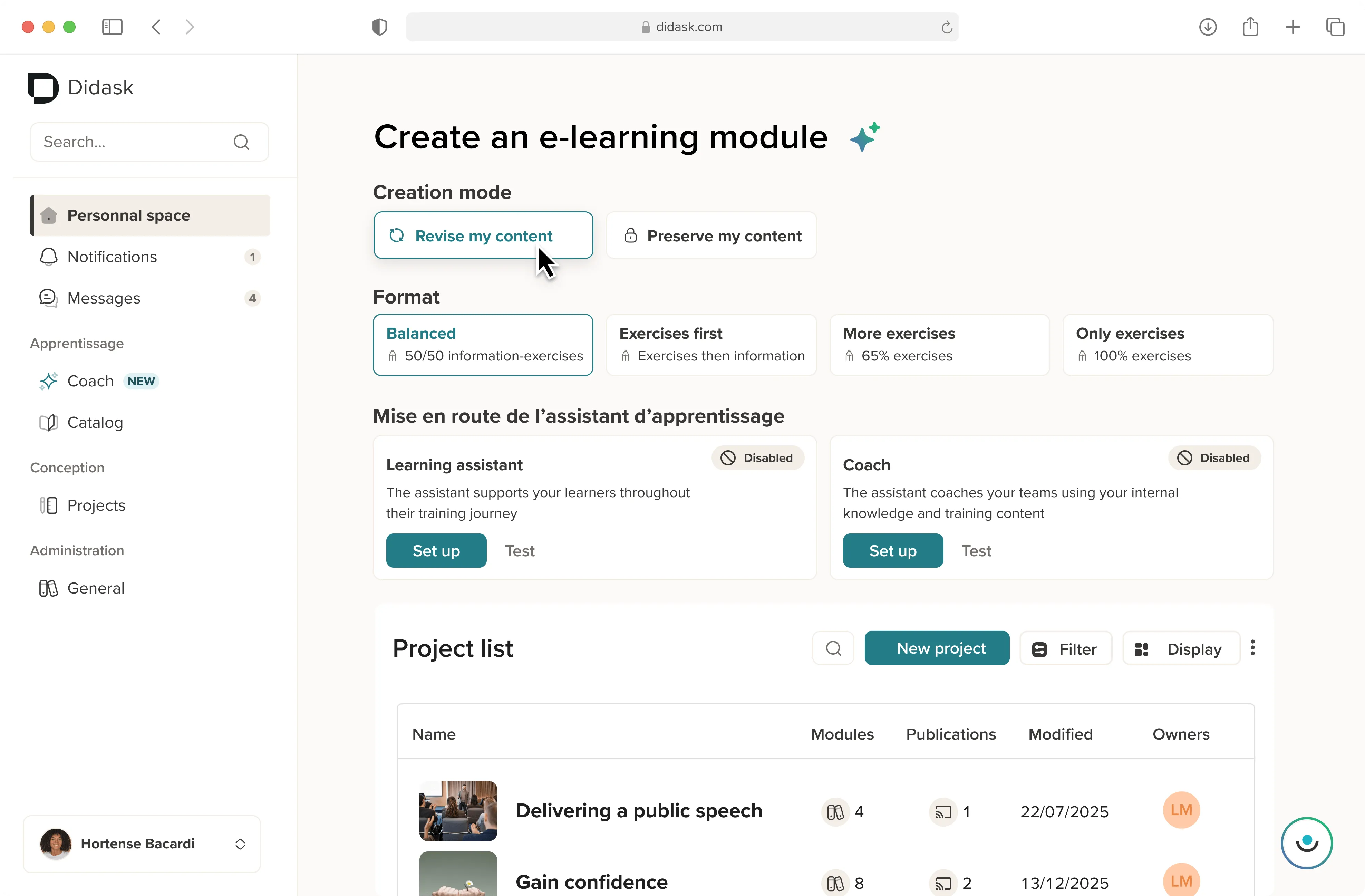
One month to produce one hour of e-learning.
Your finance LMS needs to keep pace with regulations.
The Insurance Distribution Directive requires 15 hours of continuing education per year for every distributor. Meanwhile, your design teams can be counted on one hand. Didask handles the instructional design for you: your experts provide the content, artificial intelligence structures the learning path, and the expert approves it before release.













SOLUTIONS
What’s holding back training
in banking and insurance
Your current daily workflow
WITH DIDASK
One month of production for one hour of e-learning.
Expert writing, storyboarding, design, and testing: the turnaround time is fixed with your current staff.
Design 2 to 3 times faster.
50% to 65% less time spent creating each training course.
2,237 courses · October 2025
2,237 courses · October 2025
PERSONALIZED LEARNING
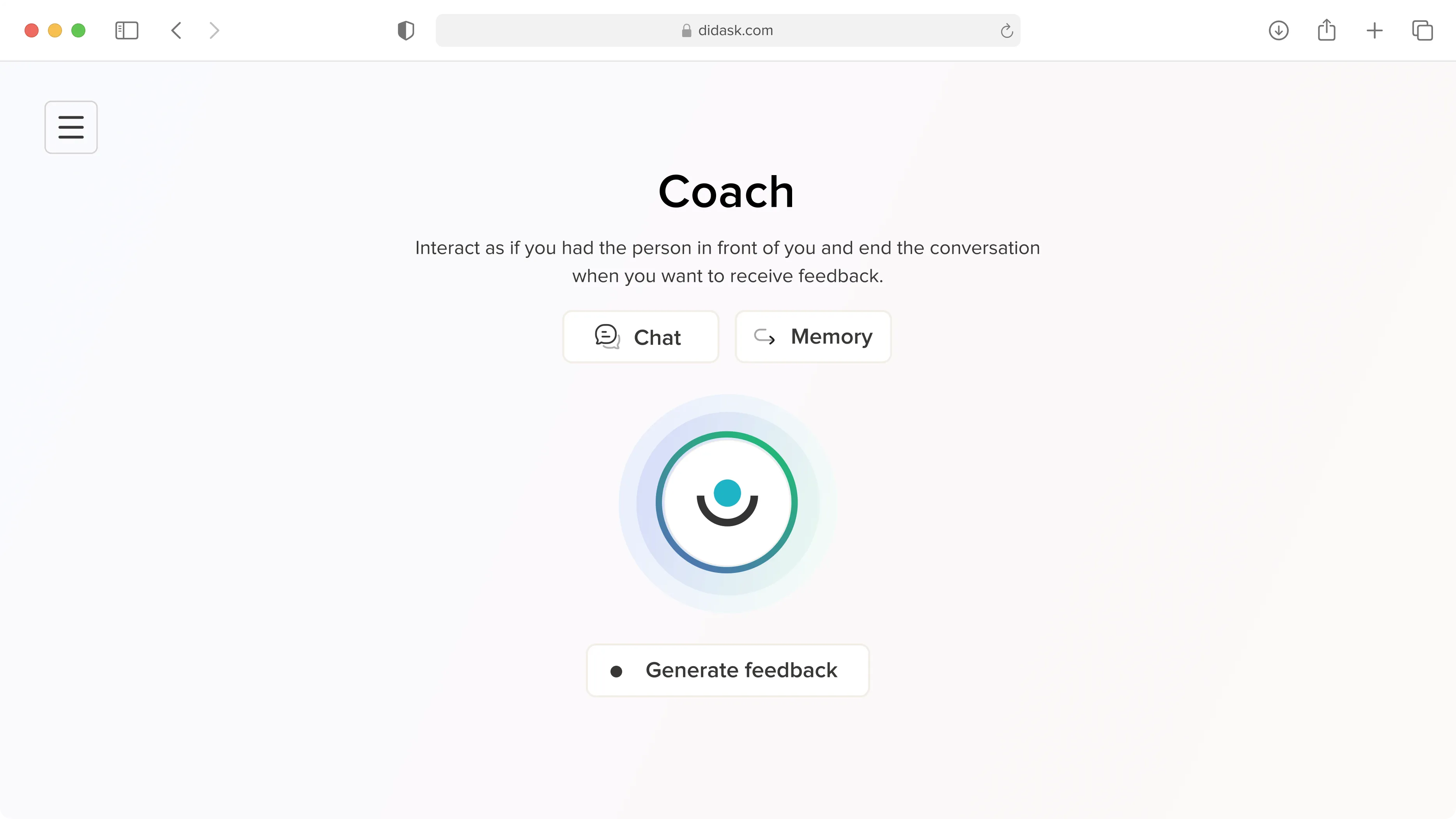
Personalized tutoring that learns from every learner, extends support beyond the session, and asks the right questions to reinforce key concepts at the right time.
Your initial training programs last four to six weeks.
Massive, in-person sessions that you can neither duplicate nor absorb during peak activity periods.
Six hours of in-person training becomes three hours of e-learning.
At Konecta, with a 3.5-point increase in exam success rates.
270 employees trained.
270 employees trained.
APPLIED PRACTICE
Targeted nudges that appear exactly when the need arises in daily work, directing users to the most relevant training modules.
Regulations change, but your modules don't.
Modifying a skill or topic in your current platform triggers a whole new design project.
Updates are done in just a few clicks.
No need to restart projects, with full version history preserved.
FOCUSED ESSENTIALS
Workflow-integrated interactions that deliver the right concept in seconds, without adding to the learner's daily workload.
Your AI committee said no, or not yet.
An omission regarding a regulatory requirement isn't just a typo; it's a legal risk.
The AI proposes, your expert approves.
Nothing is published without human review, and your content is never used to train any models.
FOCUSED ESSENTIALS
Workflow-integrated interactions that deliver the right concept in seconds, without adding to the learner's daily workload.
You are training networks you don't control.
Brokers, agents, outsourced centers, high turnover: service quality depends on people who aren't your employees.
FOCUSED ESSENTIALS
Interactions integrated into the workflow that deliver the right concept in seconds, without adding to the learner's daily workload.
Your partners train using your content.
In their own platform via SCORM or white-label.
FOR YOU
A tutor for every advisor. Without hiring a single one.
In 1984, Benjamin Bloom measured a gap that has never been disproven: a learner receiving individual support with personalized feedback reaches a level of mastery unattainable in group training. Two standard deviations—this is the 2 Sigma Problem.
Banking and insurance are familiar with this approach. Side-by-side listening followed by an individual debrief, or a mentor accompanying a new hire in a branch: this is tutoring, and it cannot be scaled to thousands of advisors. Didask makes it possible again through cognitive science: the path adjusts to each person's actual level, corrects errors the moment they occur, and revisits concepts at the right intervals for long-term retention. The Didask Coaching offer extends this tutoring into the workflow, answering compliance questions exactly when a file is being processed.
"Most platforms use AI to produce content faster. Didask uses it to make learning more effective. It’s not a productivity AI; it’s a pedagogical AI based on cognitive science."
Banking and insurance are familiar with this approach. Side-by-side listening followed by an individual debrief, or a mentor accompanying a new hire in a branch: this is tutoring, and it cannot be scaled to thousands of advisors. Didask makes it possible again through cognitive science: the path adjusts to each person's actual level, corrects errors the moment they occur, and revisits concepts at the right intervals for long-term retention. The Didask Coaching offer extends this tutoring into the workflow, answering compliance questions exactly when a file is being processed.
"Most platforms use AI to produce content faster. Didask uses it to make learning more effective. It’s not a productivity AI; it’s a pedagogical AI based on cognitive science."

THE PLATFORM
Three answers to field challenges
An hour of e-learning should no longer cost a month of work.
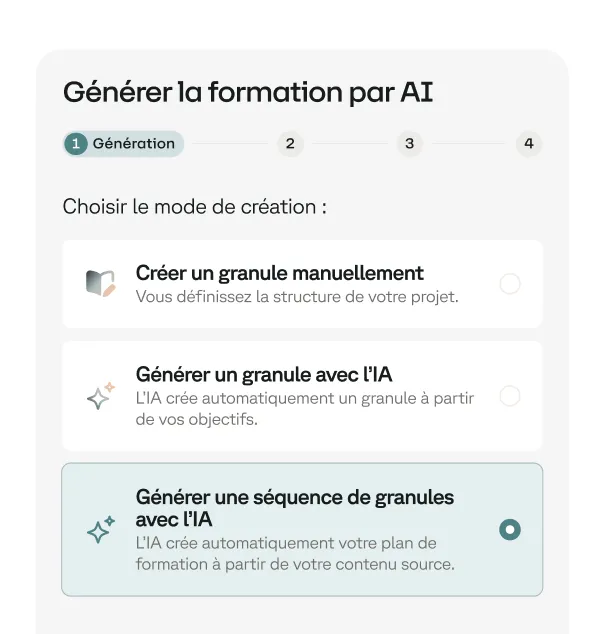
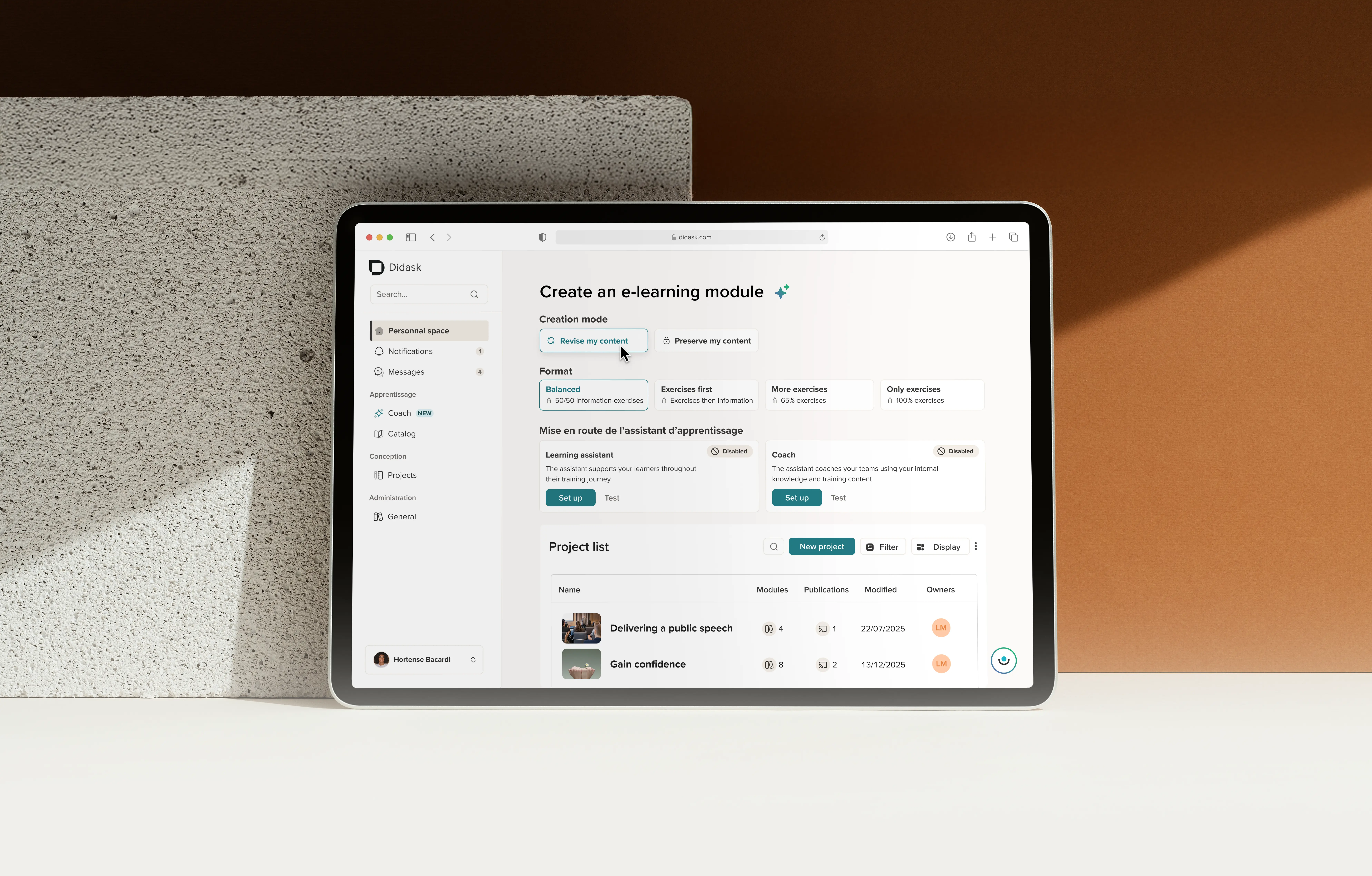
Your experts upload what they already have: compliance notes, procedures, regulatory materials, and presentations. The AI-assisted authoring tool turns them into a structured training path, complete with scenarios based on your actual files.
At an insurance training organization, a single person produced 418 modules on the platform.
At an insurance training organization, a single person produced 418 modules on the platform.
83
%
of our designers had never created a module before Didask and now produce them independently.
8,704 learners · June 2023

Your initial training doesn't need to take six weeks.
Blended learning moves theory and assessment online, reserving in-person time for what truly requires it: practice, sales techniques, and complex cases. Your new hires arrive at sessions with the fundamentals already mastered.
This allows you to handle spikes in activity without rescheduling weeks of in-person training, and regulatory updates are rolled out to everyone immediately.
This allows you to handle spikes in activity without rescheduling weeks of in-person training, and regulatory updates are rolled out to everyone immediately.

-50
%
in design time, initial training reduced from 6 hours of in-person sessions to 3 hours of e-learning, a 3.5-point increase in exam success rates, and 87% learner satisfaction with blended learning.
Konecta · 270 employees trained
.webp)
AI proposes, your expert validates. Your committee can verify it.
Three elements pass most committees: a French publisher, a cloud hosted in the European Union, and content that is never used to train models.
AI does not write the rules: it structures the content you provide, and nothing is published without your expert's review. The validation process is traceable, just like the successive modifications of a module.
AI does not write the rules: it structures the content you provide, and nothing is published without your expert's review. The validation process is traceable, just like the successive modifications of a module.
A boundary we prefer to set: with regulatory content, a model might omit a condition and make a module inaccurate. This is precisely why expert validation is not just a convenience—it is the core of the system.
.webp)
THE CHALLENGES
The features you expect from a healthcare LMS
RESULTS
of independent designers with no prior design experience
83
%
83
%
reduction in training time for equivalent content
−60 to −75
%
−60 to −75
%
say the training is useful in their day-to-day work
94
%
94
%
TESTIMONIES
How our customers turn learning
into measurable impact
A workforce of 170,000 employees to upskill on the digital transformation of their profession, with around a hundred training days to design.
Result: 8,000 training days delivered in less than six months, with a participant satisfaction rate of 95 to 96%.
“Didask was an extremely attractive platform because they weren't interested in just putting PowerPoint online.” - Philippe Barré, Chartered Accountant and Educational Consultant
Result: 8,000 training days delivered in less than six months, with a participant satisfaction rate of 95 to 96%.
“Didask was an extremely attractive platform because they weren't interested in just putting PowerPoint online.” - Philippe Barré, Chartered Accountant and Educational Consultant
People trained
+1400
Learning paths designed
50

SECURITY
Enterprise-grade security
Built into every layer, protected end-to-end
DATA SECURITY
Isolated hosting, end-to-end encryption, and zero outbound data flow — ensuring your data never leaves your controlled environment.
IP PROTECTION
Your content, raw or generated, remains 100% yours. No reuse, no training, no retention by AI models, ever.
COMPLIANCE
Strict GDPR alignment and full adherence to data-governance standards throughout the entire lifecycle of your data.
SAFE AI GENERATION
A hybrid architecture and cognitive guardrails that minimize hallucinations and deliver consistently reliable, high-precision outputs.
FAQs
What is an LMS finance and how does it differ from a standard LMS?
Definition — LMS finance: a training platform that produces regulatory courses at the pace of regulatory change, tracks obligations for audit purposes, and passes the compliance and AI governance committee requirements of a financial institution.
An LMS—learning management system—hosts your content, distributes it to the relevant teams, and tracks what each employee has completed. This is the general definition, valid in all sectors and for any company that deploys training at scale. Terms like LMS platform, learning platform, e-learning platform, or online learning platform are used interchangeably; they are commercial synonyms for the same object.
What changes in banking and insurance is not the nature of the tool, but the three constraints it must satisfy. A vendor that simply adds a catalog of compliance modules to their offering does not meet any of these requirements.
An LMS—learning management system—hosts your content, distributes it to the relevant teams, and tracks what each employee has completed. This is the general definition, valid in all sectors and for any company that deploys training at scale. Terms like LMS platform, learning platform, e-learning platform, or online learning platform are used interchangeably; they are commercial synonyms for the same object.
What changes in banking and insurance is not the nature of the tool, but the three constraints it must satisfy. A vendor that simply adds a catalog of compliance modules to their offering does not meet any of these requirements.
LMS finance: learning management system or loan management system?
Both, and they are two unrelated types of software. A learning management system is a training platform for creating, distributing, and tracking your employees' courses. A loan management system is software for managing loans, which handles the credit lifecycle from origination to collection.
The same English acronym is used for both, which explains why search results for "LMS finance" are often mixed. This page covers the first meaning: training teams in banking, insurance, and financial services.
The same English acronym is used for both, which explains why search results for "LMS finance" are often mixed. This page covers the first meaning: training teams in banking, insurance, and financial services.
How does an LMS help prove compliance in banking and insurance?
It centralizes three things that a spreadsheet cannot manage at scale: assigning mandatory courses by role, tracking continuing education deadlines, and archiving proof of completion.
Each learner has access to their history, results, and downloadable certificates, individually or in bulk. You can filter your reports by entity, department, or job function for an inspection, internal audit, or funding body: you are audit-ready without having to reconstruct a file.
A useful clarification: an LMS proves the completion and results of training, not the compliance of your overall system, which remains the employer's responsibility.
Each learner has access to their history, results, and downloadable certificates, individually or in bulk. You can filter your reports by entity, department, or job function for an inspection, internal audit, or funding body: you are audit-ready without having to reconstruct a file.
A useful clarification: an LMS proves the completion and results of training, not the compliance of your overall system, which remains the employer's responsibility.
Our governance prohibits or restricts AI. Can we still use Didask?
This is the most frequent question in large financial groups, and it is a legitimate one. At Didask, AI is a design assistant: it structures content that you provide and that your expert validates before distribution. It does not invent rules and does not publish anything on its own.
Didask is a French company; the platform is hosted in the European Union and is GDPR compliant, and your content is never used to train models.
For a committee, the points to review are generally the same: hosting, reversibility, human validation process, and traceability of changes. We provide the corresponding documentation before the decision, not after.
Didask is a French company; the platform is hosted in the European Union and is GDPR compliant, and your content is never used to train models.
For a committee, the points to review are generally the same: hosting, reversibility, human validation process, and traceability of changes. We provide the corresponding documentation before the decision, not after.
How long does it take to produce regulatory training, and with what team?
The traditional chain—drafting by the expert, storyboarding, design, and review—often takes a month for one hour of e-learning. With an AI-assisted authoring tool, the subject matter expert remains the source, but pedagogical structuring is no longer the bottleneck.
83% of Didask designers had never created a module before and are now autonomous (8,704 learners, June 2023), and design time has decreased by 50 to 65% (2,237 training courses, October 2025).
Expect a few days between setting up the platform and publishing the first course. The best test is the simplest: have one of your compliance experts produce a module during the trial period, on their own topic, without help from the vendor.
83% of Didask designers had never created a module before and are now autonomous (8,704 learners, June 2023), and design time has decreased by 50 to 65% (2,237 training courses, October 2025).
Expect a few days between setting up the platform and publishing the first course. The best test is the simplest: have one of your compliance experts produce a module during the trial period, on their own topic, without help from the vendor.
Does Didask integrate with our tools, and do we need to replace the group's LMS?
Didask Training is an all-in-one training platform: design, distribution, tracking, and traceability in the same system. This is the deployment we recommend.
If the group's LMS is mandatory, your courses can be distributed via SCORM without a migration project—and your brokers, agents, or service providers can receive the same content on their own platforms. Connection is handled via SSO, employee ID, or code, and accounts are created and deactivated in sync with your HRIS.
If the group's LMS is mandatory, your courses can be distributed via SCORM without a migration project—and your brokers, agents, or service providers can receive the same content on their own platforms. Connection is handled via SSO, employee ID, or code, and accounts are created and deactivated in sync with your HRIS.
What are the benefits and use cases of an LMS in finance?
The benefits can be summarized in three points: produce your regulatory training faster, prove what your teams have actually acquired, and train your ecosystem—brokers, agents, and service providers—using the same content as your employees.
The most frequent use cases in financial institutions are: regulatory compliance, onboarding new hires, product training, cybersecurity and data protection, customer relations, partner training, and upskilling managers.
An organization just starting out is better off focusing on one area—the one with the most urgent need—rather than opening up a full catalog.
The most frequent use cases in financial institutions are: regulatory compliance, onboarding new hires, product training, cybersecurity and data protection, customer relations, partner training, and upskilling managers.
An organization just starting out is better off focusing on one area—the one with the most urgent need—rather than opening up a full catalog.
How does an LMS contribute to risk management?
It acts on a single component of operational risk: the human factor. AML-CFT, cybersecurity, data protection, and duty of advice training are distributed, measured, and archived in one place, with an actionable audit trail.
What it does not do: reduce risk simply by being deployed. A completed module does not prove a behavior. This is why we measure effectiveness through success in practical scenarios rather than completion rates—and why a financial institution should demand this proof from any vendor.
What it does not do: reduce risk simply by being deployed. A completed module does not prove a behavior. This is why we measure effectiveness through success in practical scenarios rather than completion rates—and why a financial institution should demand this proof from any vendor.
How do you choose an LMS for a financial institution, and what should you measure afterwards?
Three criteria are disqualifying: audit-ready traceability, the ability to update training paths at the pace of regulatory changes, and the system's compliance with your internal security and AI governance rules. Three further criteria then distinguish the remaining solutions: integration with the group's HRIS and LMS, your experts' ability to design content without needing to be instructional designers, and the annual cost relative to the number of employees actually trained.
Regarding measurement, avoid completion rates: a module watched to the end proves a connection, not a competency. Instead, track success rates in practical scenarios, the time taken for new hires to reach autonomy, and the rate of repetition on trained topics.
Regarding measurement, avoid completion rates: a module watched to the end proves a connection, not a competency. Instead, track success rates in practical scenarios, the time taken for new hires to reach autonomy, and the rate of repetition on trained topics.
MEET US
Get a demo!
We'd love to learn about your project
Thank you! Your submission has been received!
Oops! Something went wrong while submitting the form.
Effective learning,
made scalable
made scalable
Mobile training
Course Authoring
Microlearning
e-Learning
Authoring Tools
Authoring Tools
Learning Experience
Platform
Platform
.png)
CapTERRA — 4.9