
.webp)

An onboarding LMS is a training platform whose learning paths, access and tracking are built for employees who arrive continuously, one at a time, with different roles and different starting levels.
In France, 902,400 permanent contracts ended during the probation period in 2024, out of 4.2 million permanent contract terminations in the private sector (Insee Références, Emploi, chômage, revenus du travail, 2025 edition, based on Dares-MMO data). Roughly one in five, before the probation period was even over.
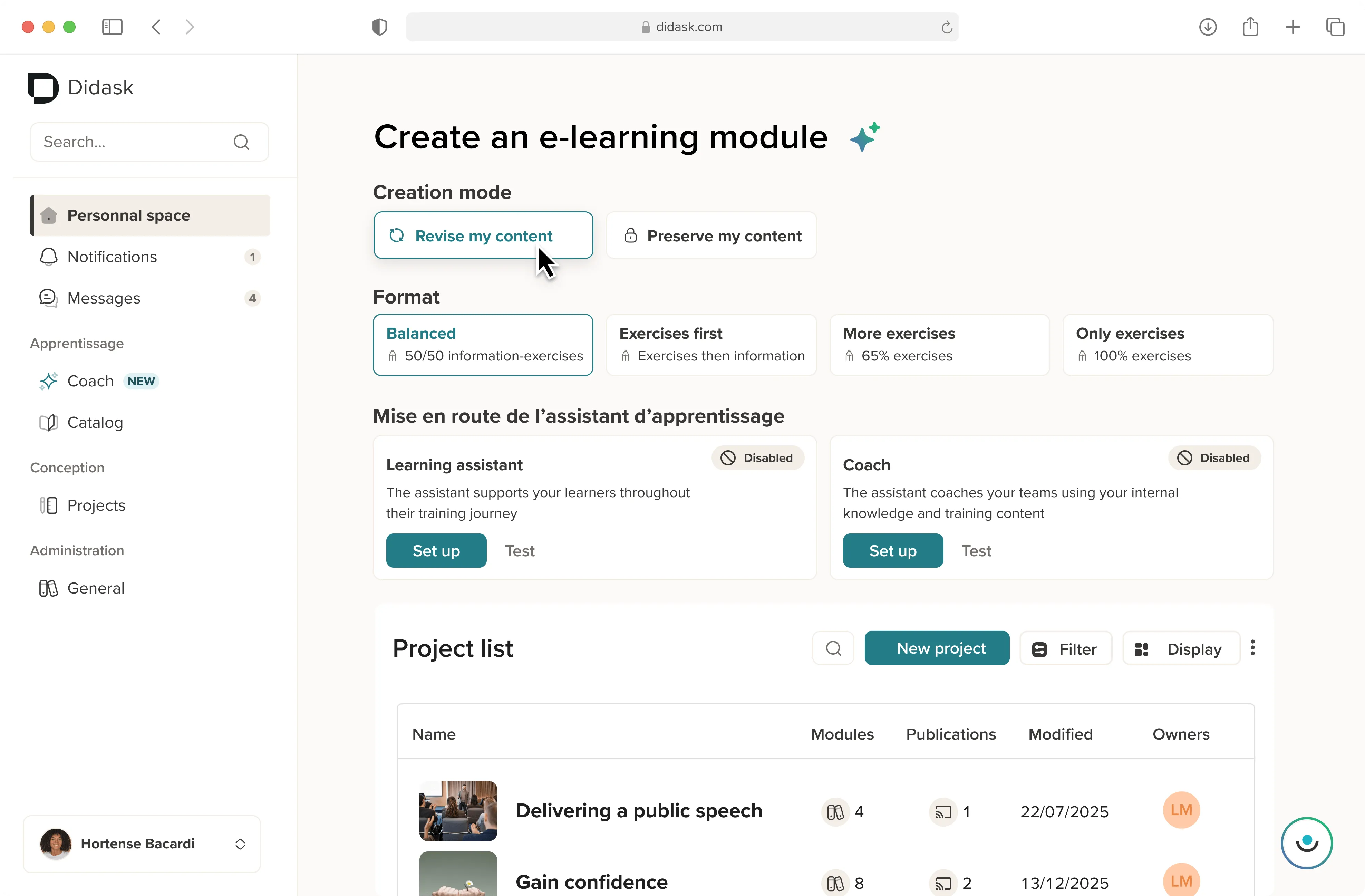
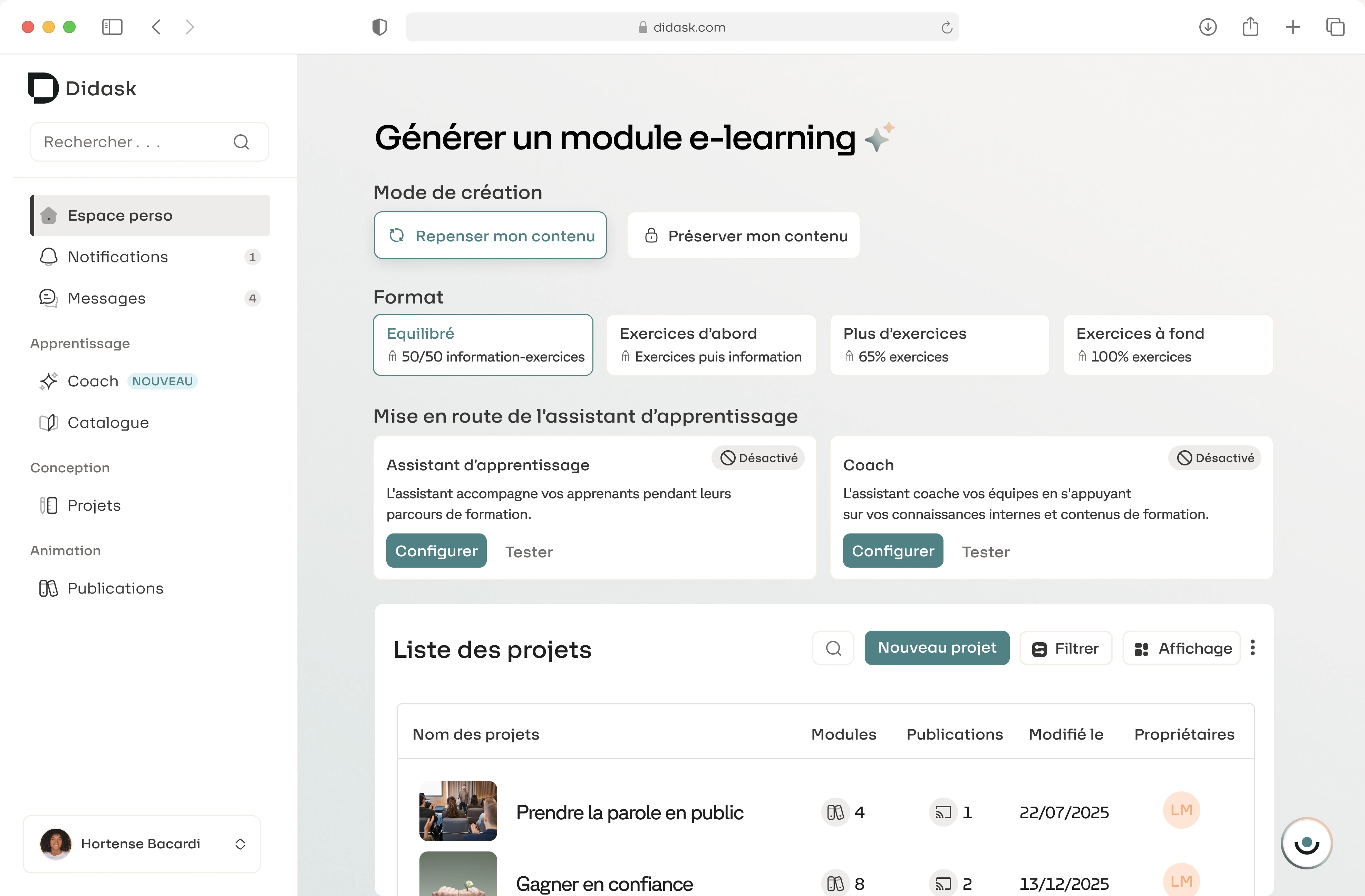
Didask is a French training platform grounded in cognitive science, which turns a company's existing procedures, tools and sales material into personalised onboarding paths.
What are the 7 best onboarding LMS platforms in 2026?
The seven platforms selected are Didask, 360Learning, Docebo, Rise Up, Beedeez, Cegid Talentsoft and Dokeos. Five of the seven vendors are French, one Italian-Canadian, one French-American.
Our method, and what it is worth
Didask publishes this comparison and ranks itself first. Each platform is assessed against the eight criteria detailed below, using publicly verifiable information collected on 17 September 2026 from each vendor's documentation.
We consistently distinguish three levels of evidence: a feature documented in a help centre, a claim made on a marketing page, and a self-reported customer figure. Where we could not find information, we write that it is not publicly documented — never that it does not exist.
Ratings collected on Capterra on 17 September 2026.
1. Didask
A French all-in-one training platform grounded in cognitive science, which builds learning paths from a company's existing documents.
What it brings to onboarding. The design AI takes existing procedures and internal material as input, and produces structured paths with realistic scenarios. It addresses the real bottleneck in most onboarding projects: the path does not exist yet.
Strengths
- Didask Training cuts course design time by 50 to 65% (Didask measurement across 2,237 courses, October 2025).
- Automated reminders on a published schedule: day 2, day 7, then every two weeks until completion, stopping automatically once the path is finished.
- A unique access code for learners without an email address, serving as both username and password. SSO via SAML 2.0 and OpenID Connect, public API included in the licence.
- A path certificate issued automatically on success, and a placement test that pre-validates what an experienced profile already knows.
The right choice if your onboarding path does not yet exist in a usable form, and nobody on the team is an instructional designer.
.webp)
They onboard their new hires with Didask
Ternois Fermetures · Konecta · ENGIE · BoondManager · Canal+ · Valrhona
2. 360Learning
A French-American LMS founded in 2013, where internal experts produce and run the training.
What it brings to onboarding. The vendor whose technical chain is the best publicly documented, from the HRIS through to learner enrolment.
Strengths
- The "Auto-enroll learners" option enrols new learners as soon as they join the platform, with dynamic enrolment and unenrolment based on filters.
- Five documented login methods, including a username login intended for "users without a unique and stable email address", and an alias login for teams without individual mailboxes.
The right choice if your HRIS is already in place and account synchronisation is your main point of friction.
3. Docebo
A vendor founded in Italy in 2005, headquartered in Toronto and publicly listed.
What it brings to onboarding. The most finely configurable automatic enrolment mechanism in the panel, with obligation levels and deadlines.
Strengths
- Enrolment rules automatically enrol a user as soon as they are attached to a group or branch, with four priority levels — mandatory, required, recommended, optional — and a deadline set per time zone.
- ISO 27001, 27017, 27018, 27701 certifications and the SOC 2 attestation are claimed in the contractual data processing annex.
The right choice if you need to combine onboarding with compliance obligations across a multi-entity organisation.
4. Rise Up
A French LMS founded in 2014, positioned for both corporate training and training providers.
What it brings to onboarding. The only vendor in the panel whose automatic targeting criteria natively include role and job title.
Strengths
- "Smart Rules" build groups with automatic membership based on the Role, Job title, Internal ID, Group and Status fields, adding and removing members automatically.
- Hosting stated in France, with Scaleway in Paris, and data residency options for the European Union and the United Kingdom.
The right choice if your onboarding differs mainly by job function and you want hosting in a named French location.
5. Beedeez
A French mobile learning vendor founded in 2015, positioned for frontline teams.
What it brings to onboarding. A reading of onboarding through time, structured as first day, first week and first month, designed for employees without a desk.
Strengths
- Deliberate time sequencing, content segmented by function, country or team, plus advertised automatic notifications and reminders.
- Advertised access through QR codes displayed on site, consistent with a frontline audience.
The right choice if your new hires are on a shop floor, in a store or on the road, and mobile is their only screen.
6. Cegid Talentsoft
A French vendor, born from Cegid's acquisition of Talentsoft, whose offer has been sold under the Cegid Talentsoft and Cegid HR brands since 2021.
What it brings to onboarding. The only vendor in the panel that also publishes an HRIS: the link between the employee record and their learning path is native, not connected.
Strengths
- Automatic enrolment with manager approval, session workflows and reminders documented on the product page.
- Certifying paths with progressive validation and built-in certifications, with certificates generated automatically.
- Cloud offering announced in 2021 on OVHcloud, with ISO 27001 claimed by both the host and the vendor.
The right choice if your HRIS is already with Cegid and you refuse to add one more interface.
7. Dokeos
A long-standing French-speaking vendor, whose platform has been stated as hosted in France, Belgium and Switzerland since 2022.
What it brings to onboarding. One of the only vendors in the panel to name HRIS products from the French market. For a French SME or mid-cap, that is the building block that determines whether the path is triggered on arrival.
Strengths
- Automatic enrolment advertised through HRIS synchronisation, and automatic alerts when completion falls behind.
- Placement tests that route an employee towards a path based on their profile, rather than a rule on an administrative field.
The right choice if you want a simple French-speaking setup and documentary compliance matters more than instructional depth.
What is an onboarding LMS, and how does it differ from a standard LMS?
An onboarding LMS is a general-purpose LMS in which three components have been adapted: the pace at which learners arrive, the differentiation of learning paths, and the duration of the programme. It is not a separate technical category.
Learners arrive one at a time, not in cohorts. An annual training plan is deployed to a known population on a known date. An onboarding path is triggered at every arrival, including on 3 August. What you measure is therefore not a coverage rate but a delay: how many days between the signed contract and the first useful module.
The path cannot be the same for everyone. A head-office manager, a shop-floor operator and a field sales rep face different risks, use different tools and need different context. At Didask, one food industry client with 500 employees breaks its induction path down by site and by temp agency — several dozen variants to maintain for 300 temporary workers a year.
Onboarding lasts longer than the welcome week. The maximum probation periods for permanent contracts set by the French Labour Code give a useful benchmark: two months for workers and clerical staff, three for supervisors, four for managers (article L1221-19). A programme that stops on day seven leaves most of that window unsupported.
Why onboarding fails on content more often than on tooling
Because the onboarding path does not exist in a transmissible form until someone creates it, and automating enrolment into a path that does not exist changes nothing.
This is the observation that comes up most often in the projects we support. A luxury villa rental and concierge operator welcomed its new hires with a 98-page PDF manual, identical for every role. A travel agency of around a hundred employees relied on a 150-page word processing document. A food industry manufacturer with 400 employees had 750 operating procedures that had never been digitised, passed on solely through mentoring, three to five years away from 40 retirements.
The knowledge exists, but it sits in the experts' heads or in documents nobody reads. And experts know how to do the work without knowing how to pass it on: they explain the how, rarely the why.
French public statistics confirm the diagnosis by their silence. The only official survey on training for newly recruited employees dates from 2016: 29% of newly recruited employees had received training, compared with 48% of employees with one to five years of service (Céreq Bref no. 351, 2016, based on 566 new entrants recruited in 2010). That data is sixteen years old, and no more recent publication has replaced it.
How do you choose an LMS for onboarding your new hires?
Eight criteria are enough to separate the platforms, and the first is the time between your existing procedures and an available onboarding path. That is what decides whether your programme ships or stays a project.
- Time from existing content to a deployed path. How many hours, starting from your processes, product sheets and internal material? Insist on a demo using your own documents, never a prepared example.
- Team autonomy. Onboarding is almost always owned by one person in HR or L&D, with no instructional design expertise. Can they produce and update on their own? On Didask, 83% of course designers had never built an e-learning module before and are autonomous today (Didask measurement across 8,704 learners, June 2023).
- Differentiation by role, site or population. How many variants of the same path can you produce and maintain, and at what marginal cost?
- Automatic triggering on arrival. Enrolment on joining a group, synchronisation from the HRIS, sequencing over time. None of the seven vendors documents native triggering on a hire date: ask for the documentation, not the product page.
- Real access for the new hire. Login without a work email address on day one, mobile usable in the field, short sessions that can be resumed after an interruption.
- Evidence and traceability. Individual tracking, a manager view, a completion certificate, and above all a measure of what was learned before and after, not just progress. Our onboarding KPIs set out which ones to follow.
- Integrations. SSO, API, HRIS synchronisation, SCORM or xAPI compatibility with the platform already in place. Replacing head office's LMS is not always the right call: sometimes you simply deliver your paths inside it. Note too that an LMS module built into an HRIS rarely meets the instructional need.
- Total cost per onboarded hire. Licences, dormant licences after a departure, internal design time, mentoring time saved, options billed separately.
.png)
Three questions to ask during the demo
1. “Build me an onboarding path from this document, right now, without having prepared it.”
2. “Show me how a new hire with no work email address logs in on the morning of their first day, from my phone, with an account you did not create in advance.”
3. “What is the exact schedule of your automated reminders, and where is it written in your documentation?”
Why the completion rate of an induction path proves nothing
Because every vendor advertises rates between 90% and 99% on their onboarding cases, with no sample size and no measurement period. An indicator on which everyone succeeds separates no one.
More to the point, having finished the module on a procedure and being able to apply it in front of a customer on day three are two different things. This is the mechanism of the illusion of mastery: fluent reading produces a feeling of competence that nothing has tested. What to measure instead: success on realistic scenarios, the gap between an entry placement test and an exit assessment, and a business indicator tracked separately.
What measured benefits can you expect from an LMS on onboarding?
Two benefits are measured and documented: design accelerates on the L&D side, and time spent in training falls at constant learning scope. A third, fewer early departures, is plausible but has not been properly demonstrated by any French study.
Measured benefit 1: design time. Didask Training cuts course design time by 50 to 65% (Didask measurement across 2,237 courses, October 2025). At Konecta, design time was halved on a phase covering 270 people, half of one site.
Measured benefit 2: time spent in training. Didask Training cuts the time learners spend in training by 60 to 75% at constant learning scope (Didask measurement across 993 learners, March 2025).
Measured benefit 3: rebalancing between remote and on-site. At Ternois Fermetures, a joinery manufacturer with 400 employees across 38 branches, training on the quoting software went from four days on site to one day on site plus two hours of e-learning, with the pass rate rising from 46% to 92%. Across the whole programme, the company trained 34% more people for 23% more hours, and reported €10,200 excl. VAT in annual savings. Face-to-face training did not disappear: it moved to hands-on practice.
.png)
What the teams who deployed it say
“With the tailored, ongoing support of a Didask instructional designer and the support team, we got to grips with the software quickly, which allowed us to develop and roll out e-learning courses in record time.”
— Blandine Mametz, Training Manager, Ternois Fermetures
“As a software vendor, we had high expectations of our collaboration with Didask — and we are fully satisfied with that choice.”
— Sarah Lorier, Content & Customer Training Manager, BoondManager
.webp)
.webp)
.webp)





.png)