


Konecta is a leading international player in customer experience (CX) and digital services on an international scale. Present in 26 countries with more than 120,000 employees, the group has supported leaders in various sectors for 25 years: telecom, banking, insurance, energy, e-commerce, e-commerce, public services, mobility.
The strength of Konecta? Combining human operational excellence with the power of generative artificial intelligence. The company covers the entire customer value chain with a multi-channel approach, guaranteeing a smooth and consistent experience. Konecta agents remain at the heart of the relationship, supported by digital and AI solutions to maximize their impact.
The challenge: modernise initial training without sacrificing performance
At Konecta, initial training in the core business represents a strategic challenge. It directly conditions the quality of service delivered to end customers and the speed of production of new recruits.
The starting point? A 100% face-to-face device, with long and expensive sessions. Effective on the merits, but very cumbersome to operate on a large scale.
The challenges were clearly identified:
- Accelerate skills development new collaborators
- Reduce training time and unavailability in production
- Modernizing the learning experience to make it more engaging
- Save time on design and the deployment of courses on the training team side
- Maintain, or even improve, the level of performance compared to 100% face-to-face
The objective was not to “do digital for the sake of doing digital”. Konecta was looking for concrete, measurable results that were at least equivalent to traditional training.
.webp)
The real challenge
How do you quickly transform a historically effective in-person training program into a high-performing blended learning path, without rebuilding everything from scratch while maintaining instructional quality?
The solution: blended learning powered by educational AI
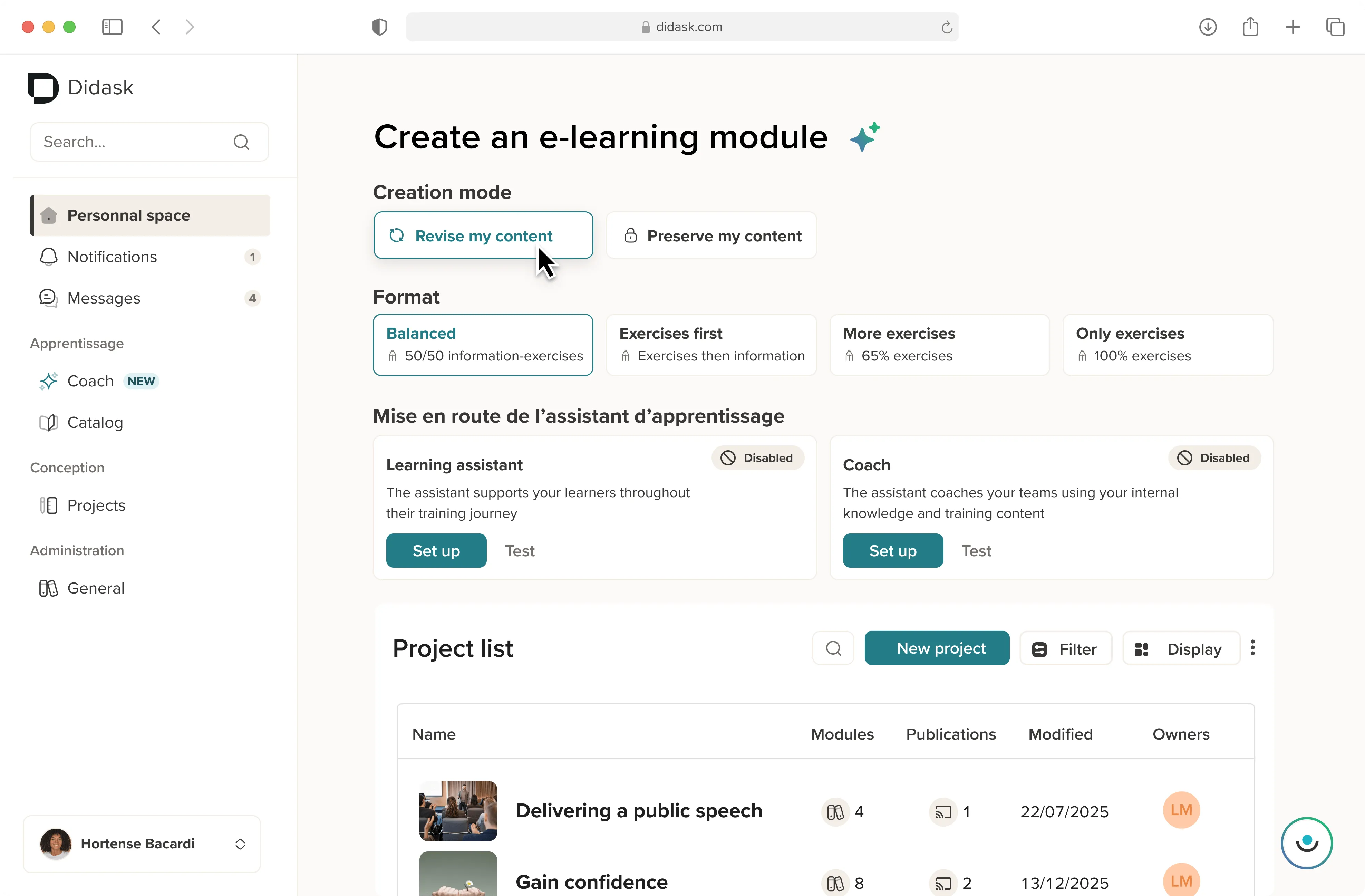
Faced with these challenges, Konecta chose Didask to deploy a blended learning system integrating educational AI. The approach is based on three complementary pillars.
Educational AI to accelerate design
Konecta uses Didask's AI to quickly generate activities from existing business content.
Concretely, AI makes it possible to:
- Automatically create plausible errors and relevant feedback based on business theory
- Transforming dense content in practical cases and concrete situations
- Automate layout and the scenarization of the exercises
The pedagogical approach favors the “Discovery then Deconstruction” logic: the learner is first put in a situation to test, explore, make mistakes. Then, the feedback comes to deconstruct the mistakes and provide the right points of reference. This method installs real learning by trial and error, which is much more effective than simple downward transmission.
The major advantage of AI? It makes it possible to get as close as possible to real field situations. With customizable prompts, Konecta can:
- Offer scenarios in discovery mode adapted to new hires without prior knowledge of the sector
- Organize activities in the right order according to business priorities
- Use specific vocabulary as close as possible to real activity
- Prioritize exercises according to the impact for the end customer
Result: a considerable gain of time in finding relevant scenarios and producing exercises that really fit the field.
Personalization at the service of the learner
The second lever for transformation: to leave the “everyone at the same pace, in the same room” model.
With Didask, courses are now personalized. Each learner progresses at their own pace, with:
- Regular micro-evaluations to secure what has been achieved
- Flashcards to anchor key concepts
- Individualized feedback adapted to the mistakes made
In addition, Konecta has set up daily quizzes outside Didask to measure knowledge over time. These quizzes serve as a thermometer: they quickly reveal the sticking points and the concepts that need reinforcement.
This approach makes it possible to precisely identify the difficulties of each learner, without waiting for the quiz at the end of the course.
“It is extremely interesting from an educational point of view [...] to invite people to learn by making mistakes. It very often allows you to better anchor.”
Blended learning to maximize field impact
The blended model orchestrated by Konecta intelligently combines online and face-to-face training.
Didask e-learning prepares the ground:
- Learners discover theoretical concepts at their own pace
- They practice through realistic scenarios.
- Micro-assessments detect individual bottlenecks
The active and consolidated face-to-face environment:
- The trainers take up precisely the elements considered difficult.
- They adapt their interventions according to the e-learning results of each learner
- They focus on practice, complex situations and personalized support
For trainers, this represents a new pedagogical gymnastics. They manage different levels in the same room, but with a clear objective: to gradually bring learners to more autonomy.
Blended learning thus regains its fundamental logic: theory structures, practice anchors, face-to-face accelerates.
.png)
A structuring project
Beyond the tool itself, this project provided an opportunity to overhaul the existing training program. Subject-matter experts realigned, the team clarified the instructional framework during a kick-off session, and a dual validation process was established to ensure every module was designed from the learner's perspective.
The results: performance and adherence to the appointment
The results of the Didask blended learning system are measurable and significant, both for the training team and for the learners.
Time and efficiency savings for the training team
The design metrics speak for themselves:
- Design time divided by 2 thanks to educational AI
- Training time reduced by 50% : transition from 6 hours in person to 3 hours in e-learning on the same perimeter
This optimization did not come at the expense of quality. On the contrary, the project was an opportunity to restructure the entire system, to align business experts, and to establish more rigorous validation processes.
Improving learning outcomes
For learners, the performance indicators confirm the effectiveness of the new model:
- +3.5 pass points in the end-of-course quizzes
- 87% adherence to blended learning, compared to 100% face-to-face training
To measure this adherence, Konecta deployed a specific hot questionnaire on blended. Learners were able to express how they experience the link between e-learning and face-to-face learning, which helps them the most, and what remains difficult.
Successful deployment on a large scale: the new format was deployed on more than 50% of employees at a production site, i.e. 270 people trained with the blended system.
Stakeholder satisfaction
Customer feedback is very positive. The blended system made it possible to align all the actors:
- Field teams are well aware of the expectations of end customers and employees
- The design team masters the pedagogical constraints and the levers of effectiveness
- Ordering customers are seeing an improvement in the performance of their contact centers
The project also created an opportunity to expand the project team, to ensure that everyone was ready for the transformation, and to better support the skills development of new collaborators.
Prospects for 2026: international deployment and new uses
Building on the success of this first deployment, Konecta is expanding the use of Didask to several dimensions.
Extension to continuing education and new customers
The blended system is gradually expanding:
- Continuing education to support the development of the skills of employees already in place
- New customers with adaptation of the modules to the specificities of each sector of activity
- Optimization of fundamental modules in the insurance sector to create blended courses adapted to various activities
Geographic expansion
Konecta is now deploying Didask internationally:
- English Speaking Market : design of training courses for English-speaking markets
- Global L&D : harmonization of teaching practices at the group level
- spain : adaptation of the devices to the local context
These new projects sometimes cover soft skills themes, not always blended, but always with the same logic of educational effectiveness and optimization of design time.
Transform your training with blended learning and educational AI
The Konecta case shows that it is possible to radically modernise an initial training system while improving results.
The keys to success:
- An educational AI that accelerates design without sacrificing quality
- A personalization of courses that respects the pace of each learner
- Blended learning that optimizes the time of trainers and learners
- A measurement approach to drive continuous improvement
Do you want to accelerate the development of your teams' skills while reducing your training costs?
Book your demo and discover how Didask can transform your training system.
.webp)
How our customers turn learning
into measurable impact








Get a demo!
We’d love to know how to help you
made scalable

Authoring Tools
Platform
.png)