


A healthcare LMS is a training platform whose audit trail, content formats and integrations are built around regulatory obligations and the time pressure clinical staff work under.
In 2024, France's national continuing professional development agency recorded 287,192 enrollments by self-employed healthcare professionals, up 15.6% year on year (ANDPC, 2024 activity report). Hospitals fall outside that particular scheme, but the volume gives a sense of the compliance reporting burden.
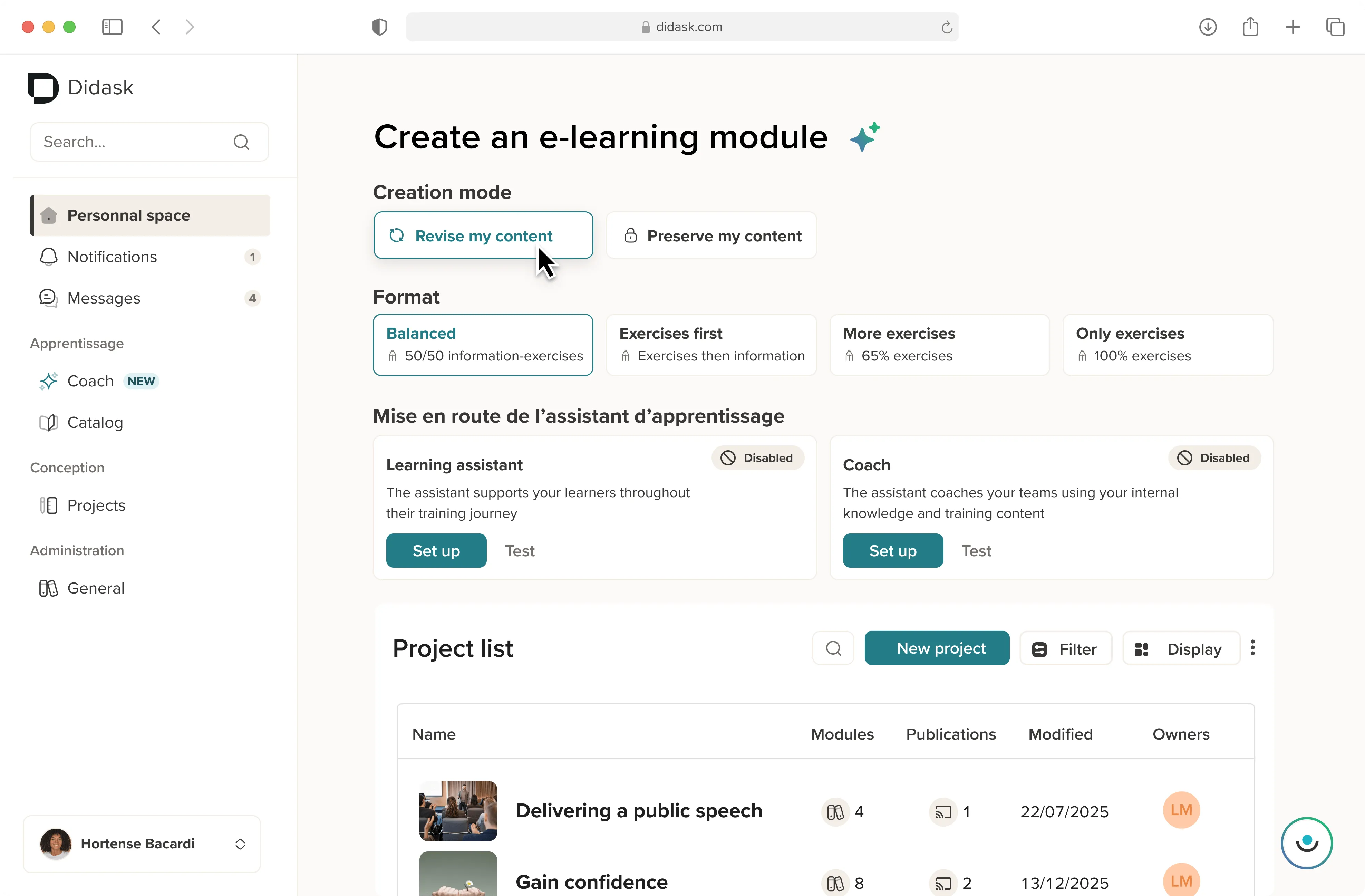
Didask is a French LMS built on cognitive science, which generates personalized learning paths from an organization's existing protocols.
What are the 7 best healthcare LMS platforms in 2026?
The seven platforms we selected are Didask, Apolearn, Rise Up, Beedeez, 360Learning, Moodle and Cegid Talentsoft Learning. Didask publishes this comparison and ranks itself first; for the other six, we only used publicly verifiable information.
Ratings collected on Capterra on 24 August 2026. Three caveats before comparing them: Apolearn has only 3 reviews, the Cegid reviews are mostly about recruitment, and Moodle Workplace has no listing of its own.
1. Didask
A French vendor behind a complete ecosystem: LMS, LXP, authoring tool and an AI coach grounded in cognitive science. Didask Training cuts the time needed to build a course by 50 to 65% (Didask measurement across 2,237 courses, October 2025) and the time learners spend in training by 60 to 75% at constant scope (993 learners, March 2025).
Strengths
- Course creation open to subject-matter experts, with no instructional design skills required.
- Scenario-based practice and adaptive learning: you train application, not recall.
- Hosting in France with Scaleway, plus SSO over SAML 2.0 or OpenID Connect.
.webp)
They train their teams with Didask
Valenciennes Hospital · Clinique Pasteur in Toulouse · CRAIF, the Île-de-France autism resource centre · the Ykoé group, a network of mental health clinics
2. Apolearn
French LMS launched in 2015, with a built-in authoring tool and a dedicated healthcare page.
Strengths
- Hosting in France, with OVH and Scaleway.
- Listed with UGAP, France's central public purchasing body, which simplifies public sector buying.
- The most visible hospital reference in the panel: Grenoble-Alpes University Hospital gives a testimonial on its site.
3. Rise Up
French platform founded in 2014, combining LMS, LXP and an authoring tool with a blended learning focus.
Strengths
- Classroom and online training in a single tool, with automated regulatory reminders.
- Documented support for SCORM, xAPI and LTI Advantage.
4. Beedeez
French mobile learning platform created in 2015, designed for teams without a fixed workstation.
Strengths
- Native offline mode: the only vendor in the panel whose product is built around it.
- A dedicated healthcare and social care page, with documented use cases for hospitals, care homes and home hospitalization.
5. 360Learning
French LMS founded in 2013, built around collaborative learning: in-house experts produce the courses themselves.
Strengths
- Broadest standards support in the panel, from SCORM 1.1 to 2004, plus cmi5, xAPI and AICC.
- A public entry price, rare in this market.
6. Moodle
Open source LMS released in 2002, under the GPL. Beware of a common confusion: Moodle Workplace, the enterprise edition, is proprietary and goes through certified partners.
Strengths
- Full control over hosting, including self-hosting by your own IT department.
- A plugin ecosystem and community with no equivalent in this market.
7. Cegid Talentsoft Learning
The learning module of the Cegid Talentsoft HR suite, born from Cegid's acquisition of French vendor Talentsoft in July 2021.
Strengths
- Native integration with the HR system, so no headcount synchronization to develop.
- Solid footprint in the public sector and in social care.
.png)
Does your LMS need HDS certification? No, in most cases
France's HDS certification governs the hosting of patient health data collected during prevention, diagnosis or care activities (article L.1111-8 of the French public health code). A training LMS hosts learner data: identity, learning paths, results, certificates. That data falls under the GDPR, and none of the 7 platforms compared here claims HDS.
Ask instead for five things you can write into a tender: a signed GDPR data processing agreement, encryption in transit and at rest, data partitioning per organization, SSO against your own directory, and an exit and data portability clause.
What is a healthcare LMS, and how does it differ from a standard one?
A healthcare LMS is a general-purpose LMS with three components adapted. The audit trail first: it produces time-stamped, exportable evidence you can put in front of an inspector during a HAS accreditation visit, where a corporate LMS produces dashboards.
Formats next: a 45-minute module is incompatible with rotating shift work. And organizational mapping, because a learner belongs to a site, a division and a department.
In practice, your platform has to track emergency care training, patient identity vigilance, manual handling risk prevention, dignity of care in nursing homes and continuing professional development.
How do you choose an LMS for a healthcare organization?
Six criteria are enough to separate these platforms, and the first is how long it takes to turn a protocol into working training.
- Time to build a module. How many hours starting from a ten-page protocol? Ask for a demonstration on your own document.
- Autonomy of subject-matter experts. Can a ward manager produce a course alone, without an instructional designer?
- Regulatory audit trail. Time-stamped exports, mapping by department and division, version history. Ask to see a real export.
- Fit with the field. Sequence length, mobile, resuming after interruption, offline. Test it on a phone, in a corridor.
- Security and integrations. GDPR processing agreement, encryption, partitioning, SSO, reversibility. Ask whether SSO is included or billed separately.
- Total cost over three years. License, integration, content production and internal time. The last item is the heaviest, and nobody costs it.
One criterion to discard: completion rate. Mandatory training reaches 100% mechanically, and that figure says nothing about practice. France's national health authority analyzed 213 serious adverse events arising during medication prescribing between 2017 and 2023: in 95% of cases, the people reporting them considered the event avoidable or probably avoidable (HAS, 12 September 2025). Transfer to practice is what you should be aiming at.
.png)
Teaching an interview technique, remotely
'It is, on the face of it, difficult through a piece of software to get professionals to grasp a verbal technique, without being able to give them examples directly. Through the scenario-based practice offered by the Didask platform, it became possible to remove those barriers.'
— Estelle Isabelle, project manager, Grand Est Addictions
.webp)
.webp)
.webp)



.webp)
.png)