

Internal trainers in healthcare facilities can produce your e-learning courses without an instructional designer. Nurses, nurse managers or psychologists supply their documents and validate the clinical content. A pedagogical AI turns them into interactive modules.
The time saved is fully measurable: Didask cuts the time needed to design a course by 50 to 65% (2,237 courses, October 2025). However, AI does not replace review. France's National Authority for Health (HAS) requires every use of generative AI in healthcare to be "conscious, supervised and reasoned" (HAS, October 2025).
Why don't your clinical experts produce e-learning today?
Your experts know how to teach in person, but digitizing your training is a different job. Their time goes mainly to patient care, and the training department often has no instructional designer to take over.
Turning a protocol into a module means breaking down the content, writing exercises and planning feedback for the learner. This design work has nothing in common with running a classroom session.
Hospital staff do not have that time. In 2019, 57% of hospital-sector employees considered their workload excessive, compared with 40% of all employees in France (DREES, Études et Résultats no. 1215, November 2021). This is often where the move to e-learning in healthcare stalls.
Who can become an internal trainer in a healthcare facility?
An internal trainer in a healthcare facility is a staff member who passes on their expertise to colleagues, alongside their main role. Nurses, nurse managers, psychologists, physicians or experienced nursing assistants can all take on this role.
They deliver in-house training, meaning training designed and delivered by the facility with its own resources, for its own staff (OPCO Santé, August 2024). In France they are also called occasional internal trainers: training remains an occasional activity, alongside their clinical job.
The model already exists with PRAP 2S trainers. With e-learning, the expert teaches, supplies the material for a module and validates what comes out of it.
How does a pedagogical AI turn your protocols into training modules?
A pedagogical AI starts from the facility's documents, such as protocols or PowerPoint decks, and structures them into modules. Clinicians review and edit every element before release.
A pedagogical AI is a generative AI guided by principles from cognitive science. It does not just summarize a document: it turns it into activities that make learners practice and remember.
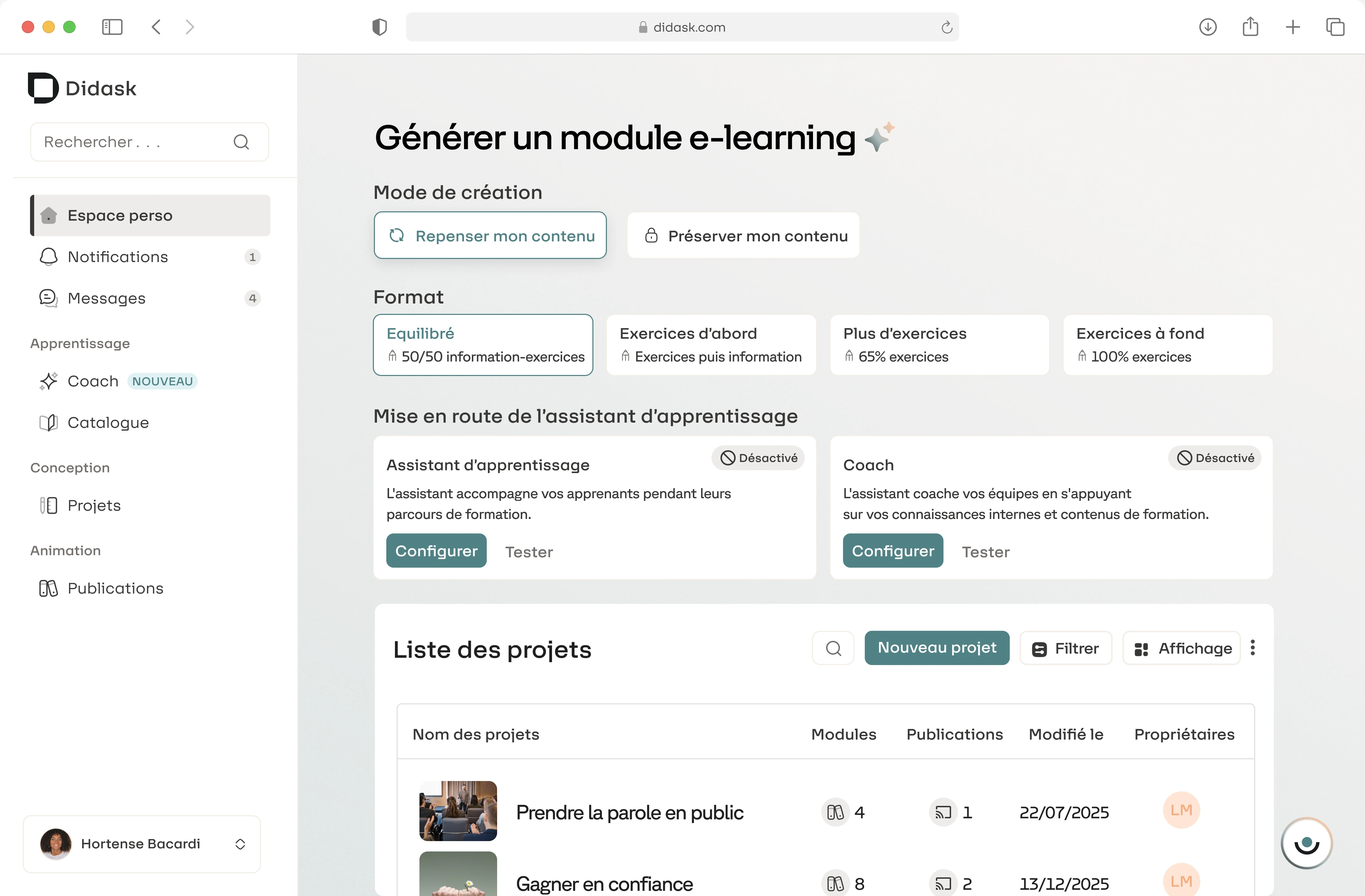
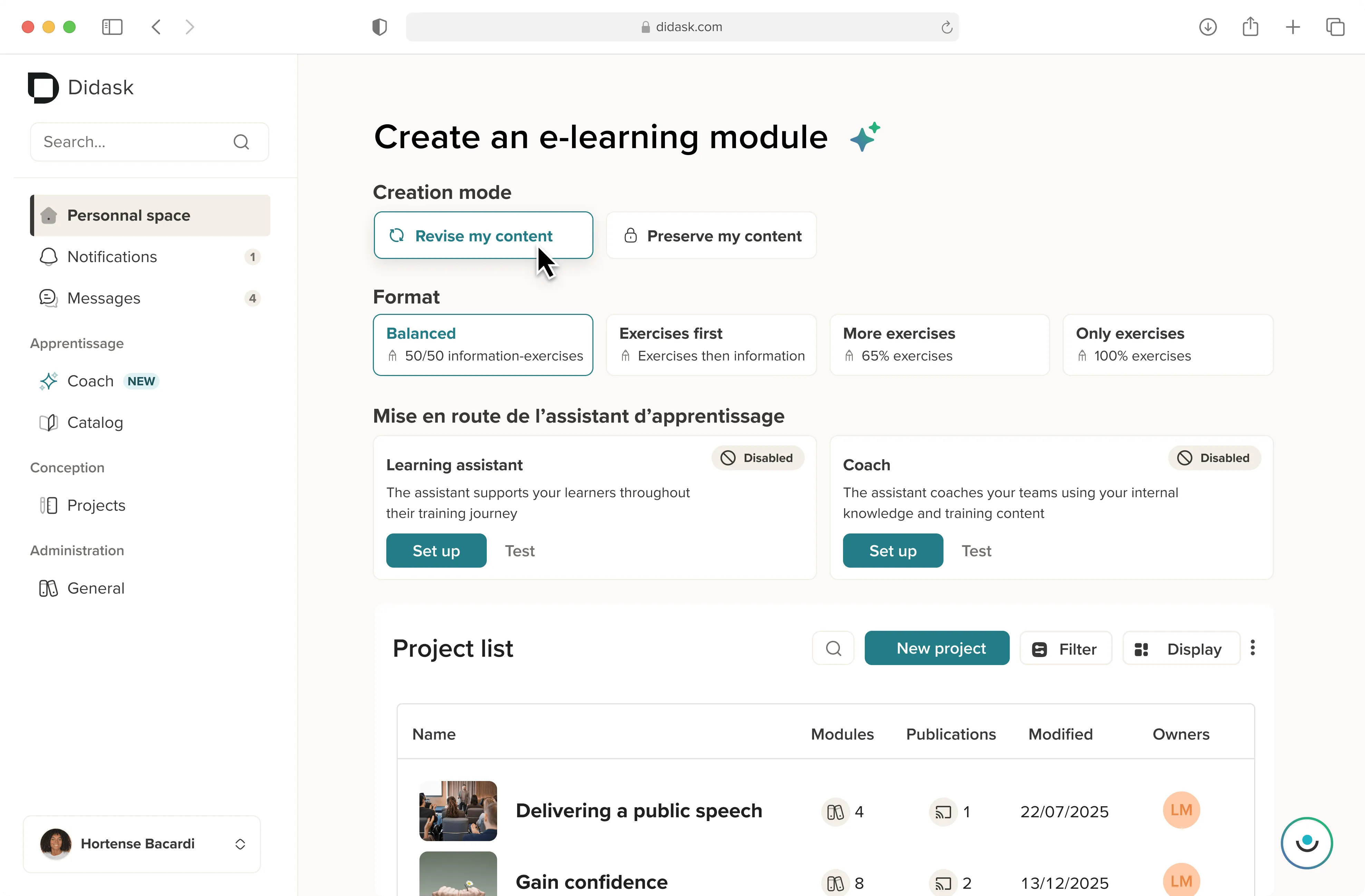
Didask's LMS Platform turns a healthcare facility's documents, such as protocols or PowerPoint decks, into interactive modules that experts review and edit before release.
The division of roles is simple:
- The expert supplies what they already use: protocols, procedures, classroom training materials, without rewriting anything.
- The tool proposes the structure, key concepts, exercises and feedback for the learner.
- The expert stays in control: everything the AI generates remains editable, and nothing is released without their approval.
Among Didask's healthcare clients, 58.1% of activities are exercises with corrective feedback, multiple-choice questions included (2,785 out of 4,794, Didask data, November 2026).
How do you keep AI-generated content clinically valid?
Have every module reviewed by a subject-matter expert before release, and keep a record of that validation. This is the principle set by the HAS: generative AI use supervised by the professional, who checks the content produced.
In October 2025, the HAS published a good-practice guide on generative AI in healthcare. It rests on four guidelines: Learn, Verify, Estimate, Communicate (HAS, A.V.E.C. guide). The guide does not target training specifically, but its principles apply directly.
According to the HAS, all generated content should be treated as a proposal that may contain errors: values, units, drug names (HAS, press release of 30 October 2025).

The 4-step review process
1. The expert selects the source documents and removes any patient data.
2. The AI generates the module.
3. The expert reviews every element: doses, units, drug names, protocol steps.
4. The division lead validates; the training department records the validation and its date.
AI errors are often subtle: an exercise that is too obvious, a generic example instead of a real ward situation. Review should cover how relevant the practice scenarios are, not just whether the facts are accurate. See also the limitations of generative AI in training.
How do you organize a team of internal trainers without hiring?
Organize production on three levels: the training department sets the framework, one lead per division coordinates review, and the experts supply and validate the content. Start with three to five priority topics.
- Choose three to five topics: mandatory training, critical procedures, onboarding of new staff.
- Appoint one expert per topic and one lead per division.
- Have modules produced from existing documents.
- Have the clinical content reviewed and validated before any release.
A team of five to seven experts is often enough to get started. The division lead, often a nurse manager, gathers needs, follows up with experts and organizes review.
Also think about the shared core of job-adaptation training programs in the French public hospital service: hygiene, patient identification, patient rights. Produced once, these modules can be reused in every program and only need updating in one place.
Authoring tool or all-in-one platform: what should you choose for clinical experts?
If you already have an LMS, an AI authoring tool may be enough. If you also need to deliver, track and support frontline teams, an all-in-one platform avoids piling up tools.
Authoring tools such as Articulate 360, iSpring or Easygenerator can now generate a first course draft from a document. Easygenerator presents itself as an authoring tool, not an LMS: you need a separate platform to deliver and track. Whatever the tool, test it with one of your own protocols and have an expert score the result.
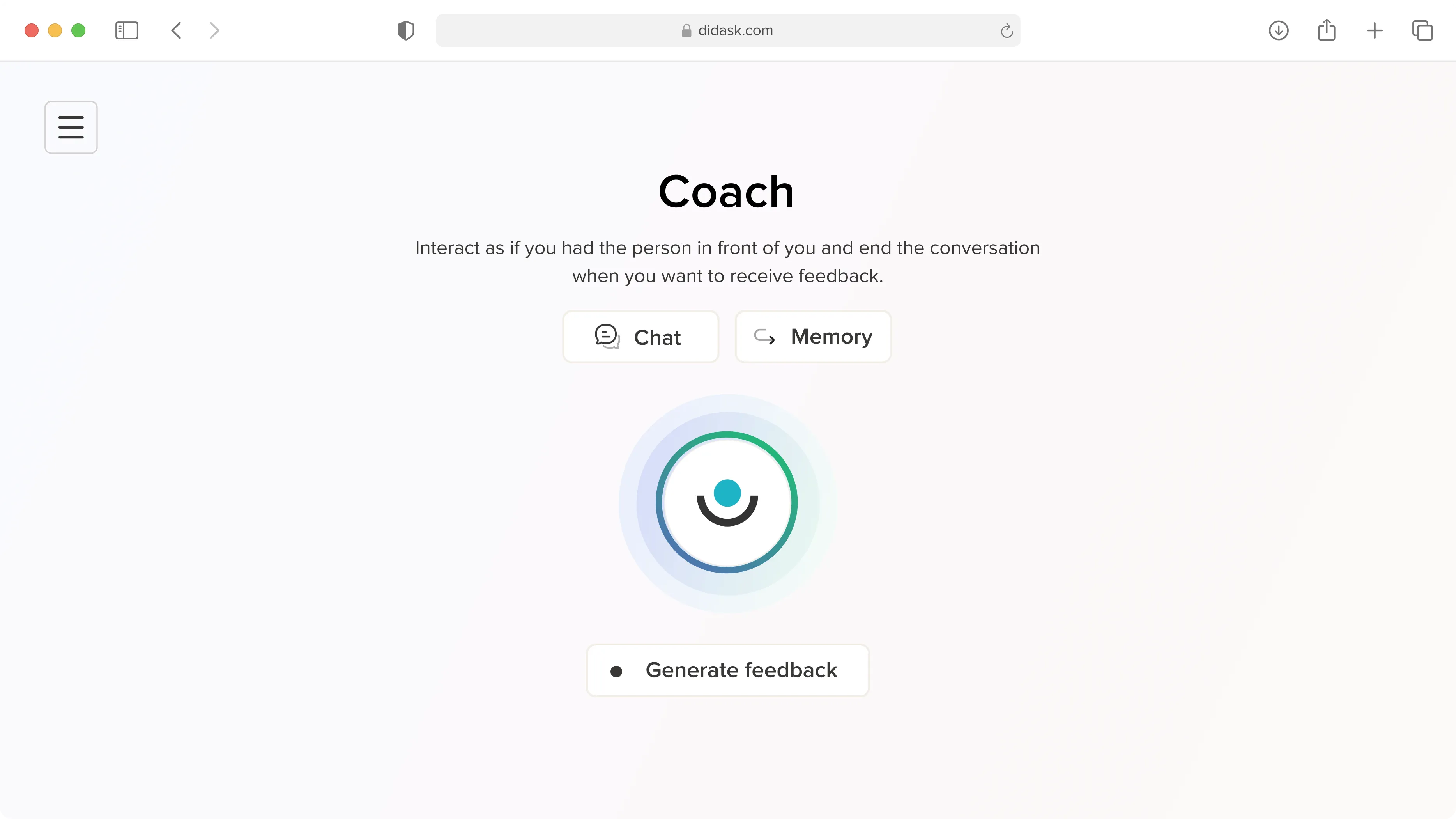
Didask brings creation, delivery, measurement and an AI assistant together in a single platform. Frontline teams can log in without a work email address. To compare platforms in the sector, see our healthcare LMS comparison.
What results can you expect when your experts produce their own training?
Modules produced faster, and actually completed. In a French university hospital supported by Didask, 161 learners out of 184 completed at least one course, or 87.5%, with 120 certificates issued (Didask data, November 2026).
Among Didask's healthcare clients, 74.6% of learners completed at least one learning path (3,494 out of 4,682, November 2026). This figure combines several facilities and several types of training.
The association Grand Est Addictions had until then trained only in person. It produced its first e-learning program: four 10-minute modules on early identification of addictions (Grand Est Addictions case study).

Estelle Isabelle, project manager, Grand Est Addictions
"Through the scenario-based practice offered by the Didask platform, it became possible to remove those barriers and to offer concrete examples that let professionals picture themselves in the situation."
In summary
Your clinical experts are your first training resource: they bring the clinical substance, and the pedagogical AI handles the pedagogy. Organize review along the HAS A.V.E.C. model, start with one division and three topics, then extend the model.