


In a context of rapid business transformation, training continuing professional development is emerging as a strategic lever for organizations. For companies, integrating the CPD into your human resources policy, while ensuring compliance and educational value, is a key issue.
Didask can be positioned as a partner of choice in the implementation of this system.
Understanding Continuing Professional Development
The CPD is a regulated device, especially in the health sector, aimed at guaranteeing the maintenance and updating of knowledge, the improvement of professional practices and the management of risks in the exercise of a profession.
Since the Health Modernization Act (2016), the CPD is refocused on the core of the business, the safety of care and controlled via the National CPD Agency. Every health professional must justify, over a three-year period, their commitment to an approach involving analysis, evaluation, optimization of practices and risk management.
The terms and conditions cover three main types of actions :
- training (updating knowledge, deepening)
- professional practice assessment (EPP)
- risk management (GdR)
For a CPD course to be valid, the professional must complete at least two commitments of two different types during his three-year cycle. Actions should respect methodological criteria dictated by the "Haute Autorité de Santé (HAS)" and correspond to the national and professional guidelines defined for the three-year period.
What sectors are affected by the CPD?
Health professionals: a three-year obligation
The CPD is particularly well known for its reach. mandatory in the health sector. All professionals in the sector, whether doctors, pharmacists, nurses, masseurs-physiotherapists, midwives, etc., must comply with this three-year obligation.
The National Professional Councils (NPC) for each specialty define the standards and ensure scientific coherence. Note that the obligation applies regardless of status (liberal, employed, hospital) and regardless of the place of practice in metropolitan France and in most overseas departments.
The areas covered by the CPD regulations
The CPD as defined by regulatory texts formally applies to health professionals. On the other hand, other sectors can draw inspiration from this approach, but without national legal obligations. For example, some regulated professions in education, social or security incorporate their own mandatory continuing education cycles.
CPD as a model for increasing skills in other sectors
Even in sectors not subject to a CPD obligation, the spirit of the system (measurement of practices, skills development) is a useful model. Businesses can adapt the principles to structure a continuous development circuit for their employees, by integrating training actions, studies of uses, feedback and the handling of operational complications.
What does a CPD training action consist of?
A CPD action combines Validated content (scientific, educational) with interactive modalities And a impact monitoring on the processes.
Here are some examples of recognized modalities:
- E-learning courses or distance modules.
- Face-to-face/workshops/simulation (simulations, practical work)
- Clinical audit, case review, clinical vignettes for process analysis.
- Multidisciplinary meeting, mortality reviews, indicators, patient tracker in the context of GoR or evaluation actions.
Each action must include a before-and-after estimate, a follow-up of gains or impacts on practice, an optimization plan and traceability via the traceability document.
Conformity and educational value are checked by independent scientific commissions.
CPD goes beyond simple continuing education : it integrates the examination of practices, the management of dangers, sectoral priority guidelines and quality control.
Integrate CPD into your company's training strategy
For a company wishing to structure its professional careers, the CPD can be used as a structuring model.
Aligning CPD with strategic and business priorities
Start with align CPD priorities national or sectoral (in the case of health) with the company's internal priorities (key knowledge, job hazards, modernization of apprenticeships). National or disciplinary guidelines offer guidelines for structuring your offer.
Create personalized journeys using digital tools
For design, monitor and evaluate these modules, businesses can rely on a efficient training platform. This facilitates the traceability of apprenticeships (certificates, results, results, evaluations, impact indicators) and centralizes the management of the CPD system.
This allows organizations to create their own CPD courses. Each module can be customized, enriched and configured to meet the three-year cycles and the requirements of educational value and scientific compliance.
Management, evaluation and improvement
Integrate indicators (satisfaction, impact on processes, feedback from “internal patients” or customer use) to measuring added value. This feedback allows for a process of continuous improvement, faithful to the CPD logic.
Consistency with other learning devices
Continuing Professional Development in this framework can work in concert with the skills development plan, internal learning plan, GPEC, or talent management, to strengthen coherence.
The benefits of the CPD for businesses and professionals
For businesses: strategic lever
- Productivity improvement: better structured actions, up-to-date knowledge, error management.
- Competitiveness: a better trained pro produces increased value for customers or patients.
- Loyalty and motivation: offering structured learning to increase skills is an argument for retaining talent and promoting internal development.
- Image and social responsibility: promoting a scientific, qualitative and innovative approach plays a positive role in terms of image and compliance with regulatory or sectoral requirements.
For collaborators/professionals
- Acquisition of new skills: updating, specialization, increasing know-how.
- Internal mobility: structured learning can support career paths.
- Professional recognition: compliance with the CPD obligation is a requirement in many professions.
- Better quality of service/care: in the health sector, this means better safety of care for patients.
Financing a CPD course: how does it work?
The financing of CPD actions depends on the status (liberal or employed) and the sector:
- For private health professionals who are covered by a contract or employed in a licensed center, The National CPD Agency (in France) covers part of the educational costs and compensates for any loss of income.
- For an employee in a company, The employer (public or private) contributes to the financing of CPD procedures (article R. 4021-22 of the Public Health Code) or can delegate via the OPCO.
- The professional must file your file via the ANDPC platform/dedicated gateway (for example C @nditOnLine) and respect the administrative eligibility criteria (hourly ceilings, eligibility according to profession).
- Sometimes there is internal co-financing of the company, ofOPCO Or of sectoral training funds (depending on the branch).
For a learning organization that offers CPD commitments, it is essential tobe registered with ANDPC and to ensure that its approaches meet the required scientific, educational and evaluation criteria.
How does Didask support companies in setting up the CPD?
A centralized and modular platform
Didask can become the digital pilot of your CPD strategy, via:
- one LMS allowing the dissemination, monitoring and evaluation of learning modules, study or audit workshops,
- one training catalog that you can structure, enrich, or customize according to CPD priorities. As well as the possibility of creating your own training courses, with the help of digital tools, to meet the specificity of your sector.
- traceability monitoring: certification, certification, statistics, statistics, reporting to justify actions to competent authorities or professional advice.
Educational design, coordination and engineering
As a partner for learning organizations and businesses, Didask can help you build courses that comply with national or specialized guidelines., to organize e-learning modules, virtual classes, the collection of evaluation results and to aggregate maneuver study actions.
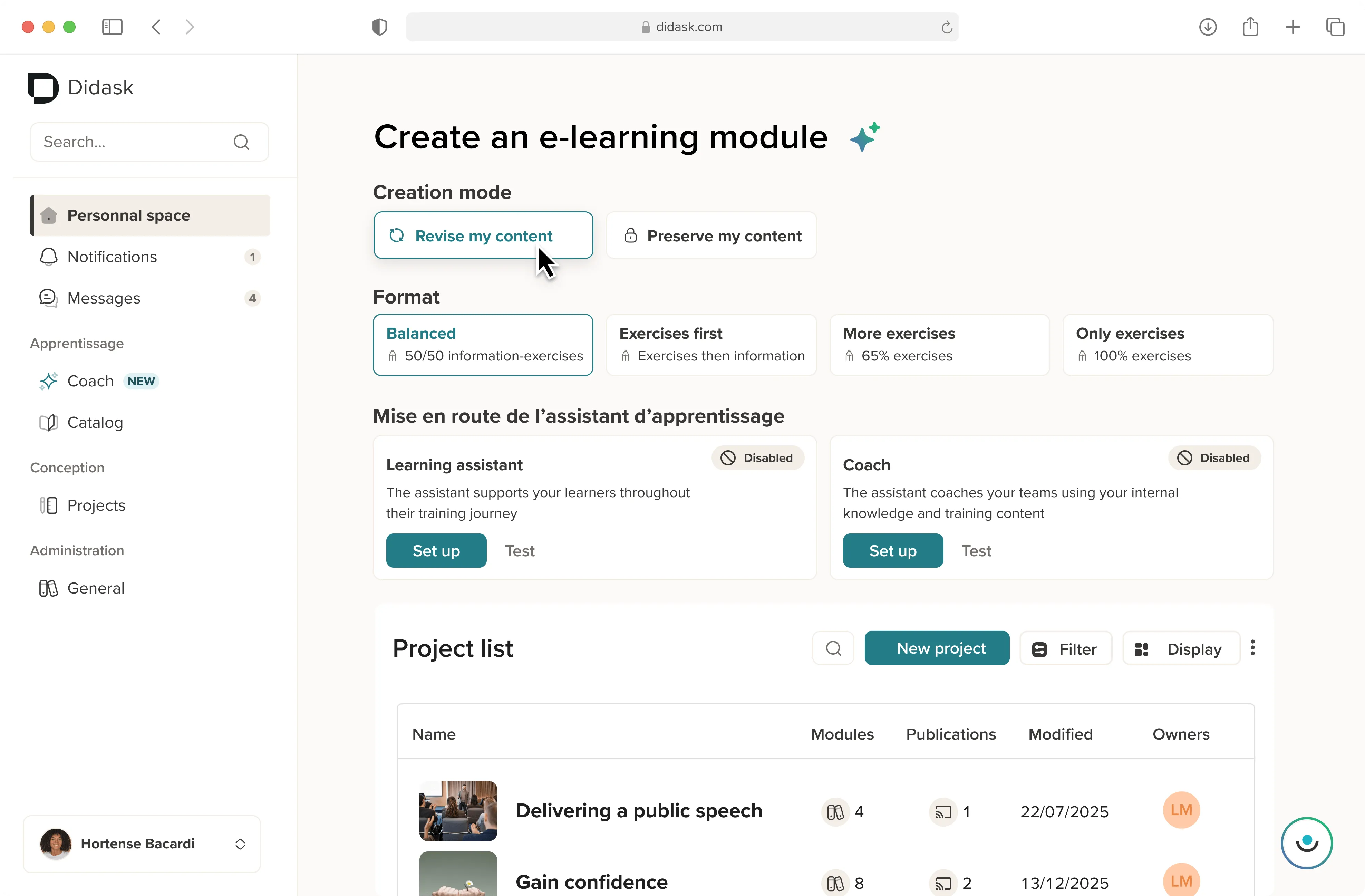
Thanks to his software tool author And his AI assistant, it becomes very easy to create adapted and relevant modules quickly.
Quality assurance and compliance
Didask can help you ensure that your procedures meet the criteria of educational quality and evaluation required by the CPD (HAS, scientific committees), which is essential for the registration or recognition of actions.
Valuation and impact
Thanks to the collection of data (statistics, feedback, impact indicators), Didask can provide analytics on the optimization of practices, the development of skills, the differences before and after, thus strengthening internal justification.
The Continuing Professional Development is an essential lever for structuring the evolution of the skills of professionals, especially in regulated sectors such as health, but also an inspiring model for any organization or company that wants to implement a high value continuous learning approach.
For learning organizations or businesses that want to build compliant, effective, and measurable CPD journeys, Didask offers the necessary tools.
.webp)
.webp)
.webp)

.webp)



.png)