


A customer service training LMS is a training platform built for agents who change often, work across several sites and learn mostly through live conversations with customers.
Staff turnover is the first constraint of the job. In French call centres, 41% of employees were not in their position a year earlier, rising to 49% for call centre agents and telesales staff (Insee Première no. 1931, December 2022, 2019 data). It is the only official turnover indicator specific to the sector in France.
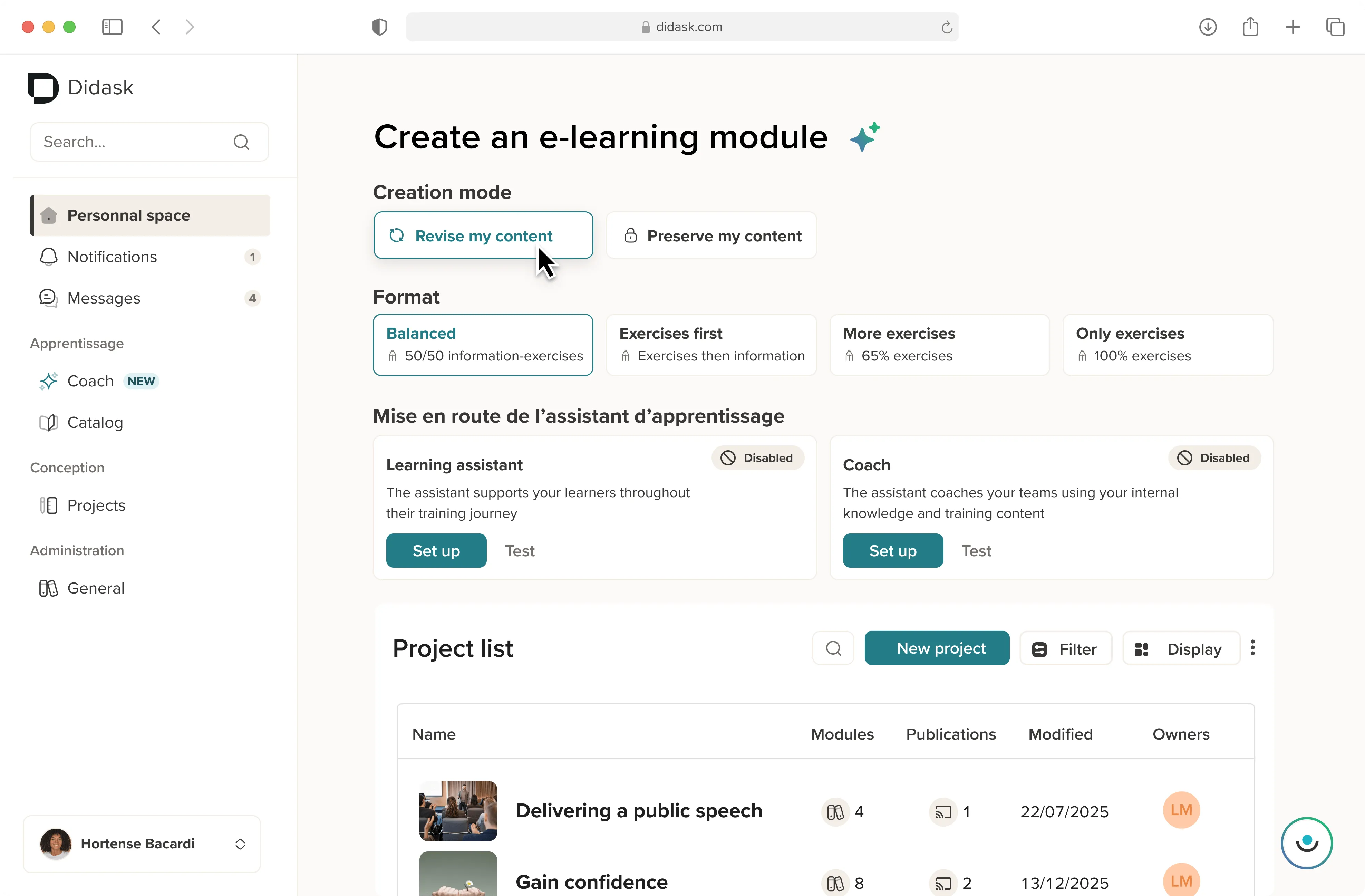
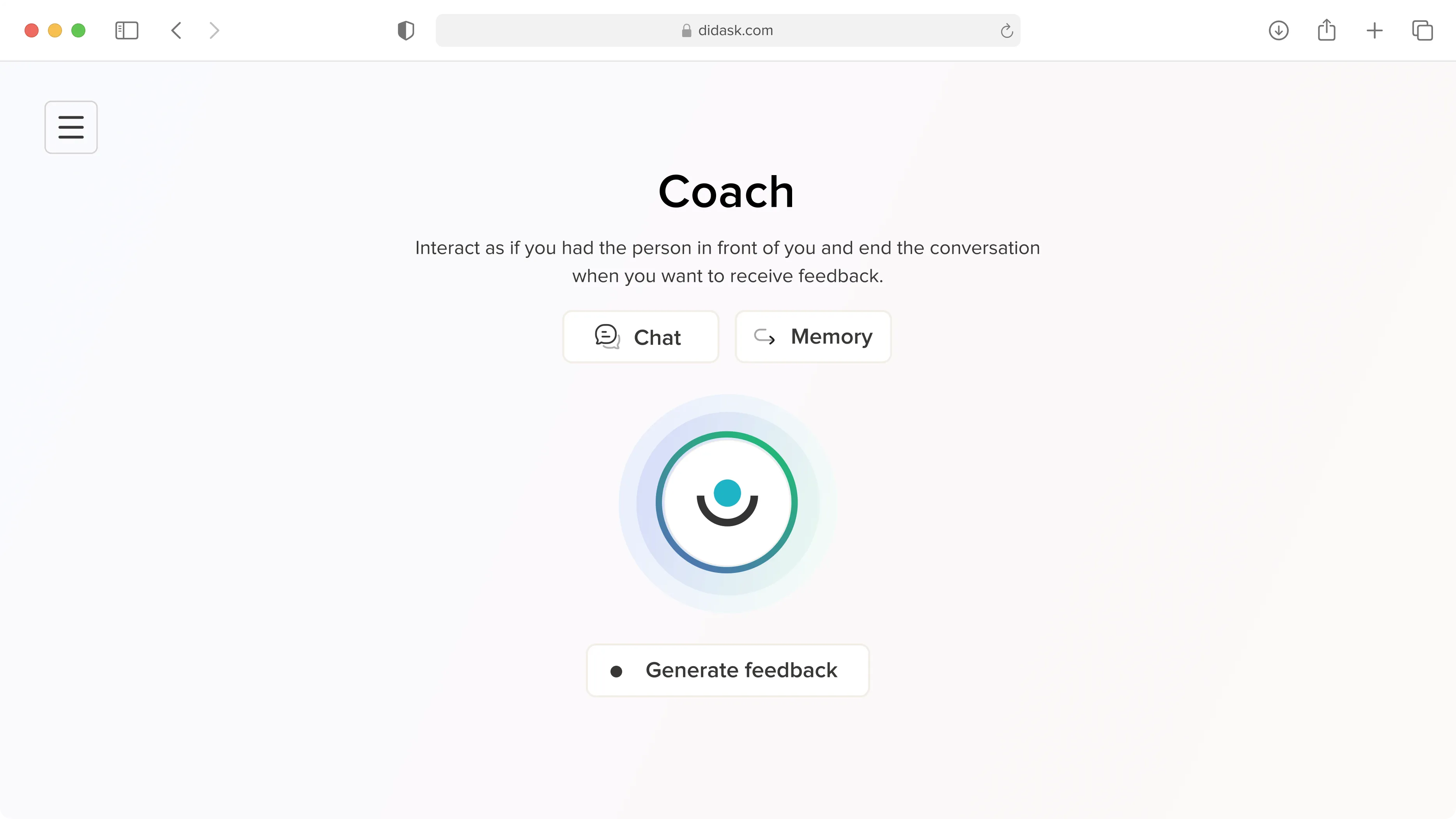
Didask is a French training platform grounded in cognitive science. It turns a company's scripts, complaint procedures and product sheets into corrected practice scenarios, and supports agents inside their business tools with Didask Coaching.
What are the 7 best LMS platforms for customer service training in 2026?
The seven platforms selected are Didask, Docebo, Rise Up, 360Learning, Cornerstone, Beedeez and Uptale. Five are French in origin, one is Italian-Canadian, one is American, and Uptale is not an LMS but a simulation layer that plugs into one.
Our method, and what it is worth
Didask publishes this comparison and ranks itself first. Each platform is assessed against the seven criteria detailed below, using publicly verifiable information collected on 29 September 2026 from vendor documentation.
We distinguish three levels of evidence: a feature documented in a help centre, a promise on a sales page, and a self-reported customer case figure. When information could not be found, we write that it is not publicly documented, never that it does not exist.
Ratings collected on 29 September 2026 on Capterra, and on G2 for Cornerstone and Uptale, which have no active Capterra France listing.
1. Didask
A French all-in-one training platform, grounded in cognitive science, that builds learning paths from a company's existing documents.
What it brings to customer service. The design AI turns a complaint procedure, a script or an offer sheet into a corrected practice scenario. It tackles the real bottleneck of customer service teams: a catalogue to rebuild at every offer change, with a training team of two or three people.
Strengths
- Didask Training cuts course design time by 50 to 65% (Didask measurement across 2,237 courses, October 2025).
- Didask Coaching answers agents' questions inside their business tools. 84% of users rate its answers as consistently relevant and contextualised (Didask measurement across 410 learners, November 2025).
- Results export by module, SSO with SAML 2.0 and OpenID Connect, public API included in the licence, SCORM delivery into an LMS already in place.
- Hosted in France, with Scaleway in Paris.
The right choice if your content changes faster than your training team can rewrite it, and you want to train for the conversation, not just for knowledge of the offer.
.webp)
They train their customer service teams with Didask
ENGIE · Konecta · Canal+ · BestDrive
2. Docebo
A vendor founded in Italy in 2005, based in Toronto and publicly listed.
What it brings to customer service. The widest integration catalogue in the panel, and the only AI role-play (an exercise where the learner talks with an AI-simulated customer, then receives feedback) documented in a help centre, with configurable scoring grids.
Strengths
- AI role-play by video, voice or chat in the authoring tool, scored on a default or custom grid, with a pass threshold.
- Documented extended enterprise feature (opening the platform to external audiences in separate spaces): one space per audience, with its own branding, language and catalogue.
The right choice if you train both your in-house teams and several outsourcing partners, and your ecosystem combines Salesforce, ServiceNow or Dynamics.
3. Rise Up
A French LMS founded in 2014, focused on corporate training and training organisations.
What it brings to customer service. The richest Salesforce integration in the panel on the display side: the agent sees their dashboard and recommendations without leaving the tool.
Strengths
- Separate academies per audience announced, to keep customers, partners and franchisees apart.
- Hosting announced in France, with Scaleway in Paris.
The right choice if Salesforce is your agents' main screen and named French hosting is a requirement from your procurement team.
4. 360Learning
A Franco-American LMS founded in 2013, where in-house experts create and run the courses.
What it brings to customer service. A model where your best agents and supervisors create the courses themselves, useful when the know-how sits in the teams rather than at head office.
Strengths
- Schedulable custom reports and group statistics, documented.
- The only public pricing in the panel alongside Didask and Uptale: $8 per user per month up to 100 users.
The right choice if your customer service expertise rests on a few senior agents you want to turn into trainers.
5. Cornerstone
An American vendor founded in 1999, specialised in large multi-country organisations.
What it brings to customer service. Proven international and regulatory coverage, for groups that already manage their talent on the same suite.
Strengths
- Documented Salesforce Lightning components: search, launch and complete a course without leaving Salesforce.
- Role-play with an AI avatar announced since July 2025, from the Talespin acquisition.
The right choice if your group already uses Cornerstone for talent management and operates in many countries.
6. Beedeez
A French mobile learning vendor founded in 2015, focused on frontline teams.
What it brings to customer service. An offer designed for in-store and front-desk customer service, where the agent only has a phone and a few minutes.
Strengths
- Written or spoken AI role-play announced, with welcome, product presentation and objection-handling scenarios.
- Native offline mode announced, microlearning, separate configuration by subsidiary or region.
The right choice if your customer service teams work in stores or branches rather than on a phone floor.
7. Uptale
A French vendor founded in 2017, specialised in immersive training. Uptale is not an LMS: its modules are delivered in yours, via SCORM or LTI.
What it brings to customer service. The most detailed voice role-play publicly documented: the learner speaks to a virtual customer, then receives a transcript and an analysis of their speech.
Strengths
- Announced analysis of speaking pace, vocabulary and filler words, on desktop, mobile or virtual reality headset.
- Public pricing from $17,000 per year for 100 learners.
The right choice if you are keeping your current LMS and only want to train spoken posture with difficult customers.
What is a customer service training LMS, and what problems must it solve?
A customer service training LMS is a general-purpose LMS adapted to three constraints: agents who turn over continuously, multiple sites and outsourcing partners, and a skill exercised in conversation. It is not a separate technical category.
Learners arrive continuously. With the turnover typical of the sector, each new agent must be trained without waiting for the next session. The programme has to absorb permanent intakes, not an annual plan.
Quality must be the same everywhere. A customer who calls an outsourced floor expects the same treatment as at head office. At ENGIE, Didask was used to train more than 2,500 agents across 20 customer contact centres (published testimonial).
The skill is a conversation, not a piece of knowledge. The French professional qualification for remote customer service advisers explicitly includes the skill "handling difficult situations in remote customer relations" (France Compétences, RNCP42431). A quiz on the offer does not assess it.
Good to know
The French qualification RNCP35304, still cited by many websites, expired on 6 July 2026. It has been replaced by RNCP42431, active until 5 July 2031. Its two skill blocks, personalised service and remote sales relationship, are a good basis for structuring your own learning paths.
Why initial training is the first thing to rethink
Because every hour of initial training is an hour when the agent is not taking calls, and turnover forces you to repeat it again and again. Cutting its length without lowering quality is the most direct gain.
At a French online bank supported by Didask, initial training for agents lasted four to six weeks.
The best-documented lever is blended learning: the fundamentals move to e-learning, and classroom time is kept for complex practice scenarios. Konecta, an outsourced customer service provider operating in 26 countries, made this shift. Training time went from 6 hours to 3 hours, with exam pass rates 3.5 points higher (published testimonial, 270 people).
The second lever is update speed. A new pricing offer or a new complaint procedure must be in the learning path before the first call that concerns it. At ENGIE, 60 training projects were created in 6 months by 5 trained course designers (published testimonial).
How do you choose a training platform for your customer service teams?
Seven criteria are enough to separate the platforms, and the first is the time between your existing documents and a deployed learning path. It decides whether your catalogue keeps pace with your offers, or stays one version behind.
- Time from existing content to a deployed path. How many hours, starting from your scripts, offer sheets and complaint procedures? Insist on a demonstration with your own documents, never with a prepared example.
- Conversational practice scenarios. Complaint, unhappy customer, refused goodwill gesture: the platform must make agents practise, and explain why one answer is better than another. See what AI has changed in practice scenarios.
- Access from the work tool. Agents learn between two calls, sometimes during one. Check what they actually see in their CRM or ticketing tool, in line with learning in the flow of work.
- Consistency across sites and partners. Same path, same progression, same assessment for an in-house floor and a BPO (a provider to which a company outsources all or part of its customer service). Ask how a partner accesses the content, and what they see of other sites.
- Skill-level measurement. Results by module, site and cohort, exportable, and success on practice scenarios rather than mere progress. It is the condition for later cross-referencing training with service indicators.
- Integrations. SSO, API, HRIS, SCORM or xAPI. The right decision is not always to replace the group LMS: sometimes delivering your customer service paths inside it is enough.
- Total cost per trained agent. Licences, dormant licences after a departure, internal design time, non-productive training hours. With high turnover, the cost per agent who is actually operational matters more than the price per user.
Want to go further? Discover the best LMS platforms across all sectors.
.png)
Three questions to ask during a demo
1. "Turn our complaint procedure into a practice scenario in front of me, now, without having prepared it."
2. "Show me what an agent sees in our CRM during a call, not from the platform's catalogue."
3. "How does an external partner access the same paths, and what do they see of other sites' reporting?"
What measured results can you expect from a customer service training platform?
Two benefits are measured and published: training time falls for the same scope, and content production speeds up. A third, better FCR (first contact resolution rate) or repeat contact rate (the share of customers who contact the service again for the same request), is plausible but publicly demonstrated by none of the seven vendors, ourselves included.
Measured benefit 1: time spent in training. Didask Training cuts the time learners spend in training by 60 to 75%, for the same learning scope (Didask measurement across 993 learners, March 2025). At Konecta, the phase covering 270 people, half of one site, halved training time (published testimonial).
Measured benefit 2: content production. Didask Training cuts course design time by 50 to 65% (Didask measurement across 2,237 courses, October 2025). At Konecta, design time was also halved, and 87% of learners embraced the new format (published testimonial).
Plausible benefit: service quality. ENGIE scored 16.72/20 in the French "Élu Service Client de l'Année" (Customer Service of the Year) ranking. This ranking measures the service delivered, not the effect of a training programme: we attribute no causality to it. Linking training and FCR requires tracking both indicators by cohort, which only you can do.
.png)
What ENGIE's teams say
"The agents were very engaged in the training paths. The format and the practice scenarios make it easier to adopt the right customer service reflexes."
— Lydie Bras, Customer Journey Quality Project Manager, Customer Experience Department, ENGIE
"With Didask, you can export results by module, with details that let you target actions for each employee."
— ENGIE testimonial published on didask.com
Why the completion rate does not prove service quality
Because an agent can finish the module on the complaint procedure and still not know how to handle it with an angry customer. Finishing is not knowing how to do.
This is the mechanism of the illusion of mastery: rereading a procedure gives a feeling of competence that nothing has put to the test. What to measure instead: success on practice scenarios, the gap between entry and exit assessments, and a business indicator tracked separately.
Didask is held to the same standard, which is why every figure on this page carries its sample and its date.
The best test remains your own: give each vendor one of your complaint procedures, and see what your agents would be able to do with it the very next day.
.webp)
.webp)
.webp)

.webp)


.png)