



Often seen as a constraint, mandatory corporate training is actually an opportunity: for the employer, to meet legal obligations, and for the employee, to protect their health, adapt to their role and grow professionally.
But what exactly does this cover? Which training courses must a company provide? When should they take place? And above all, how can you ensure they are properly built into a coherent training plan?
Mandatory corporate training: definition
Mandatory corporate training is a professional training action required by law or regulation. Its main goal is to guarantee safety, health, adaptation to the role, or the continued employability of staff.
This training is therefore mandatory for the employer, who must ensure it is delivered within specific deadlines, depending on the role or sector. Failing to organize it exposes the company to sanctions, as well as significant risks in the event of an accident or litigation.
The legal framework for professional training in companies
Essential training falls under a strict legal framework:
- Labor Code: articles L4121-1 (safety), L6321-1 (training), L2315-63 (works council), etc.
- Collective agreements: some agreements or sector-wide agreements may require specific training.
- Regulated sectors: transport, nuclear, construction, healthcare... these fields carry specific obligations.
The employer is responsible for compliance with these texts. These actions must be included in a skills development plan, formerly known as a training plan.
Which training courses are mandatory for employees?
Here are the main essential courses every company must implement, depending on the situation:
1. Safety training
This is one of the best-known obligations. Under article L4121-1 of the Labor Code, the employer must ensure the health and safety of workers. Training adapted to each role must therefore be organized, such as:
- Safety training upon hiring
- Training in occupational risk prevention
- Fire safety training (extinguisher use, evacuation...)
- Manual handling and posture training for physical roles
- Training on protective equipment (PPE, machinery)
2. Electrical authorization training
Required for any employee working on or near electrical installations. Authorization is defined by the NF C 18-510 standard.
3. First aid training (SST)
Recommended in all companies, but mandatory beyond a certain number of employees or depending on identified risks. SST training (Workplace First Aid Responder) trains employees able to respond in the event of an accident.
4. Non-discrimination in hiring training
Since 2017, this training has been mandatory for employers or recruitment staff in companies with more than 300 employees, or those who recruit frequently.
5. Works council (CSE) training
Members of the Social and Economic Committee (CSE) must receive economic and/or health and safety training according to their role. This training is the employer's responsibility.
6. Professional equality and anti-harassment training
Certain specific training requirements often apply in companies with more than 250 employees.
Mandatory training vs. the training obligation: what is the difference?
It is important not to confuse mandatory training with the general training obligation:
- Mandatory training is required by a specific legal or regulatory rule.
- The training obligation, meanwhile, stems from article L6321-1 of the Labor Code: the employer must ensure employees adapt to their role and remain employable.
So even if training is not explicitly "mandatory" under a specific law, it may still become necessary to help a worker adjust, particularly when their role changes or new tools are introduced.
When should mandatory training take place?
Essential training must be planned rigorously, since it depends on the work context, current regulations, and risks identified within the company. Delivering it once is not enough: updating and reinforcing it over time is often essential to maintain compliance and guarantee employee safety.
Here are the main moments when essential training should be put in place:
- Before taking up a role, particularly when the job carries specific risks or requires specific authorization (e.g. electrical authorization, working at height, handling hazardous products). This is an essential requirement to guarantee safety from the very start of an employee's activity.
- On a periodic basis, when required by regulation. For example, Workplace First Aid Responder (SST) training must be renewed every two years to maintain skills and ensure first aid actions remain effective.
- When a role evolves or new tools are introduced, along with new equipment or work processes. Helping an employee adjust to their professional environment is a right enshrined in the Labor Code. It sometimes requires new training, even for experienced employees.
- In the event of work reorganization, a change in method or process, affected employees must receive training to ensure a smooth, safe transition that complies with regulatory requirements.
- Following the identification of a risk in the Single Occupational Risk Assessment Document (DUERP). The DUERP is a fundamental risk-prevention tool, and the corrective training it triggers can be essential.
Managing deadlines, tracking training actions and archiving proof of completion are key to avoiding any shortfall.
What is mandatory corporate training for?
Essential training courses are not mere formalities: they play an indispensable role at several levels within the company. Their purpose goes beyond regulatory compliance alone; they are a strategic lever for human resources management, risk prevention and skills development.
Here are the main purposes of this training:
- Protecting employees from accident risks and preserving their well-being. By training workers in the right actions, safety equipment and protocols to follow, the company reduces the risk of accidents and contributes to a healthier work environment.
- Ensuring compliance with the legal framework. In the event of a breach, the company is exposed to administrative or even criminal sanctions. An employer must be able to prove it has met its legal training obligations.
- Preserving the company's reputation and credibility, particularly during labor inspections or quality certifications. A company able to demonstrate its compliance builds trust with its partners, clients and employees.
- Improving overall performance, by ensuring every employee masters safety rules, best practices and the tools needed for their role. This reduces errors, work stoppages, and costs linked to accidents or non-compliance.
- Preventing psychosocial risks and strengthening well-being at work. Training on harassment prevention, stress management or psychosocial risks has become essential to protect employees' mental well-being.
- Supporting the integration of new hires, who must be trained as soon as they arrive to understand safety rules, how the company operates and what is expected in their role.
- Developing versatility and maintaining team employability. Some mandatory training supports career development, prepares employees for new responsibilities, or helps them adapt to emerging technologies.
Mandatory training therefore sits at the crossroads of several issues: legal obligation, prevention tool, driver of professional development and a key part of skills organization. For companies, integrating it effectively into their HR strategy is essential.
How Didask supports the implementation of mandatory training
Organizing, tracking, managing and renewing essential training can quickly become a headache for HR or HSE managers. Fortunately, solutions exist, starting with the Didask training platform.
An LMS tool designed for compliance
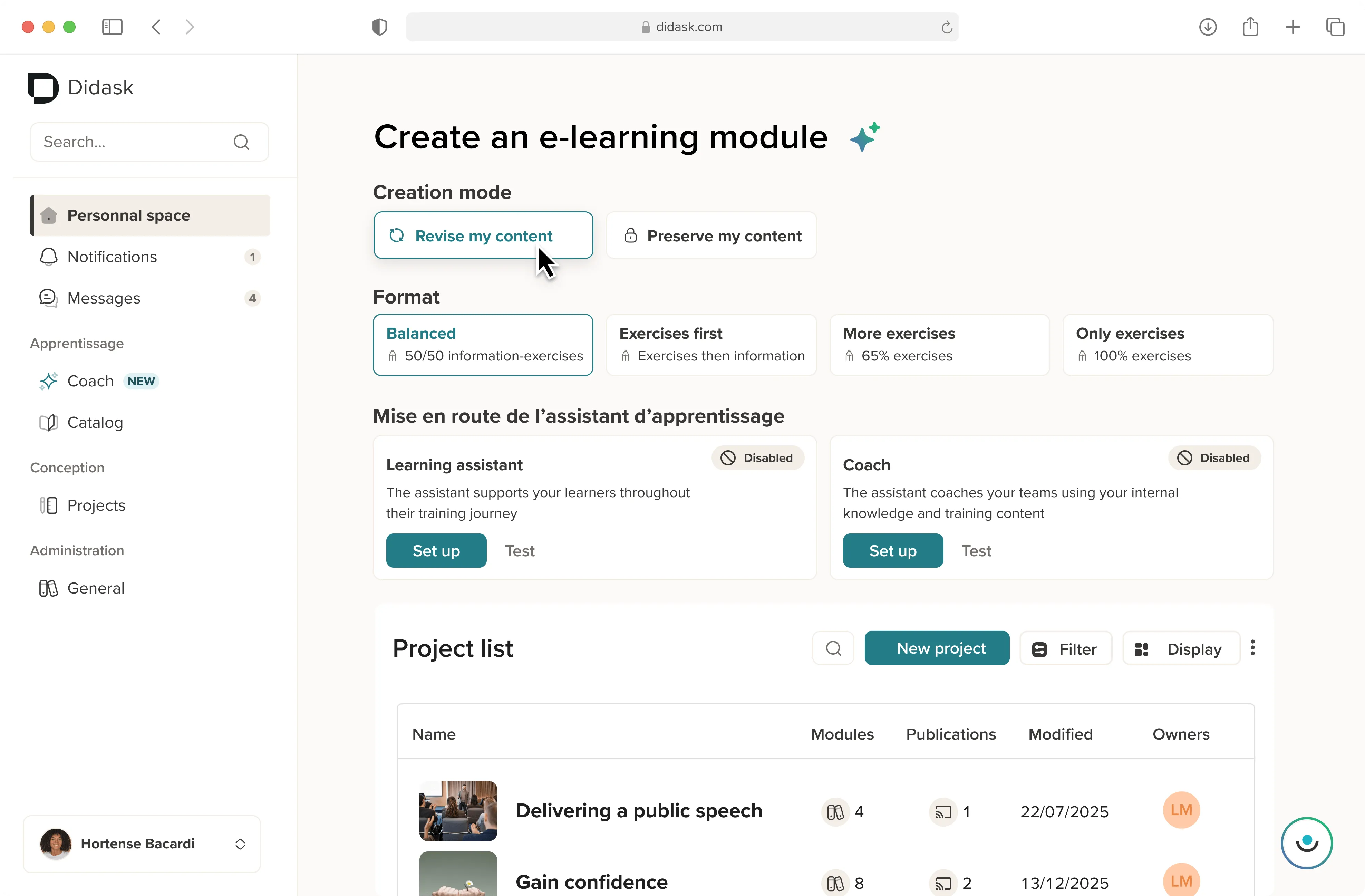
The Didask LMS tool lets you:
- Centralize all regulatory training
- Schedule automatic reminders
- Track employee progress
- Generate certificates or proof of training
- Ensure every essential training course is completed and archived
An AI assistant for effective oversight
Thanks to its AI assistant, Didask guides you through managing your obligations: suggesting learning paths, prioritizing actions, flagging compliance risks... a real time saver and a source of legal security for the employer.
An authoring tool to create your own tailored content
With the Didask authoring tool, easily build custom modules tailored to your company's or sector's specific needs. An ideal feature for adapting prevention messages, for example.
Smart learning paths powered by pedagogical AI
Didask's pedagogical AI personalizes learning, even for required training. It identifies gaps and offers adaptive pathways (adaptive learning) to strengthen knowledge retention.
A catalog of ready-to-use training courses
The Didask training catalog includes ready-to-use content written by experts in their field, covering topics such as safety, harassment, risk prevention or data protection (GDPR). Enough to quickly cover essential needs without mobilizing internal resources.
Mandatory corporate training is not just a legal formality: it is a strategic issue for the health, performance and compliance of organizations. To meet the requirements of the Labor Code while supporting the evolution of jobs, every employer must build these actions into a sustainable, structured approach.
With innovative tools such as the Didask LMS, enhanced by pedagogical AI, the authoring tool and the AI assistant, managing mandatory training becomes fluid, traceable and efficient. It is the promise of learning that is professional, useful and aligned with legal obligations.
.webp)
.webp)
.webp)

.webp)




.png)