

Qualiopi quality certification, established by the "Avenir professionnel" law of September 5, 2018, has become an essential mark of quality for any certified training organization seeking access to pooled funding. This certification mark, issued by an accredited certifying body under the national quality standard, determines access to public funds for training activities. At Didask, an online training platform specialized in LMS solutions based on cognitive science, we support organizations in their certification application with a data-driven approach perfectly suited to the requirements of this quality label and to setting up comprehensive support.
Understanding Qualiopi certification
What is Qualiopi certification?
Qualiopi certification, resulting from the vocational training reform codified in the labor code by the Ministry of Labor, is a mark that guarantees the quality of the processes implemented by providers of skills development actions. This labeling, defined by decree and ministerial order, is based on 7 precise quality criteria grouping 32 indicators, aimed at ensuring quality training for learners.
A Qualiopi-certified training organization guarantees a recognized level of quality that allows client companies to have their training courses financed through public schemes such as the CPF (Personal Training Account), Pôle Emploi or the OPCOs. This certification is also a mark of credibility for trainees and apprentices.
Why is Qualiopi certification mandatory?
Since January 1, 2022, the certification obligation applies to all organizations wishing to offer training courses financed by public funds. This legal obligation, set out in a specific decree from the Ministry of Labor, aims to improve the quality of services and strengthen the recognition of vocational training in France.
Uncertified providers can no longer have their training courses financed by public funders, making this certification essential to maintain their training activity. This implementation of the certification obligation helps ensure the State has visibility over the quality of the training provided and helps develop a common quality standard.
.webp)
Good to know
Qualiopi certification is valid for 3 years and requires a surveillance audit between 14 and 22 months after the initial certification audit. The certification cycle also includes additional audits if minor non-conformities are detected.
How does Didask make the certification process easier?
Alignment with Qualiopi's 7 quality criteria
Our LMS platform, designed to serve learners, offers powerful tools to meet Qualiopi's criteria in an optimal way:
1. Conditions for informing the public about training courses
- Transparent, detailed communication about training courses
- Clear visibility of objectives and expected outcomes
- Precisely defined access procedures
2. Precise identification of training objectives
- Clear definition of learning objectives
- Adaptation to the needs of beneficiary audiences
- Integrated skills assessment
3. Adequacy of pedagogical, technical and supervisory resources
- Appropriate resources and teaching materials
- Qualified supervision by expert teams
- Implementation of advanced technologies
4. Conditions for reception, support, monitoring and evaluation
- An environment conducive to learning
- Personalized learner monitoring
- Continuous, adaptive evaluation
5. Adapting services to beneficiaries
- Personalization based on specific needs
- Adaptive learning based on cognitive science
- Contextualized learning
6. Taking beneficiary feedback into account
- Integration of learner feedback
- Continuous improvement of training courses
- Measured and analyzed satisfaction
7. Delivery of the service
- Effective achievement of learning objectives
- Tracking of skills acquired and progress
- Validation of skills developed
Our technology powering smart analytics
Didask, with its tool, stands out through its advanced smart analytics. These tools enable precise tracking at two essential levels and make it easier to conduct Qualiopi audits:
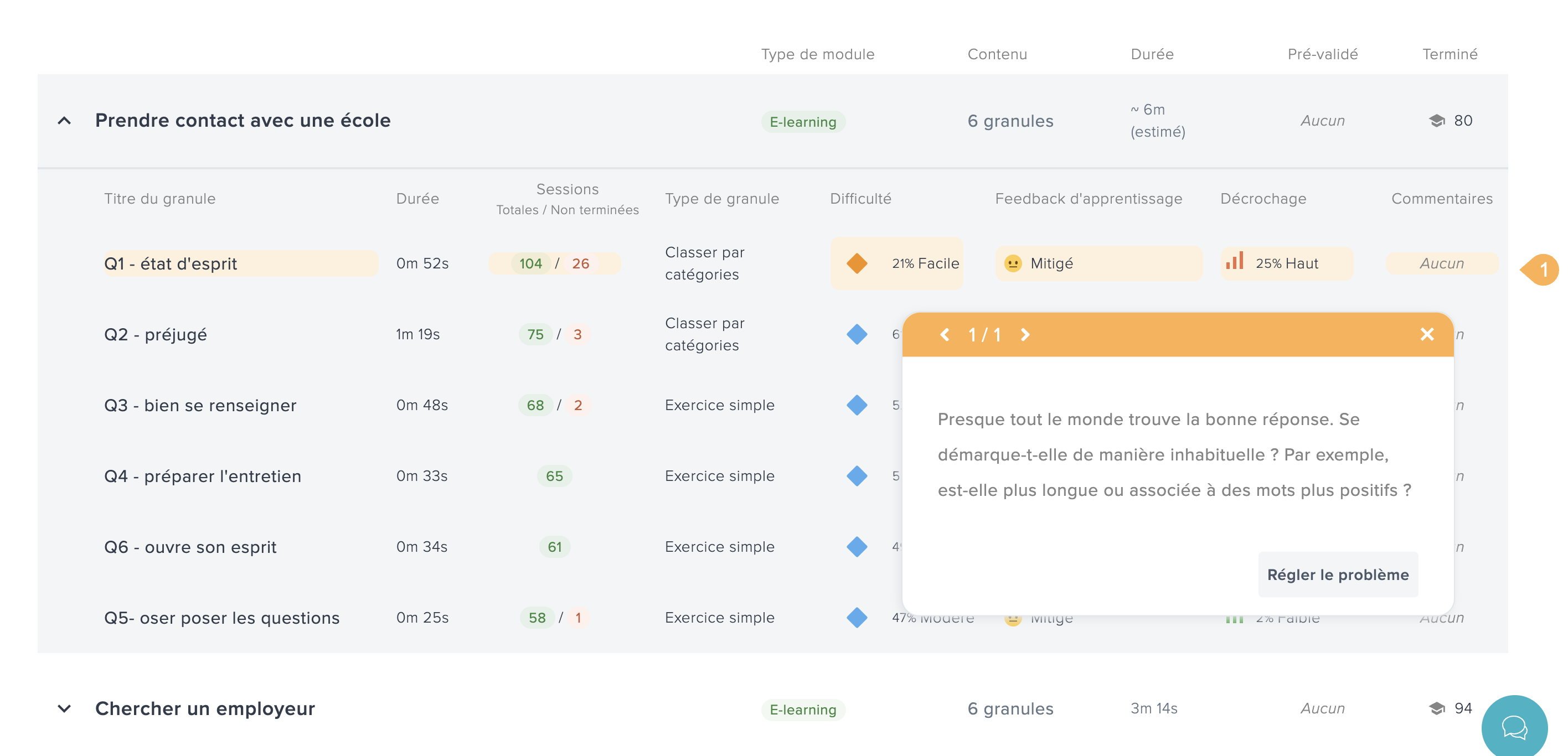
At the level of each piece of training content: Didask's analytics provide detailed insights into the effectiveness of each module, allowing trainers to understand exactly which aspects are working well and which need adjustment. This information is useful for preparing audits and demonstrating pedagogical quality.
At the level of each learner: This individualized approach makes it possible to track progress and areas of difficulty, offering a complete view of training effectiveness as well as managing the assessments and certifications needed to obtain Qualiopi certification. The provider can thus set up personalized tracking that meets auditors' expectations.
In addition, Didask's smart analytics include algorithmic recommendation features. For example, if a high percentage of learners answer a question incorrectly in a short time, the algorithm detects this pattern and suggests rephrasing the question to improve clarity and pedagogical effectiveness. These features are particularly relevant in the context of Qualiopi, where training effectiveness and adaptation to learners' needs are key criteria. Thanks to these tools, training organizations can not only ensure compliance with Qualiopi standards but also continuously improve the quality of their educational offering.
5 key steps to getting certified with Didask
1. Analysis of training needs
Precise identification of each organization's specific needs. Didask offers a pedagogical audit carried out by experts such as Svetlana Meyer, a cognitive science researcher. This audit provides valuable insights for optimal planning of the certification path, ensuring alignment with the 32 indicators of the quality standard. This essential first step helps identify areas to develop and prepare the application with the certifying body.
2. Adapting instructional content
Creating or adapting new instructional content based on the initial analysis. Didask's pedagogical AI plays a key role, ensuring content is produced quickly, aligned with Qualiopi requirements and designed to maximize learner engagement. This content update allows for a personalized approach tailored to each learning situation.
3. Implementing evidence-based teaching methods
The platform incorporates scientifically validated pedagogical approaches: trial-and-error learning, smart repetition, and flashcards to help anchor key concepts in learners' memory. These methods are particularly recommended in the Qualiopi reading guide for their proven effectiveness.
4. Tracking and evaluating results
The integrated tracking (smart analytics) and evaluation tools make it possible to measure training effectiveness and ensure alignment with Qualiopi standards. The generated report makes auditors' work easier during the audit and demonstrates compliance with quality indicators.
5. Continuous improvement
Thanks to the analysis of training data and support from our pedagogical engineers, organizations can continuously refine their programs to meet changing learner needs and Qualiopi's evolving requirements. This approach guarantees a permanent update of pedagogical practices.
Qualiopi: what costs should you plan for?
Certification costs
The initial audit: A thorough first review of training practices to determine whether the organization meets Qualiopi criteria. Costs range between €1,500 and €2,500, depending on the size of the organization and the complexity of its needs. This audit is carried out by a certified auditor from a COFRAC or AFNOR Certification accredited body.
The surveillance audit: Carried out 14 to 22 months after the initial audit to ensure ongoing compliance. Costs generally range between €1,000 and €2,000. This audit checks that standards are being maintained and can identify minor non-conformities requiring corrective action.
Other associated costs
Support during the process: Consultant services, training and mock audits to prepare for the Qualiopi audit. Costs starting from €2,000 depending on the scope of services required. A detailed quote makes it possible to precisely estimate support needs.
Human cost: Time spent by internal staff preparing for certification, including team training and setting up procedures.
Administrative fees: Filing the application, declaring training activity, updating the registration number (NDA) with the relevant authorities.
How can you optimize these costs with Didask?
Investing in a platform like Didask proves extremely beneficial. By providing tools for effective certification preparation, Didask helps reduce the costs of external support and the human effort required. The platform enables rapid program design, effectively aligning practices with Qualiopi standards.
Didask adaptive learning: personalizing your certified training courses
Our platform allows for the personalization of learning paths through adaptive learning, a key aspect of learner engagement. Following a positioning test (optional, can be disabled with one click), each learner benefits from training adjusted to their specific needs, without suffering from impersonal content.
Verification and recognition of certification
How do you check whether an organization is Qualiopi certified?
To verify that an organization does hold Qualiopi certification, several methods are available:
- Checking the official public list of certified organizations on the Ministry of Labor website
- Verifying the Qualiopi certificate directly with the certifying body (AFNOR Certification, COFRAC, etc.)
- Checking the activity registration number (NDA) on the official website
- Checking the directory of certified companies
- Verifying the accreditation of the certifying body with the relevant authorities
This verification step is recommended before choosing a training provider, since it guarantees access to public funding and ensures the quality of the service.
Validity period and renewal
Qualiopi certification is valid for 3 years. A renewal audit must be scheduled before expiration to maintain the use of the Qualiopi mark and continue benefiting from public funding. The certification cycle includes:
- Initial certification audit
- Surveillance audit (14-22 months after the initial audit)
- Renewal audit (before the 3-year expiration)
Certifications obtained before January 1, 2021
Due to the health crisis, Qualiopi certifications obtained before January 1, 2021 benefit from an exceptional 4-year cycle (instead of 3). The surveillance audit must take place between the 14th and 28th month following the initial audit, and the renewal audit must be scheduled during the fourth year of validity. This provision is set out in Article 2 of decree no. 2020-894 of July 22, 2020, confirmed by the order of July 24, 2020.
This periodicity helps ensure continuous improvement and maintain funders' confidence in the quality of the services offered.
Conclusion
Qualiopi certification represents a significant opportunity for training organizations to demonstrate their commitment to quality. Didask, with its learner-centered platform, its pedagogical AI and its advanced smart analytics, offers an invaluable tool for achieving and maintaining this certification.
By integrating technologies based on cognitive science, Didask not only helps simplify the certification process, but also continuously improve the quality of the learning experience.
If you would like to explore how Didask can transform your approach to vocational training and support you in obtaining Qualiopi certification, we invite you to get in touch with us.
.webp)
.webp)

.webp)




.png)