


Every year, thousands of companies train their teams on diversity and inclusion. The indicators barely move. The problem is not the organisation's commitment: it is instructional. A one-off awareness session produces buy-in in the moment, rarely a lasting change in practice. Research documents this gap precisely, and points to what works. This guide covers your legal obligations, the topics to address, the available formats, the design principles and the indicators that measure real impact.
Diversity and inclusion training: what research says about its effectiveness
Diversity and inclusion training pursues two distinct objectives. Raising awareness of the issues on one hand, building applicable professional skills on the other. Confusing the two explains most failures.
The reference meta-analysis, Bezrukova et al. (2016), aggregated 260 independent samples (Psychological Bulletin, 142(11), 1227-1274). Its conclusions leave little room for doubt.
Effects on reactions and attitudes erode over time. Effects on cognitive learning, understanding a mechanism or spotting a risky situation, remain stable and sometimes improve.
Three conditions clearly increase a programme's impact:
- training spread over time, rather than a single session;
- content that works on awareness and operational skill;
- an approach backed by other actions: recruitment, HR policy, management.
In other words, the half-day awareness session is not a bad idea. It is an incomplete one: it produces emotion, not reflexes.
This gap has a name. It is the illusion of mastery, a close relative of the Dunning-Kruger effect: after an engaging session, everyone overestimates their ability to act well in a real situation.
What the law requires, and what it is not enough to produce
In France, article L1131-2 of the Labour Code sets a precise obligation. In any company with at least 300 employees, and in any recruitment agency, staff responsible for recruitment must receive training on non-discrimination in hiring at least every five years.
This obligation targets the best documented friction point: the recruitment process. That is where bias produces the most measurable effects, from screening applications to the final decision, including how interviews are conducted.
Beware of the minimal reading, though. One session every five years satisfies the legal framework; it does not transform a recruitment practice.
Companies that get results treat the obligation as a foundation, never as a goal. They add structured interview guides, objectified evaluation criteria and regular reminders.
Other frameworks overlap depending on your situation: disabled worker employment quotas, the gender equality index, CSR commitments. That last strand is best handled consistently with your CSR training, rather than in a silo.
The five topics to cover in a diversity and inclusion programme
A complete programme covers five areas. Each involves different work situations, and therefore distinct modules.
- Unconscious bias and recruitment: spotting the mechanisms that steer a decision without the person noticing, then neutralising their effects through the process.
- Disability and accessibility: understanding disability situations, knowing the possible adjustments, being able to talk about them without awkwardness. A topic where prejudice weighs more heavily than actual constraints.
- Gender equality: pay, access to senior positions, parenthood, sexist behaviour.
- Cultural diversity and origins: working in multicultural teams, avoiding projections, adapting your communication.
- Age and intergenerational work: tackling ageism and getting junior and senior profiles to cooperate.
Two audiences need a reinforced track. Managers first, because they arbitrate daily: evaluation, allocation of assignments, promotions. Here inclusion is squarely a matter of managerial skills, not personal sensitivity.
HR and recruitment teams next, because they own the processes that produce, or correct, the gaps observed.
Everyone else needs a shorter common foundation. Understanding the legal framework, recognising a problematic situation, knowing how to report it.
In-person, e-learning, scenarios: which format for which objective
Each format has a precise use. Stacking them without intent remains the best way to dilute the message.
- Asynchronous e-learning: the common foundation deployed at scale. Remotely accessible, measurable, with no scheduling constraint.
- Scenarios and practical cases: the most effective format for training decision-making. Learners face an ambiguous case before being given the rule.
- In-person or virtual classroom workshops: useful for opening up discussion and handling objections, hard to deploy across thousands of people.
- Individual coaching: reserved for managers and diversity officers, on their real situations.
The choice rests on two criteria: the number of people concerned and the level of proficiency expected.
A regulatory foundation for 3,000 employees calls for digital. Upskilling 40 recruiters justifies intensive practice.
The in-house format keeps a decisive advantage. The cases discussed are yours (your job postings, your processes, your roles), not generic examples.
Designing a module that changes practices: five cognitive principles
Cognitive science provides design rules that apply directly. Five principles make the difference.
1. Start from the situation, not the definition. Open with an ambiguous work case: two applications to choose between, a comment made in a meeting. The rule comes afterwards, once the need exists.
2. Create desirable difficulties. These are deliberate obstacles, such as testing yourself rather than rereading, or answering before having the solution, which slow learning down in the moment but strengthen lasting retention.
3. Give personalised feedback. A plain "wrong" teaches nothing. An explanation that names the bias at work in the chosen answer does.
4. Space out and reactivate. The meta-analysis cited above confirms it: duration makes the difference. A few targeted reminders at three and six months beat one dense session.
5. Design for accessibility from the start. Subtitles, contrast, keyboard navigation: inclusion training that is not accessible discredits itself. This is the principle of universal design for learning, a direct extension of an inclusive pedagogy that leaves no profile behind.
These principles address a problem identified by Benjamin Bloom in 1984 (The 2 Sigma Problem, Educational Researcher, 13(6), 4-16). A learner supported one to one reaches a level of mastery that group training cannot deliver.
Individual tutoring remained impossible to deploy at scale. Instructional AI makes it accessible: every employee gets support calibrated to their level and their mistakes.
Measuring the real impact of your diversity and inclusion training
Completion rate measures nothing. It shows the training was taken, not that it produced an effect.
Three levels of indicators deserve tracking:
- Learning: scores on application activities, progress between entry and exit of the pathway, results on spaced reminders.
- Behaviour: share of interviews conducted with a structured guide, pass-through rates of applications at each stage of the recruitment process, number of reports handled.
- Organisation: gender split by hierarchical level, promotion rate by population, employment rate of people with disabilities, comparative turnover.
Set the measurement before deployment, not after. Without a starting point, no gap can be interpreted.
One frequent trap is worth flagging. A rise in reports is not a deterioration of the working climate. It is often the first sign that an inclusion policy is working, because people feel able to speak up.
These behavioural indicators are the only ones that make it possible to measure a real training ROI. They do, however, require a tool able to track application, not just content consumption.
Rolling out your diversity and inclusion training with Didask
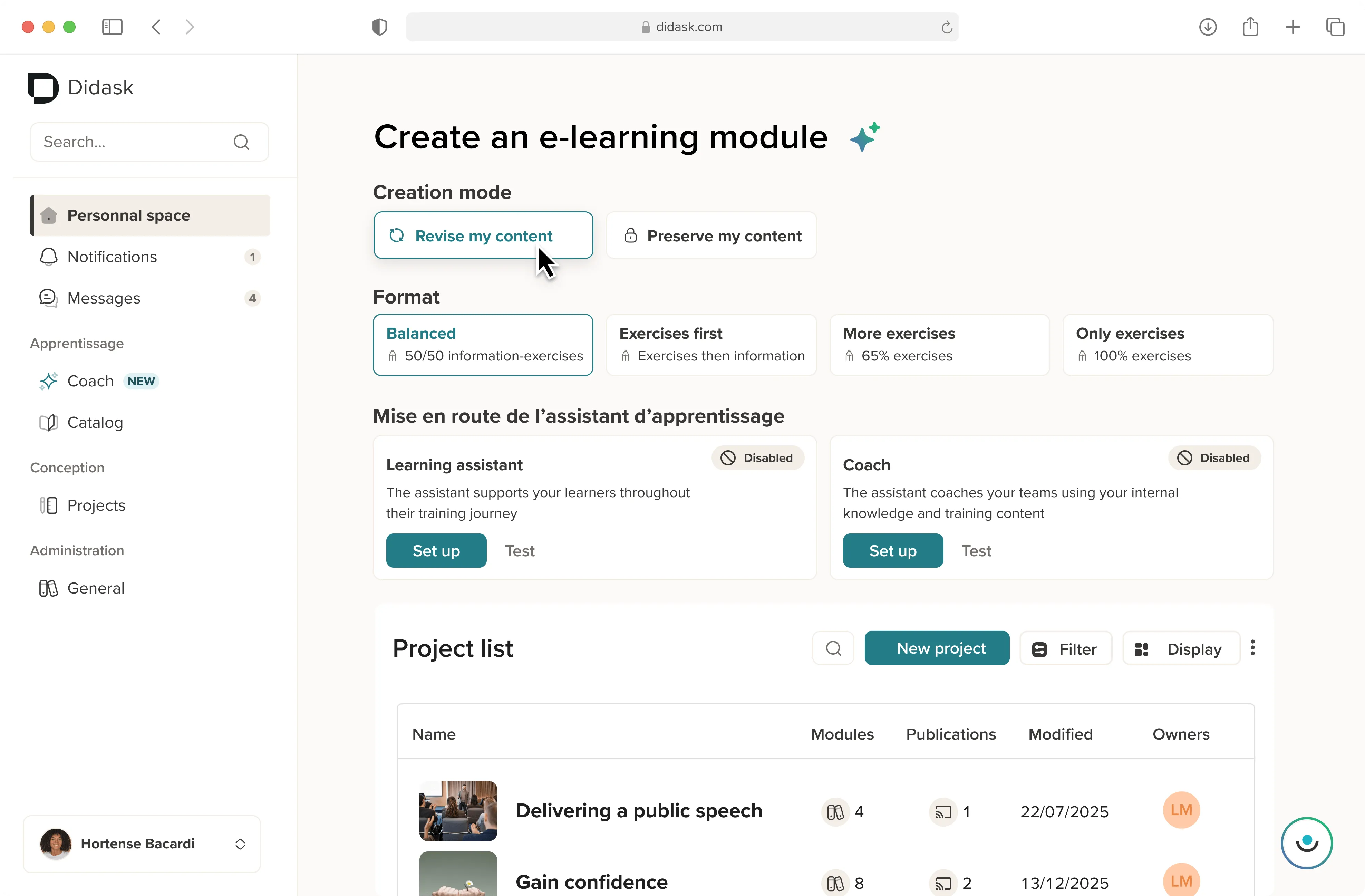
Didask is an all-in-one training platform grounded in cognitive science. It brings design, delivery and impact measurement together in one place, without stacking up LMS-type tools.
Didask Training turns your raw content (charter, recruitment procedure, internal cases) into learning sequences centred on concrete application. Instructional AI automatically structures that content along the principles detailed above.
The results are measured and sourced:
- 94% of learners say the training is useful in their actual work (1,780 learners, Nov. 2025);
- 50% to 65% less design time (2,237 training courses, Oct. 2025);
- 83% of designers had never created a module before and are now autonomous (8,704 learners, June 2023).
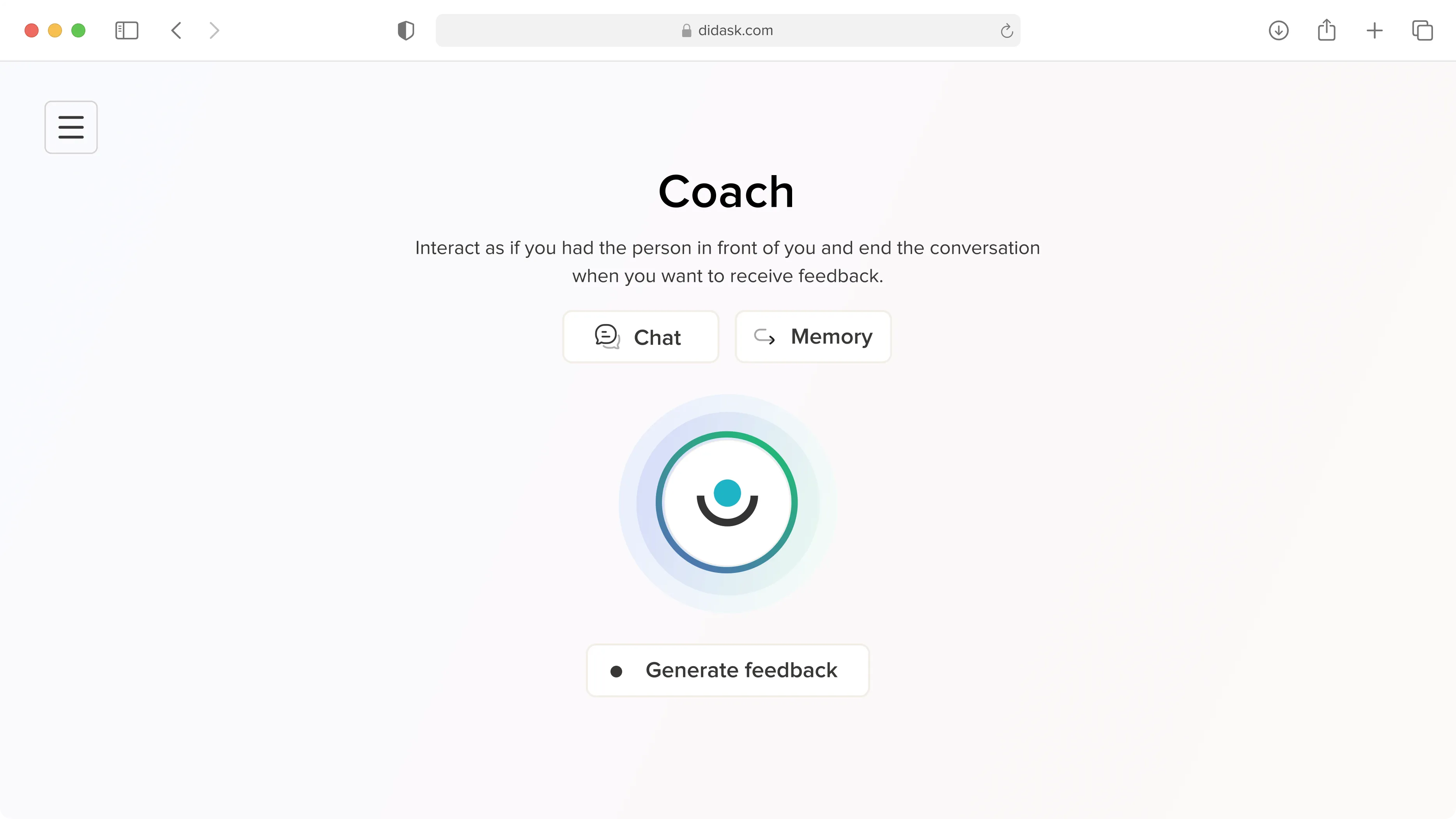
Didask Coaching takes over after the training. An AI coach answers in the flow of work, at the exact moment the question arises: "can I ask this in an interview?".
84% of learners find its answers consistently relevant and contextualised (410 learners, Nov. 2025). This is precisely the duration condition identified by research.
This logic applies well beyond diversity. It holds for any skill that has to translate into concrete decisions in the field.
Conclusion
Effective diversity and inclusion training is not judged by the number of enrolments. It is judged by what changes in your recruitment, evaluation and management decisions.
Three levers make the difference. A legal framework treated as a foundation, a design grounded in cognitive science, and support that lasts beyond the session.
.webp)
.webp)
.webp)

.webp)




.png)