


As organizations and school environments increasingly want to take into account the diversity of their learners and students, a new approach to instructional design is emerging: the Universal Design of Learning (UCA). This method radically transforms our vision of teaching and education by drawing on decades of research in neuroscience and cognitive sciences, thus offering a concrete answer to the challenges of inclusive education.
What is universal learning design?
Definition and origins
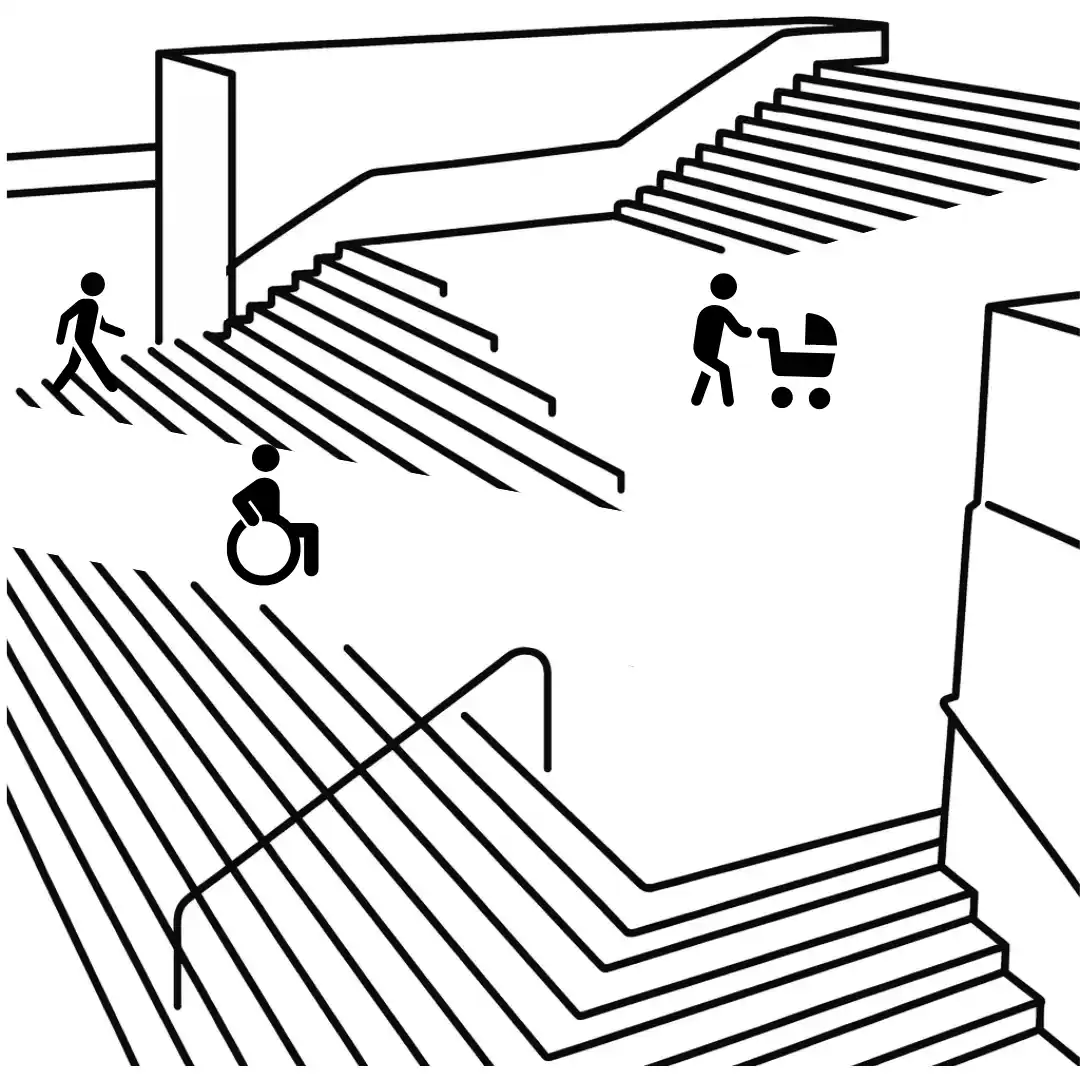
The Universal Design for Learning (UDL), is a scientific educational framework developed by the Center for Applied Special Technology (CAST) in the 1990s. This educational approach is inspired by the architectural concept of “universal design”: designing environments that are accessible to all at the time of design, rather than adding adaptations afterwards.
Like a ramp integrated into a staircase, which would simultaneously benefit people with disabilities, parents with strollers and travelers with suitcases, the UDL aims to create learning solutions that naturally benefit all learners, thus promoting academic inclusion and universal accessibility in the classroom.
The neuroscientific bases
The scientific foundations of UDL are based on research in cognitive neuroscience and cognitive psychology. David Rose and Anne Meyer, leading authors in this field, have thus shown that the human brain processes learning via three distinct neural networks:
- Recognition networks : identify and understand perceived information
- Strategic networks : plan and execute learning actions
- Emotional networks : maintaining commitment and motivation
This neurological architecture forms the scientific basis of the three principles of the UDL, making it possible to manage the heterogeneity of needs in the classroom.
The three fundamental principles of the UDL
Principle 1: Several means of representation (Recognition networks)
This essential principle consists in presenting students or learners with the same information in different formats: text, audio, video, diagrams, infographics, etc.
This holistic approach recognizes that information can be perceived and understood in multiple ways, making it possible to meet the varied needs of each student.
Practical applications in the classroom:
- Various visual supports (tables, posters, chalkboard diagrams)
- Oral explanations accompanied by gestures and demonstrations
- Documents that respect accessibility rules
- Provision of manipulable equipment
- Specialized vocabulary definitions posted all the time
Practical online applications:
- Content available in multiple formats (text, audio, video)
- Interactive infographics for complex concepts
- Automatic transcriptions for audio media
- Subtitles and descriptions for video content
- Integrated glossaries with contextual definitions
Principle 2: Several means of action and expression (Strategic networks)
This principle consists in offering learners different ways to demonstrate their knowledge and skills.
This flexibility in teaching recognizes that mastering a concept and expressing it are two distinct processes, a point of particular importance for pedagogical differentiation.
Practical applications in the classroom:
- Oral presentations in front of the class as an alternative to written assignments
- Practical projects and artistic creations
- Physical or experimental demonstrations
- Possibility of team or individual achievements
- Assessments through direct observation of competencies
Practical online applications:
- Various digital assessment formats (quizzes, portfolios, videos)
- Built-in media creation tools
- Possibility of audio/video recordings
- Provision of collaborative tools for remote group projects
- Peer review systems
Principle 3: Several means of engagement (Affective networks)
This principle proposes different teaching strategies to maintain learners' motivation and interest.
This student-centered approach recognizes that the sources of motivation vary between contexts and individuals, thus promoting the participation of all.
Practical applications in the classroom:
- Choice in subjects of study and working arrangements
- Connections to students' personal experiences
- Appropriate challenges at the individual level
- Group or individual activities according to preferences
- Projects related to local and community interests
Practical online applications:
- Adaptive courses depending on the level and preferences
- Reasoned gamification
- Thematic discussion forums
- Choices in additional resources
- Personalized recommendation system
Implementation challenges and their solutions
Common challenges
The implementation of the UDL raises practical challenges that explain the resistance of educational institutions. The time challenge is the most frequent obstacle: creating content according to the principles of the UDL can greatly increase the initial preparation time of teachers.
Effective implementation strategies:
- Progressive approach : transform one activity, one task or one module at a time
- Smart reuse : use existing educational resources in different formats
- Collaboration between teams : sharing development costs
- Teacher training : professional support to develop these skills
Challenges specific to classroom instruction
Managing heterogeneity in the classroom presents particular challenges related to physical space and group management. Teachers must simultaneously orchestrate different learning modalities in the same place.
Solutions for the classroom:
- Flexible spatial organization : flexible spaces according to activities
- Specialized educational equipment for elementary and secondary school
- Time Management : planned alternation between individual and collective modalities
- Reusable templates : business models that can be quickly adapted
Challenges specific to online education
The technical challenge represents the major obstacle for online training. Creating accessible digital content requires specialized skills in digital instructional design and web accessibility.
Technology solutions and resources for online training:
- Artificial intelligence for the modification, adaptation or simplification of already existing content
- Creation tools adapted learning materials
- Automatic generators subtitles and transcripts
- Voice synthesizers professional quality
How the UDL promotes inclusion
Beyond the traditional medical model
The universal design of learning is revolutionizing our understanding of inclusive education by going beyond the traditional medical view of disability. Historically, educational institutions have approached diversity according to a deficit model: identifying individual “problems” and responding to them with special accommodations. The UDL takes a different perspective by recognizing that it is the learning environment that creates barriers, a revolutionary idea for inclusive schooling.
Proven universal benefits
This transformation generates benefits that go beyond the initially targeted population. Research, particularly in the International Journal of Inclusive Education, shows that accommodations designed to meet specific needs benefit all learners, thereby promoting the success of all students.
Examples of universal benefits identified by research:
- Improving outcomes for all students
- Revealing competencies masked by unique assessment constraints
- Reducing the overall dropout rate
- Better management of heterogeneity in the classroom
- Development of sustainable inclusive practices
The normalization of diversity
Authentic inclusion is achieved by reducing the stigmas associated with traditional adaptations. In a system where everyone has multiple options, no one is “different” or “special.” This standardization is transforming institutional culture by creating an environment where individual differences are perceived as natural variations, a principle at the heart of the inclusive aim of the UDL.
Explicit pedagogy and the UDL
Explicit pedagogy is particularly well articulated with the principles of universal design. This didactic approach, which seems to be gaining in popularity, proposes to make each stage of learning explicit. Prior to the session, the teacher plans a device that will gradually guide the student towards mastering skills.
This logic of clarification and support is aimed at all levels, from primary to university, and facilitates the consideration of the diversity of learners. The latest research on this topic shows that this combination is becoming essential to effectively support all students, whether they are in traditional classrooms or in online training.
Take action with the UDL
The universal design of learning is much more than just a pedagogical method: it represents a paradigm shift in the way we think about education. By considering diversity from the start, rather than adapting after the fact, this approach creates truly inclusive learning environments.
Obstacles to learning are no longer seen as individual problems, but as collective challenges to be solved by better designing teaching situations. This reflection opens up new possibilities for all learners, whether they have special needs or not, whether they are in person or remotely.
Your deployment plan
Recommended classroom steps:
- Audit of your practices : evaluate an existing session according to UDL principles
- Teacher training or self-training : become aware of neuroscience in the service of learning
- Arrangement of spaces : create flexible areas in the rooms
- Pilot project : transform an activity with support
- Impact measurement : observe changes in participation and results
Recommended steps for online training:
- Technological audit : assess the accessibility of your current platforms
- Team training : develop skills in educational engineering numerical
- Tools and resources : acquire the necessary technological solutions
- Content transformation : adapt your modules according to UDL principles
- Follow-up and optimization : analyze usage data and adjust
.webp)
.webp)
.webp)



.webp)

.png)