

Onboarding new nurses is decided before they arrive. To train new healthcare staff from their first day, three things must be ready. They need an active account, a short core module focused on patient safety, and a mentor who follows their first weeks.
It has become ongoing work. In 2023, the staff turnover rate in French nursing homes (EHPAD) reached 25.6% (CNSA, Repères statistiques no. 24, April 2025). On Didask, an all-in-one training platform, a new hire assigned to the onboarding group receives the core training as soon as their account is created.
Why Has Onboarding New Healthcare Staff Become an Ongoing Challenge?
Because teams change all the time. Onboarding is no longer a once-a-year event: it is a flow to organize all year round, for very different profiles.
In French nursing homes, turnover comes with an absenteeism rate of 11.4% in 2023 (CNSA). Replacement and agency staff therefore arrive every week. In French hospitals, 54% of hospital nurses still hold that job after ten years in their career (DREES, Études et Résultats no. 1277, July 2023). The study does not measure the effect of onboarding, but it shows what is at stake for retention.
Onboarding new staff covers everything a facility prepares so that a professional can work safely and become part of the team. It includes access, information, training and support. A permanent employee, an agency nurse, a six-month intern and a newly qualified nurse do not have the same needs.
What Are the Key Steps in Onboarding a New Healthcare Professional?
There are three stages: day one for what protects the patient, week one for the unit's tools, then six months to reach autonomy. Giving everything on day one means everything gets forgotten.
Cognitive load is the amount of information working memory has to process at the same time. It is limited (Sweller, Cognitive Science, 1988). A new nurse who receives the welcome booklet, twenty protocols and three software tools on the same day will mostly remember what they saw last.
Facilities that have structured their onboarding already work this way. At the EPSM of the Lille metropolitan area, a public mental health hospital, nurse onboarding starts with "flash" sessions on arrival: patient record and medication dispensing software, email, fire safety instructions. These are followed by a seven-day job-adaptation course, then a program spread over two years.
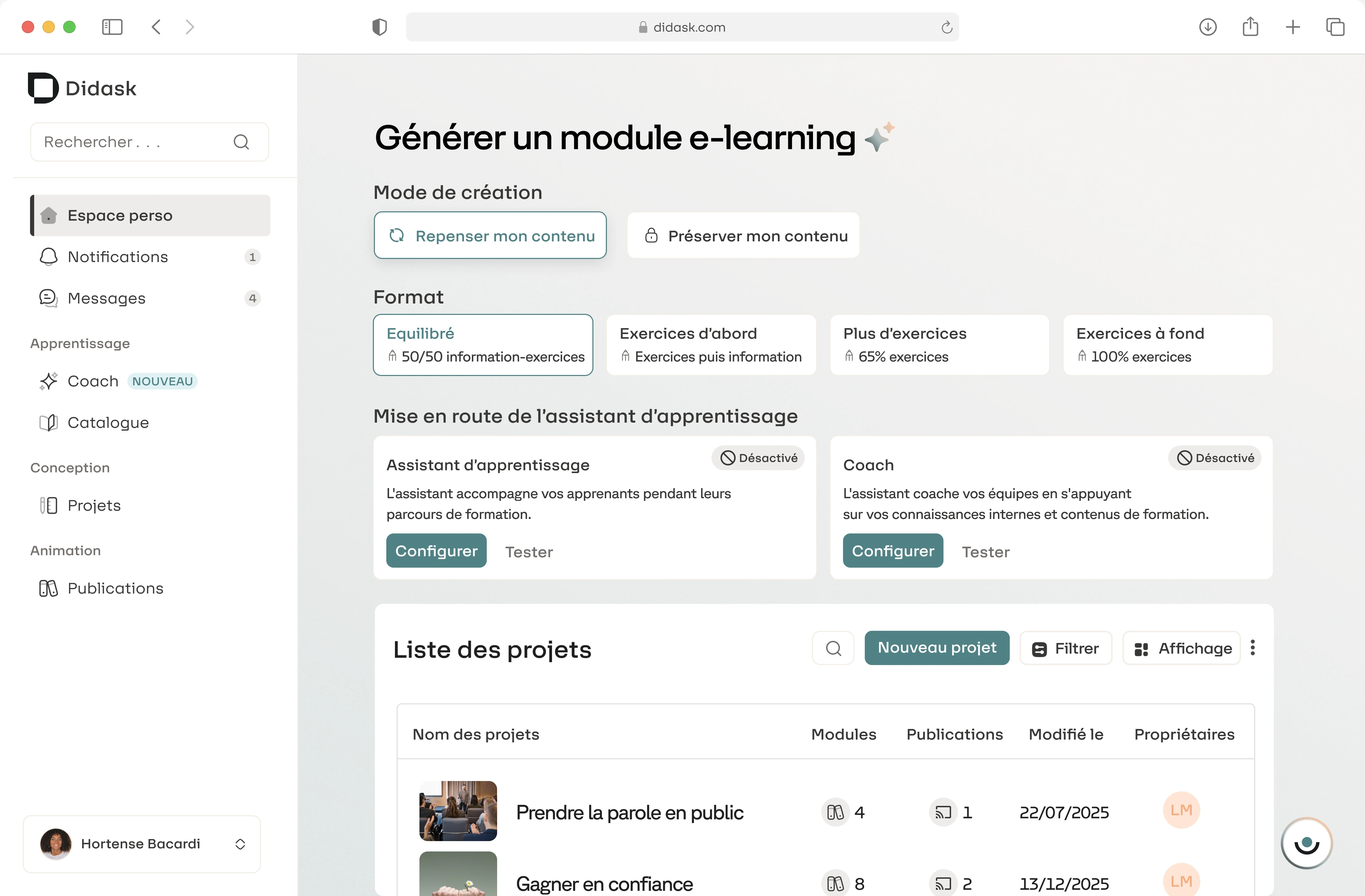
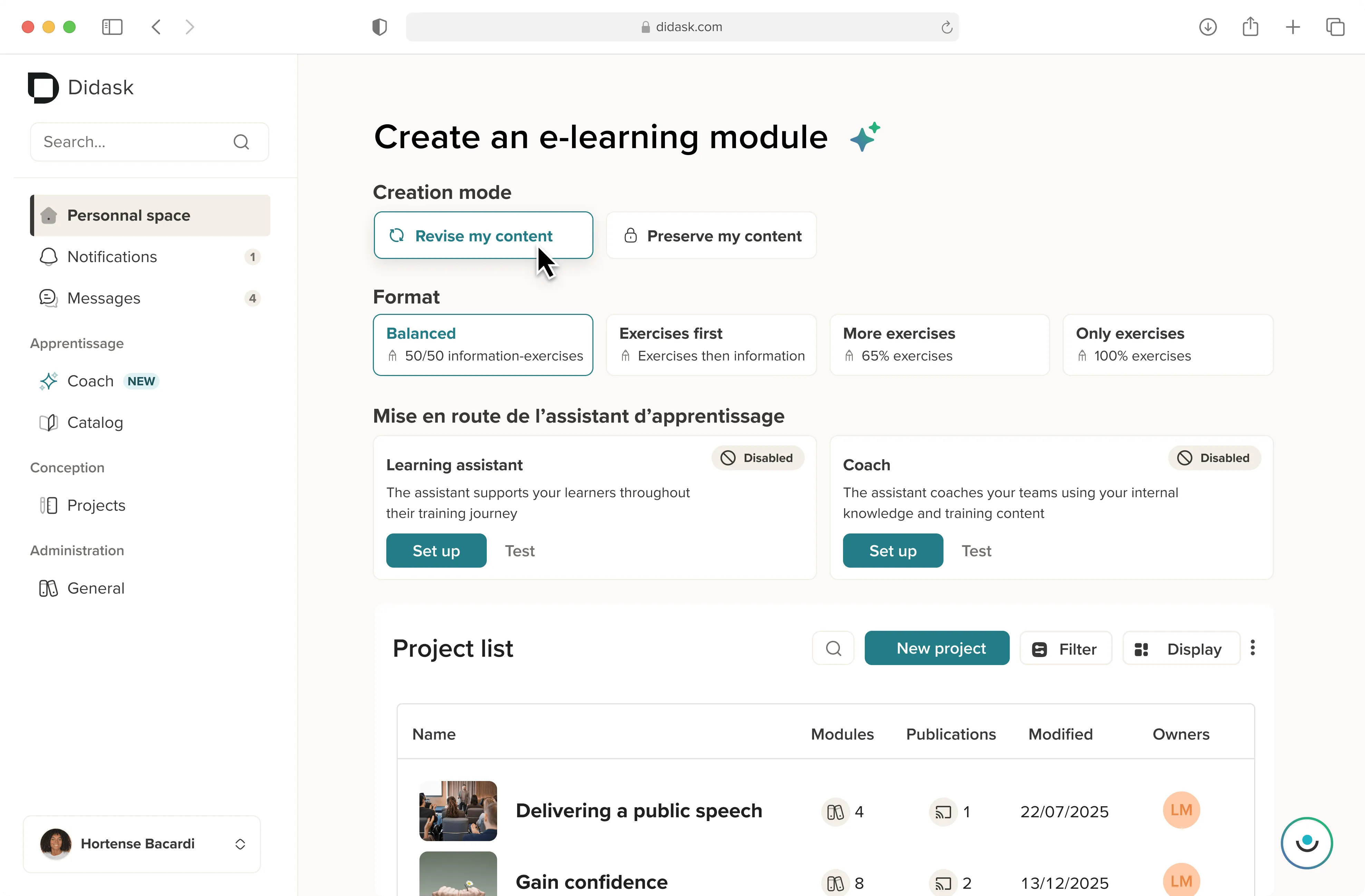
The day-one core is built from what already exists: welcome booklet, protocols, procedures. Didask cuts the time needed to design a module by 50 to 65% (measured on 2,237 courses, October 2025). Your clinical experts then review what was generated.
How Do You Give New Staff Access to Training From Day One?
Create the account before arrival and assign it to the new hires group. The core training then opens with no further action. The login method depends on the profile.
On Didask, staff log in through SAML 2.0 SSO with their directory account (Azure AD, Okta, Google Workspace), with no extra password. A whole group can be imported in one go, and an access code replaces the email address (Didask help center).
Beware of quarterly imports. A new hire then waits weeks for access they needed on day one. Align account creation with the pace of arrivals.
How Do You Onboard Temporary Staff, Agency Nurses and Interns?
With a short, reusable core, opened per cohort and closed when the contract ends. The freed-up license goes to the next person.
Interns arrive in groups, every semester: one group per intake is enough, closed at the end of the semester. Agency nurses arrive alone, often the day before: they need the day-one core, not an institutional welcome module.
On Didask, an expiration date applies to a whole group: all its members lose access on the same day (Didask help center). It suits groups of interns, not agency staff who arrive one at a time.
For agency or temporary staff, deactivate the account at the end of the assignment. On Didask, the license is then freed for another learner (Didask help center). If they come back, their reactivated account recovers all their progress and certificates.
A checklist before an agency nurse arrives fits in four points: code created, group chosen, end date of the assignment noted, mentor informed.
How Do You Assess a New Professional's Integration?
With a mentor named before arrival and check-ins on fixed dates. A completed module does not mean a nurse is integrated.
Mentoring is support given to a new professional by an experienced peer, appointed for a set period. The mentor shows the unit's practices and answers the questions the welcome booklet does not cover. The nurse manager or coordinating nurse tracks the team's progress.

Samuel Venel and Solange Brisbout, senior nurse managers, EPSM of the Lille metropolitan area
"Professional integration of newly qualified nurses is a major challenge", for quality of care as well as retention. Their facility welcomes around 80 new nurses every year ("L'intégration stratégique des nouveaux arrivants", Revue hospitalière de France, no. 614, September-October 2023). Translated from French.
Their program assesses integration with a "first impressions" report at 100 days, and a self-assessment with a skills passport at the start and end of the program. The first impressions report collects what the new hire noticed, understood or looked for in vain. It also shows what is missing from the onboarding core.
What Does HAS Certification Require for Onboarding New Staff?
Criterion 3.2-11 of the 2027 framework of France's National Authority for Health (HAS) covers new staff, including agency staff, interns and students. They must have the information and supervision they need to work and integrate (HAS, 2027 certification framework).
This standard criterion is assessed through a system audit, with management and teams. The HAS lists the welcome booklet, the onboarding day, the intranet and the website as supporting materials.
Criterion 3.2-03 adds a specific requirement: all professionals, new staff included, are informed of their duty to report adverse events. Put this point in the day-one core.
Keep named, dated proof of who completed the core, by cohort and by unit. This record-keeping for HAS certification is covered in a dedicated article.
In Summary
Prepare access before day one. On that day, give only what protects the patient, then spread the rest over six months with a mentor. Close access and reuse licenses when contracts end. To compare tools, see our comparison of onboarding LMS platforms.