

.webp)

On-the-job training (OJT) is a pedagogical method that continues to revolutionize corporate training. Unlike traditional classroom training, OJT is based on real situations allowing employees to develop their skills directly at their workstation, thus promoting their increase in professional skills.
This structured and supervised system allows an organization to implement training actions adapted to the concrete needs of learners. It contributes to the development of skills and can even be part of a certification process.
Let's explore in detail what OJT is, its legal framework, its implementation methods and the benefits it provides to a company and a learner.
What is on-the-job training (OJT)?
Workplace training, also called OJT (on-the-job training), is a pedagogical modality that allows employees to learn directly at their workplace. A 2018 law in France specifies a new definition for training action: "an educational path that makes it possible to achieve a professional objective. It can be carried out in whole or in part remotely. It can also be done in a work situation." (Art. L. 6313-2).
OJT is based on concrete situations linked to the professional activity of the company. It differs from informal training in that it is structured and supervised by a trainer. This approach is particularly effective for the development of professional skills, because it combines action and reflection on practices, and can be part of a certification process to validate achievements.
The specificities and legal framework of OJT
OJT is based on a well-defined legal framework in France. It is recognized as a training modality in its own right by the 2018 "Future" law.
To be considered a genuine training action, it must meet several criteria:
- A preliminary analysis of the activity to identify the skills to be acquired.
- A designation of a trainer (internal or external) who can exercise a tutoring function.
- Reflective phases to allow the learner to take a step back from their learning.
- A final assessment of the skills acquired.
OPCOs (Competence Operators) and training organizations can support companies in setting up this type of apprenticeship.
When and how to set up on-the-job training?
OJT is particularly suited to companies wishing to:
- Quickly train an employee in a new job or a new skill.
- Support the evolution of practices within a department.
- Facilitate the integration and development of new employees.
- Optimize the transmission of internal knowledge.
The key steps for a successful OJT
- Identify the need: define the educational objectives and the skills to be developed.
- Mobilize the stakeholders: select internal or external trainers and involve managers.
- Appoint a trainer: internal or external, to support employees in training.
- Design the course: establish educational engineering integrating situations and reflexive phases.
- Evaluate and adjust: measure effectiveness, refine training actions and validate achievements as part of a certification.
It is essential to rigorously document each step of an OJT. These elements serve as indispensable evidence to guarantee its legal recognition as a training action. Note that attendance sheets are no longer sufficient as supporting documents.
Who can be an OJT trainer?
OJT uses internal or external trainers who must be in a position to transmit their knowledge while leading adapted educational sequences.
A trainer can be:
- An experienced manager or colleague.
- An internal or external business expert.
- A training organization offering specific support.
The important thing is to ensure effective and structured support, in particular through adapted teaching tools.
The benefits of OJT for all stakeholders
OJT (on-the-job training) offers multiple benefits for employees, companies and trainers.
For learning employees
This pedagogical approach promotes engagement in training and improves the perception of learning. It makes it possible to develop concrete skills that are directly applicable in a professional situation. Learners become more aware of their achievements and know better how to manage the unexpected encountered in their work.
For businesses
OJT contributes to improving the relationship between managers and employees, by promoting the sharing of knowledge. It encourages companies to optimize their working conditions and production tools. In addition, it reduces costs by limiting the need for travel or room rentals, while integrating training directly into daily activity.
For trainers and training organizations
Trainers benefit from more accurate monitoring of learners' progress, because OJT accelerates the acquisition of skills. This method also allows them to strengthen their pedagogical and technical know-how. Training organizations, for their part, can offer support adapted to the needs of businesses, by integrating approaches such as tutoring and educational engineering.
In summary, OJT is a powerful lever for the development of skills in business, provided that training courses are co-constructed with the actors concerned.
Why use the Didask LMS platform for OJT?
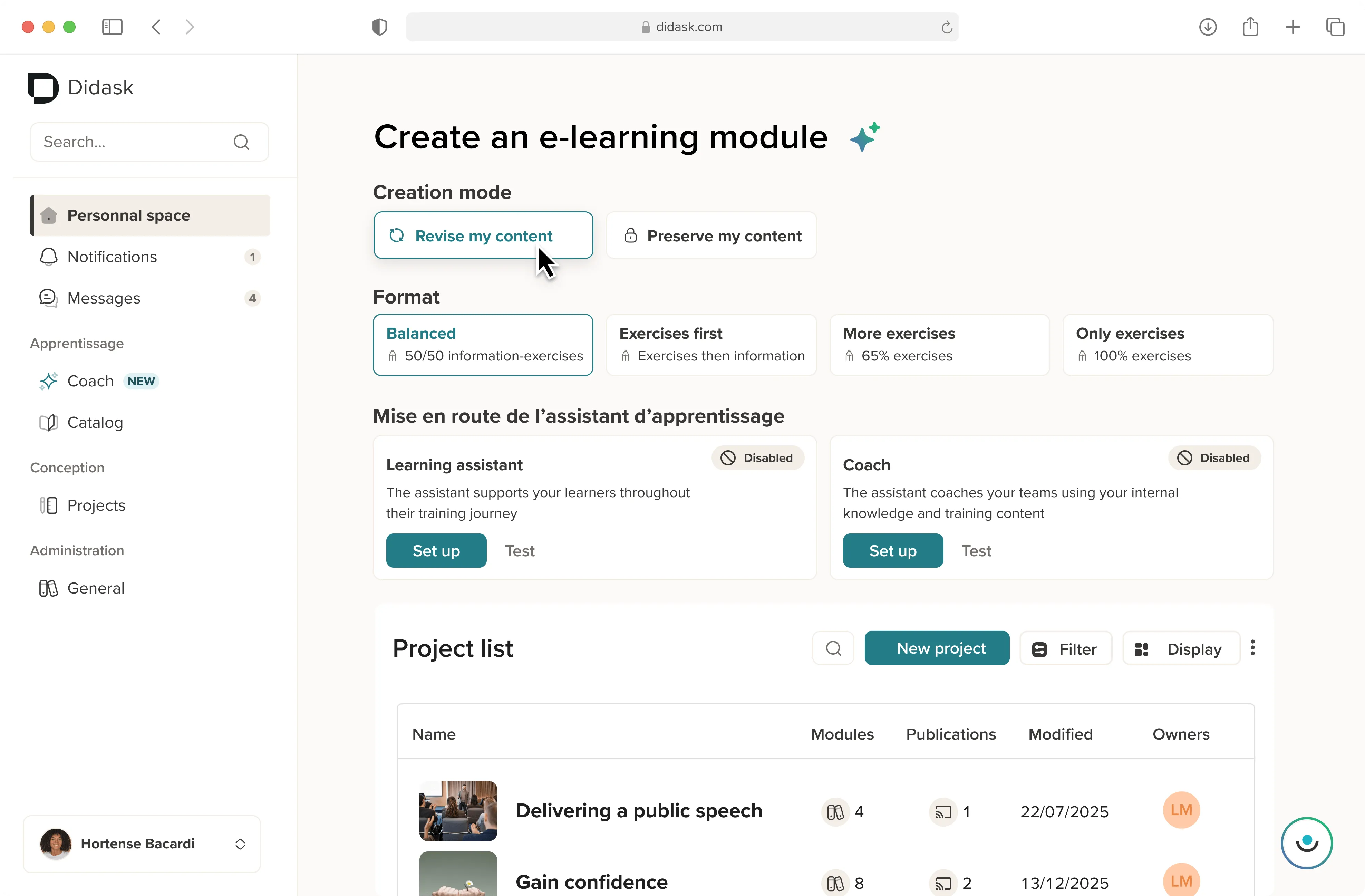
The LMS tool proposed by Didask makes it possible to optimize and supervise OJT by digitizing certain stages of the training course:
- Course design: with an authoring tool, it is possible to create engaging educational sequences.
- Support for learners: an AI assistant answers learners' questions at any time.
- Evaluation and follow-up: thanks to adaptive learning, learning is personalized according to the needs and performance of learners.
- Access to the Didask training catalog: businesses can complement OJT with existing modules.
- Creation of educational resources: the use of AI for course creation facilitates the production of relevant and personalized content.
The Didask LMS offers interactive training courses, designed to adapt to the specific needs of businesses. Thanks to its hybrid approach combining tailor-made training and pre-designed modules, it guarantees great flexibility. By relying on cognitive science, Didask promotes learning that is effective, sustainable and accessible to all.
OJT is an innovative learning modality that allows companies to effectively develop the skills of their employees by anchoring training in the reality of work. Thanks to digital tools like those offered by Didask, OJT becomes easier to structure and monitor, guaranteeing optimized and effective learning. However, do you know the differences between AFEST and LIFOW?
.webp)
.webp)
.webp)
.webp)
.webp)

.webp)



.png)