


An AI platform is a software environment that brings together artificial intelligence models, data and an interface. It lets you apply AI to concrete tasks: analysing, generating, recommending or automating.
Its use is growing fast in French companies. In 2025, 18% of companies in France with 10 or more employees used at least one AI technology, up from 6% in 2023 (Insee Première no. 2120, July 2026). Insee is France's national statistics institute.
Not all AI platforms share the same goal. This guide covers their main types and their uses in business, then what sets apart a learning-focused AI, designed to help your teams learn.
What is an AI platform?
An AI platform, or artificial intelligence platform, brings together AI models, the data that feeds them and the tools to use them. It differs from a simple AI tool through its integration with company systems and its governance.
Artificial intelligence refers to computer systems that can carry out tasks usually requiring human intelligence. Understanding a text, recognising an image or making a decision are examples.
An AI platform rests on four building blocks:
- Models: the engines that analyse, predict or generate. A large language model (LLM) is a model trained on very large volumes of text to understand and produce language.
- Data: documents, records, business databases. Their quality determines how relevant the results are.
- The interface or API: the interface is for users. An API is a gateway that lets two pieces of software exchange data automatically.
- Governance: access rights, security, confidentiality and usage tracking.
Three terms are often confused. An AI model is the engine, and an AI tool is an application that uses it for a task. An AI platform organises several tools and data sources within a controlled framework.
Two techniques appear in every platform. Machine learning lets a system learn from examples rather than written rules. Generative AI produces new content: text, images, sound, video or code.
What are the main types of AI platforms?
There are four main types of AI platforms: model development platforms, general-purpose AI assistants, enterprise AI platforms and job-specific AI platforms. The last type is designed for a specific use, such as training.
Development platforms are aimed at technical teams. They provide the infrastructure, often in the cloud, and libraries such as TensorFlow to build your own models.
General-purpose assistants are the best known to the public. They can answer almost any request, but they know nothing about your procedures, your customers or your working methods.
Enterprise AI platforms connect AI to internal data. An AI agent is a program that chains several actions to reach a goal, for example finding information and then drafting a reply.
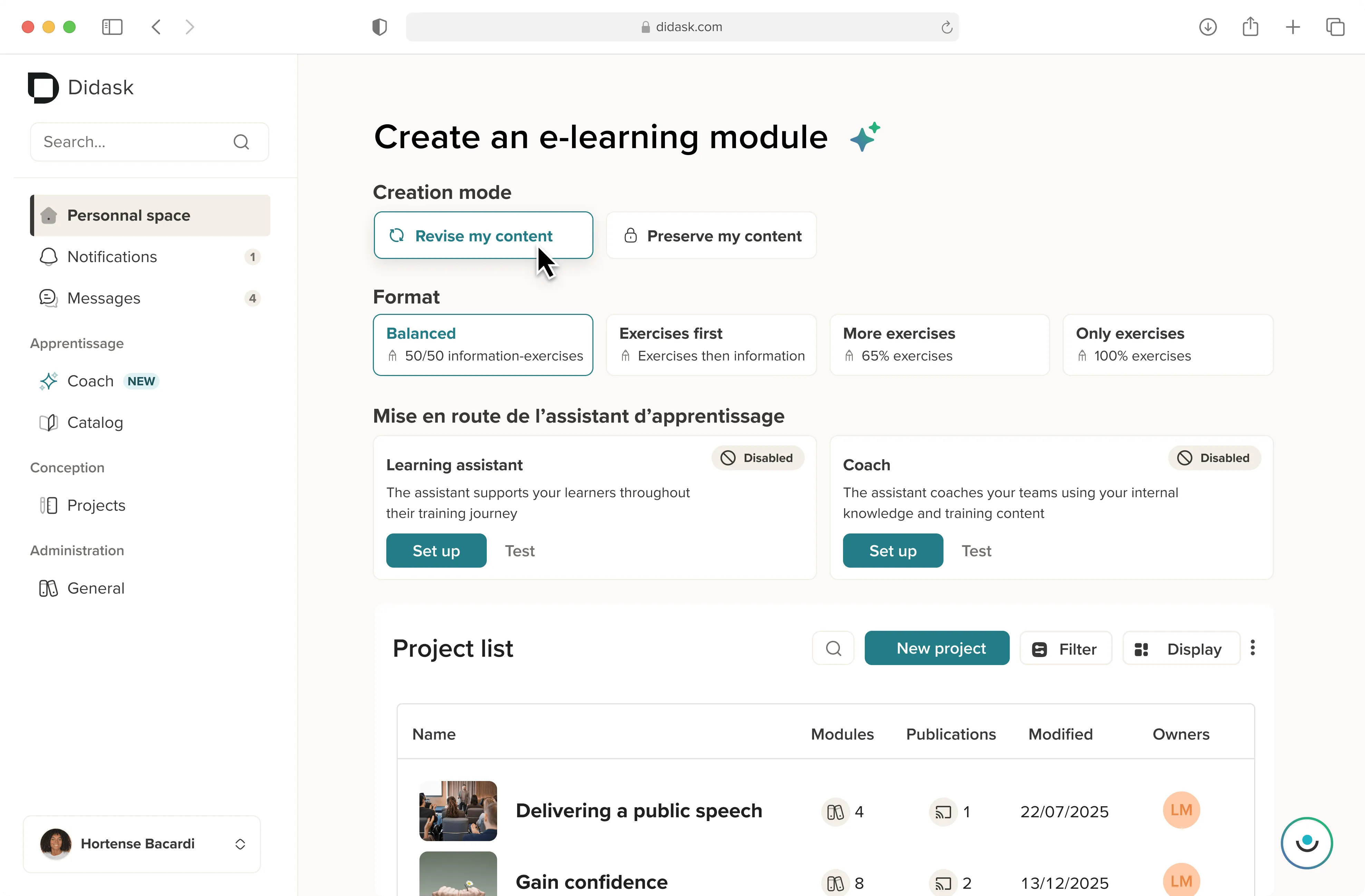
Job-specific AI platforms start from a specific problem rather than a technology. Didask is a French all-in-one training platform, grounded in cognitive science, that uses learning-focused AI to generate personalised learning paths from a company's existing content.
What is an AI platform used for in business?
In business, an AI platform is mostly used to automate repetitive tasks, analyse data, generate content and assist employees in their daily work. Training is one of the areas where it changes teams' work the most.
The most common use cases are:
- Customer relations and support: answering frequent questions and preparing replies for agents.
- Data analysis: spotting trends, forecasting demand, detecting anomalies.
- Content creation: writing, summarising, translating, producing visuals or videos.
- Internal information search: finding the right procedure in a knowledge base in seconds.
- Employee training: designing modules, getting people to practise and supporting each person when they need it.
Adoption varies widely with company size. In France in 2025, 58% of companies with 250 or more employees used at least one AI technology, compared with 15% of companies with 10 to 49 employees (Insee, 2026).
What is an AI platform for training?
An AI platform for training applies artificial intelligence to the design, delivery and tracking of training. It can aim for productivity, producing faster, or for learning, helping people learn better. That difference changes the results.
Most tools highlight production speed: a module in a few minutes, a quiz in one click. The promise is real, but it says nothing about what learners will retain and apply on the job.
Productivity AI or learning-focused AI: what is the difference?
Productivity AI is AI that speeds up the production of training content without changing how learners learn. It generates slides, quizzes or videos faster, in the same formats as before.
Learning-focused AI, which Didask calls "IA pédagogique", is AI designed from cognitive science to make each learner practise, correct their mistakes and adapt their path. It starts from how people learn, not from how content is produced.
The two approaches can coexist. The risk is mistaking the first for the second, and industrialising training that changes nothing in practice. For the everyday uses of AI by training teams, see our article on using AI for your professional training.
Why does a learning-focused AI platform help people learn better?
A learning-focused AI platform helps people learn better because it reproduces, at scale, the work of a good tutor. It makes learners practise, corrects them immediately and adapts what comes next to each person's level.
Personalised tutoring, finally at scale
The 2 sigma problem refers to the gap in results between group instruction and one-to-one tutoring, identified in 1984. Tutoring is the most effective format, but also the most expensive to roll out widely.
Benjamin Bloom, professor at the University of Chicago, measured this gap. The average student receiving one-to-one tutoring outperformed 98% of students in a conventional class (Bloom, Educational Researcher, 1984).
A learning-focused AI platform aims to make this kind of tutoring available to every employee. It does not replace the trainer: it handles the individual practice that a trainer cannot provide for everyone.
Immediate feedback on every mistake
Corrective feedback is an explanation given right after a mistake, helping the learner understand why their answer does not work. This is the moment when learning happens.
A Harvard University team compared an AI tutor built on specific teaching principles with an active-learning class. Among 194 physics students, median learning gains in the AI tutor group were more than double. The median time spent with the tutor was 49 minutes (Kestin et al., Scientific Reports, June 2025).

Learning more, in less time
"Students learn significantly more in less time when using the AI tutor. They also feel more engaged and more motivated." Greg Kestin, Department of Physics, Harvard University, lead author of the study, Scientific Reports, 2025.
This result comes from a US university and a physics course. The authors themselves state that it may not hold in every context. Their tutor followed specific teaching principles: the design of the AI, not the AI alone, produced the effect.
To explore this lever further, read our article on feedback in the age of learning-focused AI.
A learning path that adapts to each person's level
Adaptive learning adjusts content and exercises to each learner's answers. Those who master a concept move on to the next one, those who struggle get targeted practice.
This adaptation relies on mechanisms documented by research, such as the testing effect. We remember what we had to retrieve better than what we simply reread. These principles are covered in our article on cognitive science applied to learning.
Less training time for the same result
A learning path that skips what the learner already knows shortens training without narrowing its scope. Didask Training reduces training time by 60 to 75% while keeping the same learning scope (993 learners, March 2025).
Data to improve training continuously
An AI platform records every answer, every mistake and every hesitation. This data shows which concepts cause problems, far beyond the simple completion rate.
Designers can then fix a misunderstood exercise or reinforce a weak concept. Our article on how AI is transforming training evaluation covers these new indicators.
How does the Didask AI platform work?
Didask is an all-in-one training platform whose learning-focused AI turns a company's existing content into personalised practice paths, which designers review and approve. It comes in two offerings: Didask Training to design and deliver training, and Didask Coaching to support employees in their work.
Didask Training: turning your content into training that makes people practise
Didask Training starts from the documents a company already has: procedures, slide decks, job guides. Its learning-focused AI structures them into short sequences built around real-life scenarios with instant feedback.
The first gain is in design. Didask Training reduces training design time by 50 to 65% (measured on 2,237 training courses, October 2025).
The second gain is perceived usefulness. 94% of Didask Training learners say the training is useful in their actual work (1,780 learners, November 2025).
To see the method applied to an existing resource, read our article on optimising learning materials with learning-focused AI.
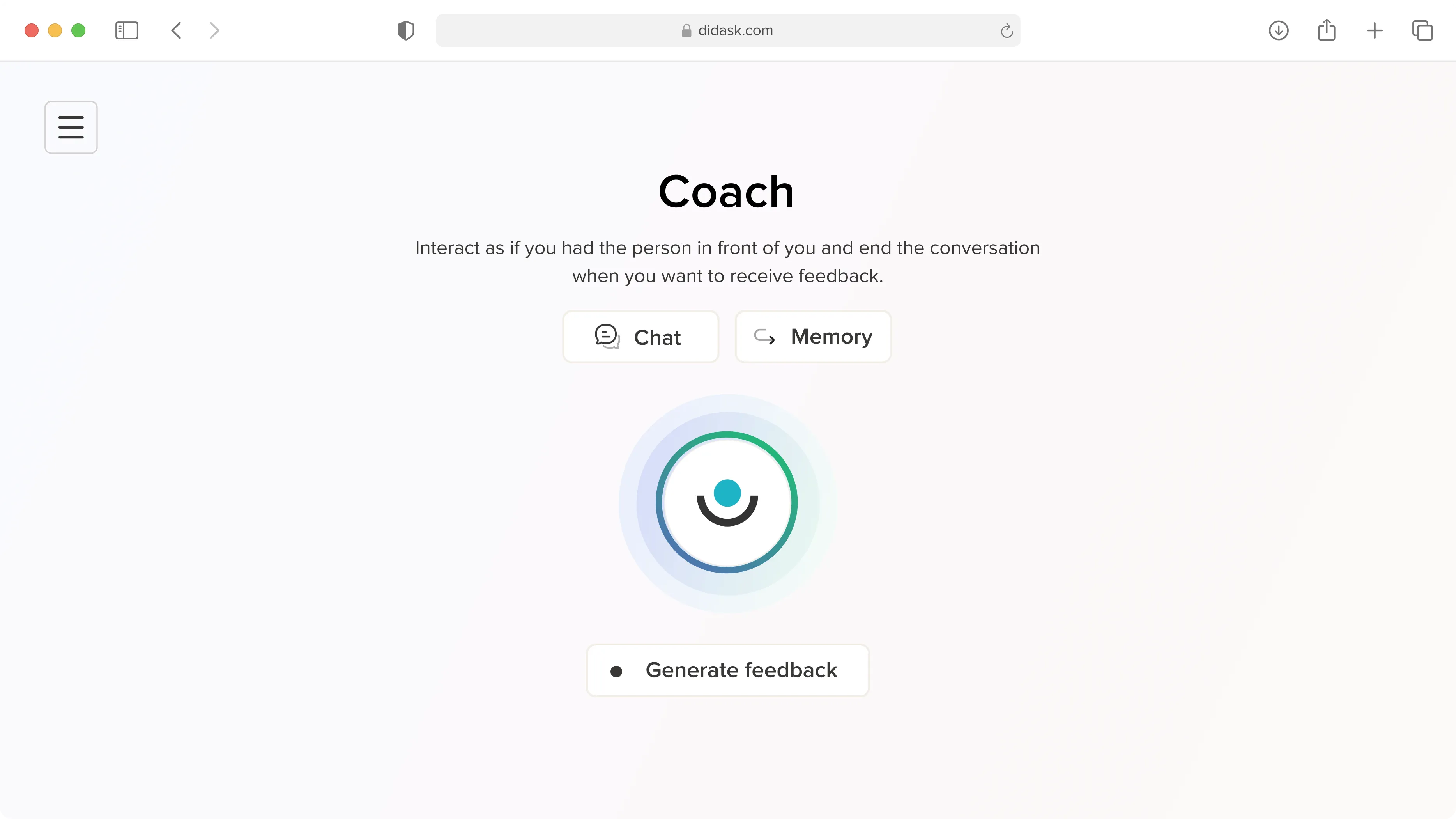
Didask Coaching: an AI coach in the flow of work
Learning in the flow of work means learning at the exact moment you need it, without leaving your task. It complements scheduled training, which often comes too early or too late.
Didask Coaching is an AI coach built into company tools, such as the CRM, the support tool or the intranet. It draws on the company's training courses and documents to check understanding, suggest practice and correct mistakes.
84% of learners using Didask Coaching find its answers consistently relevant and contextualised (410 learners, November 2025).
Designers stay in control
In Didask, the AI suggests and the designer decides. Every generated exercise can be reviewed, edited or deleted before it is published.
This approach makes the tool accessible to subject-matter experts. 83% of designers using Didask had never built a module before and are now autonomous (8,704 learners, June 2023).
On data, Didask states that it uses isolated hosting, end-to-end encryption and no AI model training on its customers' content. For a hands-on comparison with a general-purpose assistant, read our test of ChatGPT versus Didask for designing an e-learning module.
How do you choose an AI platform to train your teams?
To choose an AI training platform, check six points: its learning foundations, the control left to designers, data confidentiality, integrations, indicators and support. The demo should use your own content.
These six criteria can be checked during a demo:
- Learning foundations: does the AI make people practise, or does it only produce content to read?
- Human control: can every piece of generated content be reviewed and edited before it goes live?
- Confidentiality: where is the data hosted, and is it used to train models?
- Integrations: does the platform connect to your single sign-on, your HRIS and your business tools?
- Indicators: does it measure progress and application on the job, not just completion?
- Support: does the vendor help your teams during the rollout?
Checklist: will this AI platform actually help your teams learn?
0 / 8 criteria checked
If the AI platform also needs to manage all your training, compare it with the other options in our comparison of the best LMS solutions.
How do you integrate an AI platform into your company?
Integrating an AI platform starts with a specific use case and with upskilling the teams who will use it. Lack of expertise is the main barrier to AI cited by French companies.
The Insee figures are clear. 54% of French companies that do not use AI cite a lack of expertise, rising to 73% among those with 250 or more employees (Insee, 2026).
The barrier does not disappear after adoption. Among French companies already using AI, 53% are held back by a lack of expertise and 43% by data protection concerns.
A successful integration follows four steps:
- Choose a first measurable use case, linked to a clearly identified business problem.
- Involve IT and the data protection officer from the moment you choose the tool.
- Train users on the tool, its limits and good verification habits.
- Measure the results, then expand to other teams or other uses.
The European framework points the same way. Article 4 of the EU regulation on AI, known as the AI Act, covers AI literacy. It was amended by Regulation (EU) 2026/1744, which entered into force on 27 July 2026. It now requires providers and deployers of AI systems to support AI literacy among their staff (Regulation (EU) 2024/1689, EUR-Lex).

Good to know
Training is both a use case for an AI platform and a condition for its adoption. A company that trains its teams poorly in AI will get little value from it, whatever tool it chooses.
If you already have a training platform, the question becomes a technical one. Our guide to integrating AI into your LMS sets out the options.
What are the limits and risks of an AI platform?
The main limits of an AI platform are model errors, confidentiality risks and the illusion of competence. Each one can be addressed through the choice of tool and the way it is used.
Factual errors. A hallucination is a false answer produced by an AI model with the same confidence as a correct one. In training, an error in a piece of content reaches every learner: human review remains essential.
Data confidentiality. Consumer versions of AI assistants do not always guarantee how your documents will be used. Check the hosting, the contract terms and whether your content may be used to train models.
The illusion of competence. The illusion of competence is the feeling of mastering a subject because you have read or obtained the answer, without being able to reproduce it alone. An AI that gives answers feeds it, an AI that makes people search and practise counters it.
These limits are covered in detail in our analysis of the limits of generative AI in training. On how these tools affect the way we think, also read Is ChatGPT really making us dumber?
Key takeaways on AI platforms
An AI platform brings together models, data and an interface to serve a specific use. General-purpose platforms help you produce, job-specific platforms solve a problem for a given profession.
In training, the decisive question is not production speed but what employees can do afterwards. That is what sets learning-focused AI apart from productivity AI.