




The global e-learning market is estimated at between $295.6 billion and $369.7 billion in 2025, depending on the research firm (Straits Research, September 2026; IMARC Group, June 2026). In France, the EdTech sector generated €1.8 billion in revenue in 2025 (EY-Parthenon and EdTech France, 2026).
E-learning means training delivered digitally: platforms, online content and AI tools, in companies as well as in education. This article brings together the 2026 market figures for the world, Europe and France, with the source and date of each one. For the basics, see our guide to digital learning: definition, formats and tools.
How big is the e-learning market in 2026?
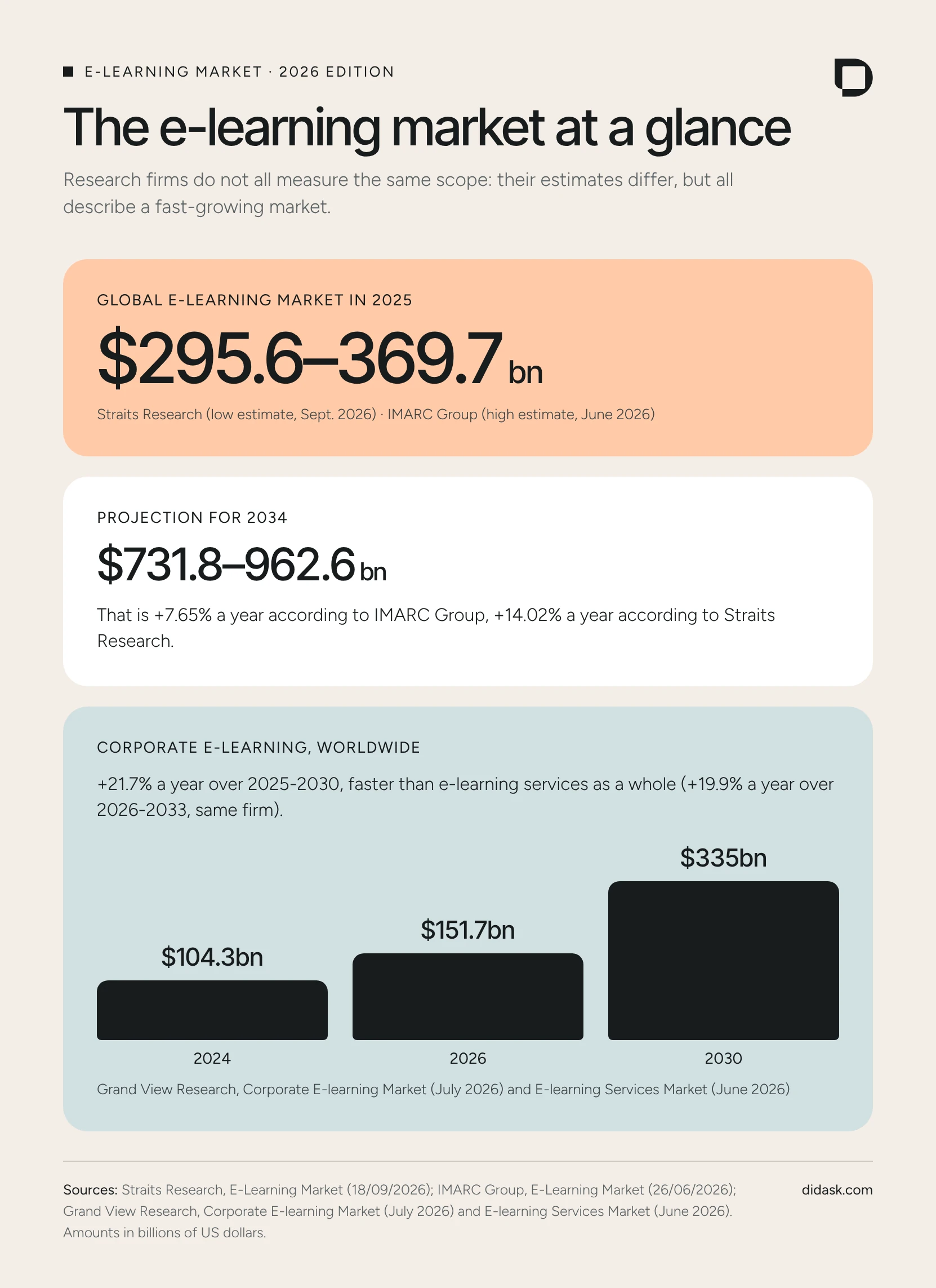
The global e-learning market is estimated at between $295.6 billion and $369.7 billion in 2025, depending on the research firm (Straits Research, September 2026; IMARC Group, June 2026). Projections range from $731.8 billion to $962.6 billion in 2034.
For 2026, Straits Research puts the market at $336.99 billion, with annual growth of 14.02% through 2034. IMARC Group starts from a higher base, $369.7 billion in 2025, but expects slower growth: 7.65% a year over 2026-2034.
The corporate segment is the most dynamic. According to Grand View Research, corporate e-learning grows from $104.3 billion in 2024 to $335 billion in 2030, an annual growth rate of 21.7%.
Why do the estimates vary so much? Each research firm measures a different scope: services only, platforms and content, education or corporate training. A market figure only makes sense with its scope, its source and its base year.
How big is e-learning in France and Europe?
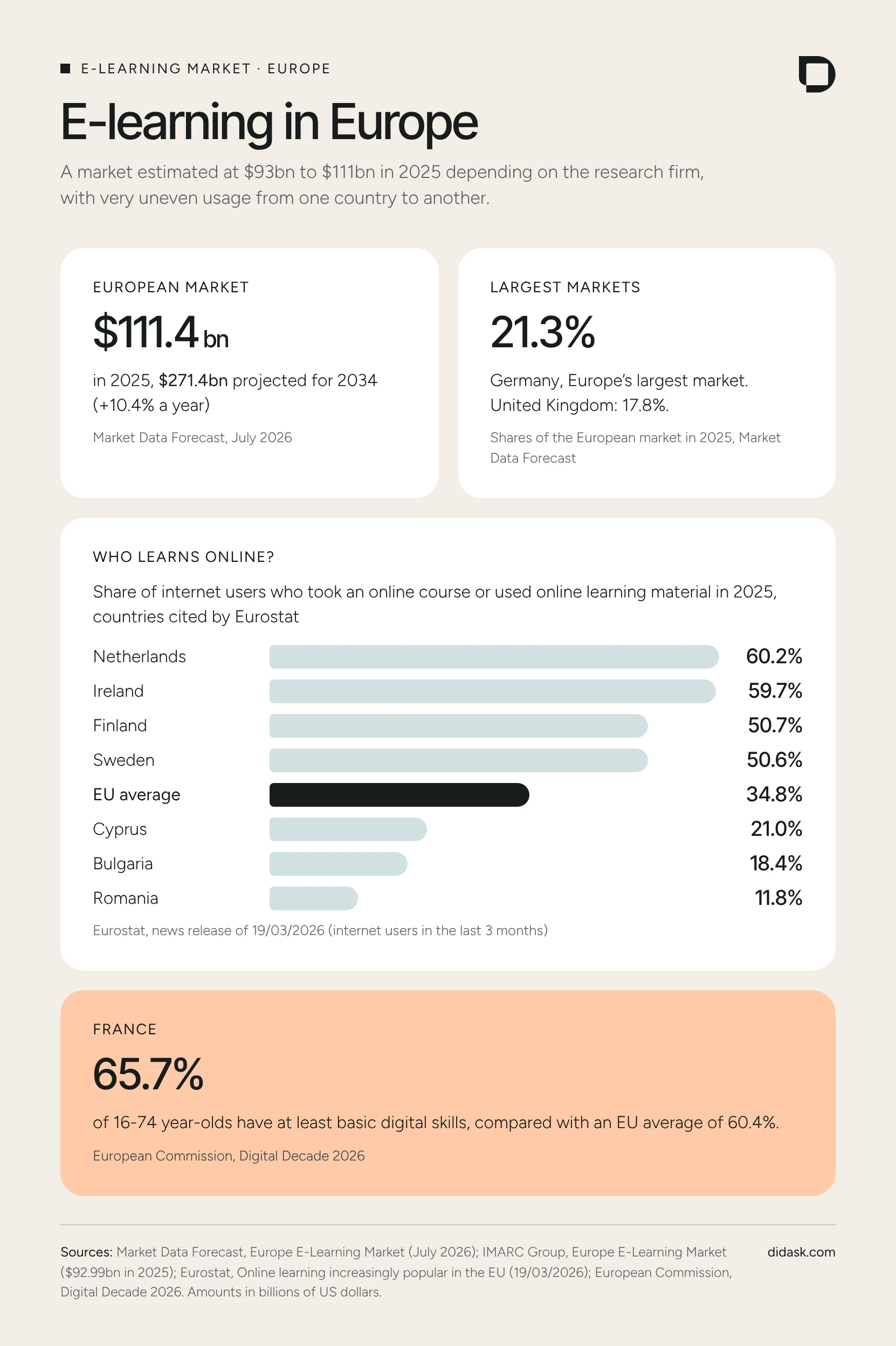
The European e-learning market is estimated at between $92.99 billion and $111.40 billion in 2025, depending on the research firm (IMARC Group, Market Data Forecast). In France, spending on continuing vocational training and apprenticeships reached €56.6 billion in 2024 (Dares).
In Europe
Market Data Forecast (July 2026) projects the European market at $271.40 billion in 2034, an annual growth rate of 10.4%. Germany is the largest market, with a 21.3% share in 2025, ahead of the United Kingdom (17.8%). IMARC Group gives a lower estimate of $92.99 billion in 2025.
Usage remains very uneven. In 2025, 34.8% of internet users in the EU took an online course or used online learning material, compared with 60.2% in the Netherlands and 50.7% in Finland (Eurostat, March 2026).
Institutional support is shaping this momentum. The Digital Education Action Plan 2021-2027 supports the adaptation of education and training systems. The Digital Europe Programme, with a budget of over €8.1 billion, funds advanced digital skills among other areas.
In France
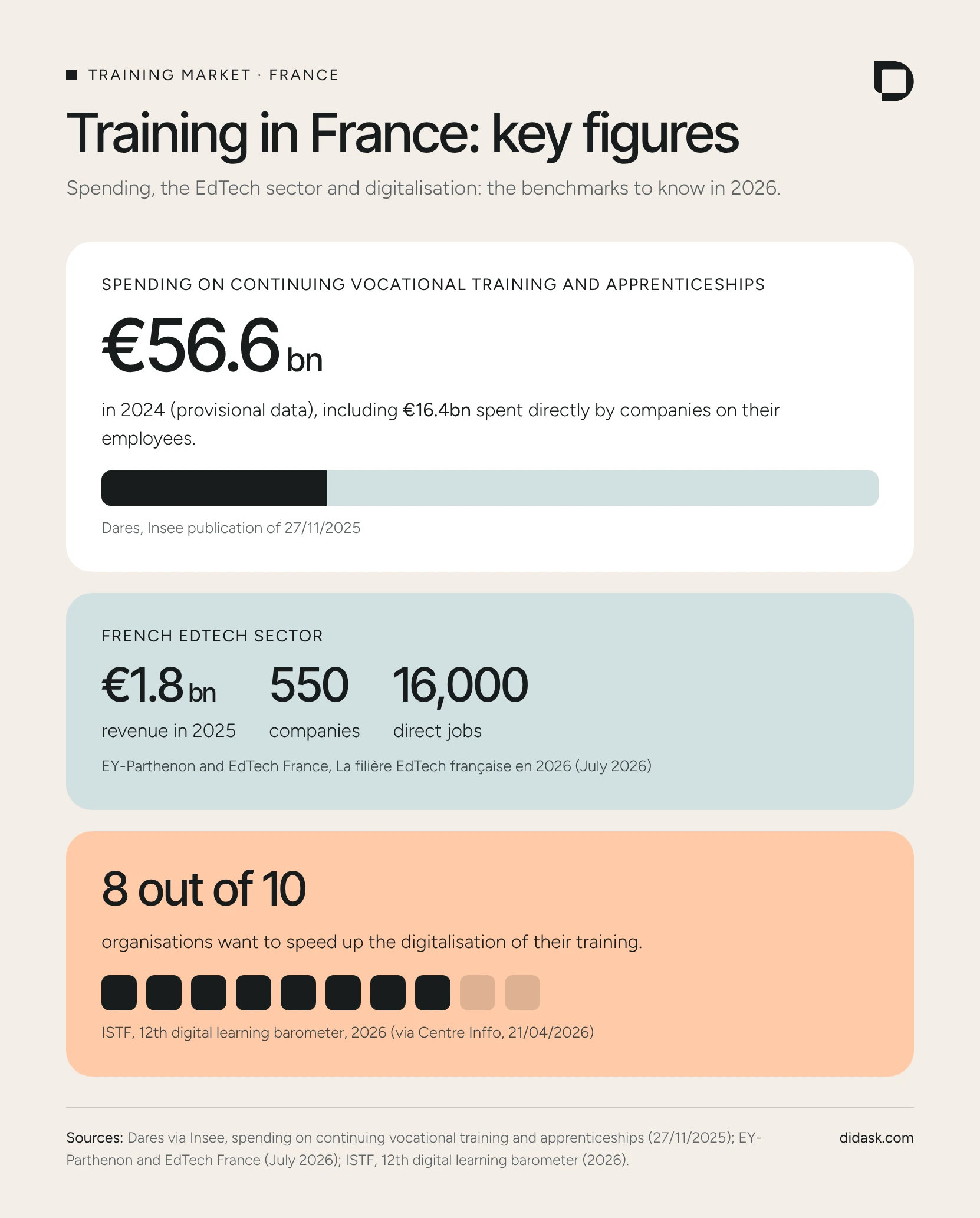
The French EdTech sector has 550 companies and 16,000 direct jobs, with €1.8 billion in revenue in 2025, up about 6% a year since 2023 (EY-Parthenon and EdTech France, July 2026).

Orianne Ledroit, Executive Director of EdTech France
“The question is whether we are collectively giving ourselves the means to build European champions.” (translated from French)
Spending on continuing vocational training and apprenticeships reached €56.6 billion in 2024, including €16.4 billion spent directly by companies on their employees (Dares, via Insee, November 2025).
Corporate e-learning in France is expected to grow by 20.5% a year between 2024 and 2031 (KBV Research, 2025). The fundamentals are favourable: 65.7% of 16-74 year-olds have at least basic digital skills, compared with 60.4% in the EU (European Commission, Digital Decade 2026).
On the company side, eight organisations out of ten want to speed up the digitalisation of their training (ISTF, 12th digital learning barometer, 2026). For an overview of platforms, see our LMS and professional training overview.
How is AI transforming the e-learning market?
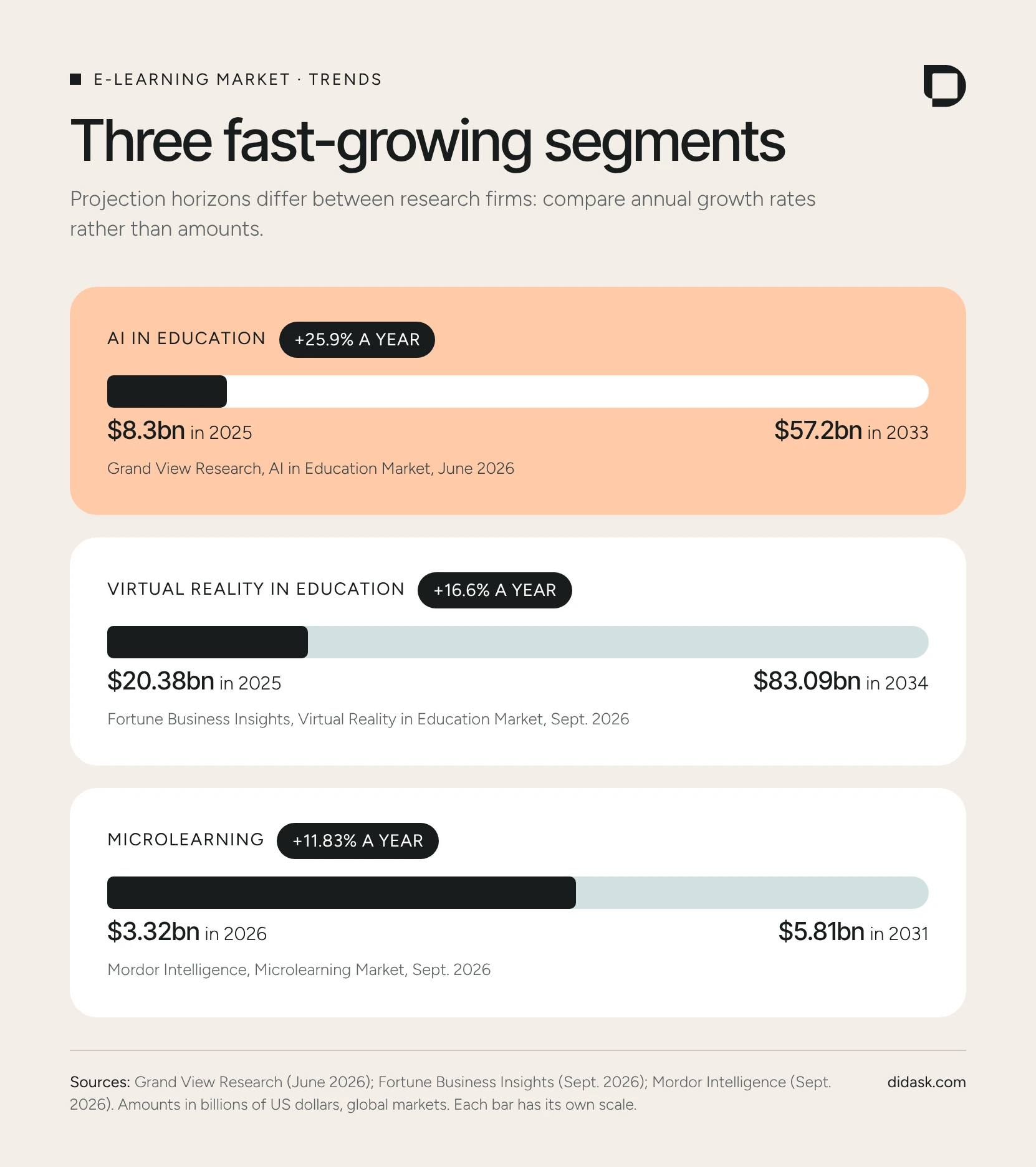
AI in education is one of the most dynamic segments of the market: $8.3 billion in 2025 and a projected $57.2 billion in 2033, an annual growth rate of 25.9% (Grand View Research, June 2026).
Two uses of AI coexist in training. Productivity AI generates content faster. Learning AI draws on cognitive science to choose the right learning format for each concept.
Didask Training, Didask’s all-in-one training platform built on cognitive science, reduces course design time by 50% to 65% at constant learning scope (internal measurement across 2,237 courses, October 2025).
In a randomised impact study run by Didask in 2026 with around sixty participants, learners trained with Didask scored 60% correct answers on memorisation, compared with 50% with a standard LMS and 40% with video.
Which trends will shape e-learning through 2030?
Three segments are driving growth: AI in education, virtual reality and microlearning. Their annual growth rates range from 11.83% to 25.9%, depending on the research firm.
Microlearning breaks training down into short sequences focused on a single concept. Its market grows from $3.32 billion in 2026 to $5.81 billion in 2031, or 11.83% a year (Mordor Intelligence, September 2026). Its learning value lies mainly in spaced repetition, whose effect on memorisation is well documented (Cepeda et al., 2006). See also our article on microlearning.
Adaptive learning adjusts each learner’s path according to their answers and gaps. Combined with generative AI, it enables personalisation at scale: see adaptive learning and generative AI.
Virtual reality in education grows from $20.38 billion in 2025 to $83.09 billion in 2034, or 16.6% a year (Fortune Business Insights, September 2026). For practical uses in companies, see the e-learning trends that will matter for professionals.
Is e-learning profitable for companies?
The return on investment of e-learning depends first on its learning effectiveness: a course that is completed but not applied brings no return. The easiest gains to measure concern design time and training time.
At Didask, internal measurements show a 60% to 75% reduction in training time at constant learning scope (993 learners, March 2025).
Measuring this return means choosing the right indicator: financial return on investment or return on expectations. See ROI or ROE to evaluate your training.
Which skills will companies need to develop by 2030?
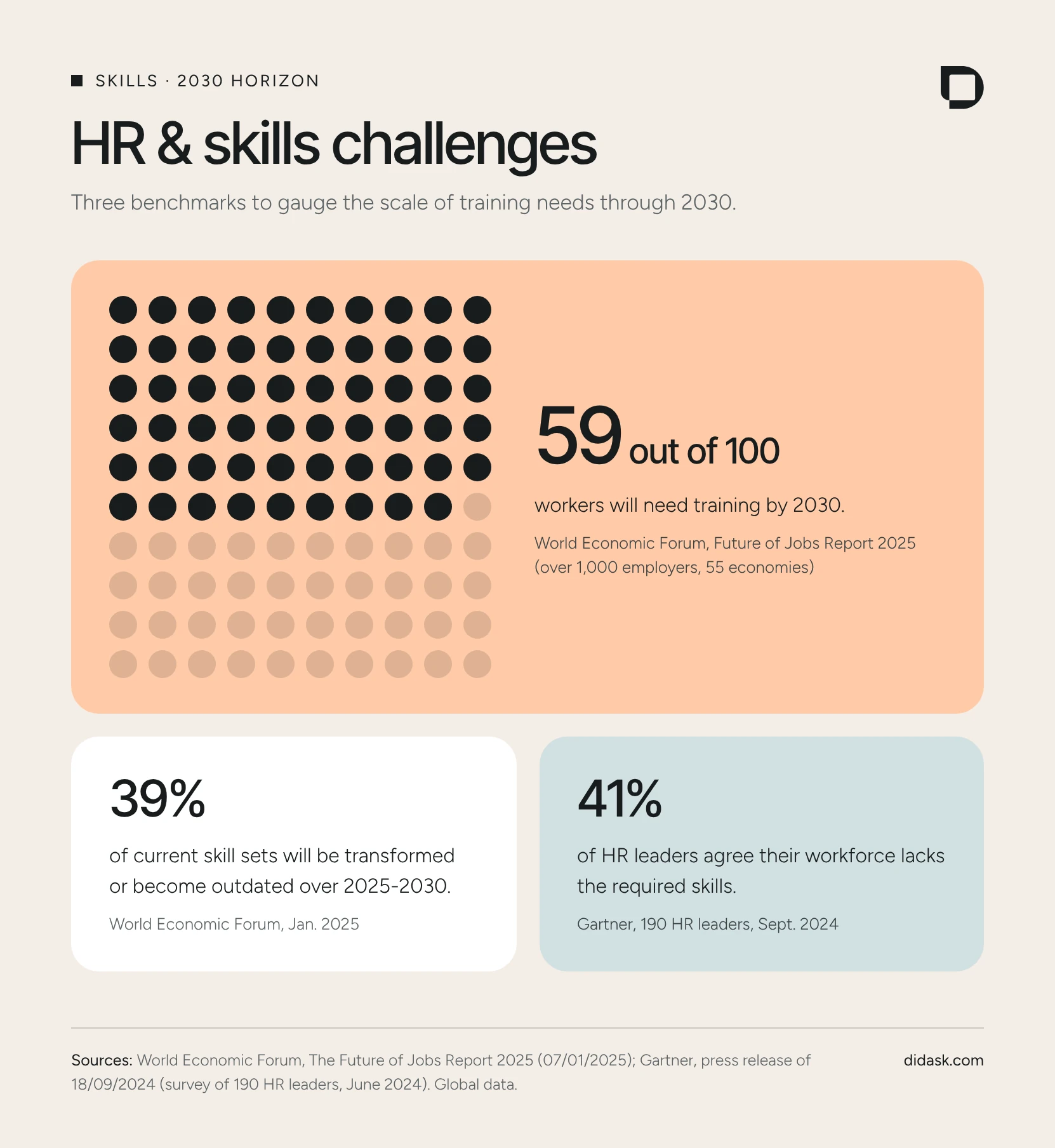
Out of every 100 workers, 59 will need training by 2030, and 39% of current skills will be transformed or become outdated over 2025-2030 (World Economic Forum, Future of Jobs Report 2025). The survey covers more than 1,000 employers in 55 economies.
HR leaders share this view: 41% agree that their workforce lacks the required skills (Gartner, survey of 190 HR leaders, June 2024).
Investment is following. Within three years, 92% of companies plan to increase their AI investments (McKinsey, January 2025, mostly US sample). In its Tech Trends 2025 report, Deloitte argues that AI will become as foundational as electricity.
What should L&D leaders do?
The first challenge is not technological but pedagogical. Digitising content is not enough: training must move from top-down transmission to learning that is adaptive, continuous and built into work.
AI makes “learning in the flow of work” possible, meaning learning built into daily work, at the moment the need arises.
The solutions to favour combine three criteria: measured learning effectiveness, AI-driven personalisation and smooth integration with work tools.
Key takeaways on the e-learning market in 2026
The global e-learning market is worth between $295.6 billion and $369.7 billion in 2025, and corporate training is its most dynamic segment. In France, the EdTech sector reaches €1.8 billion.
For organisations, the challenge goes beyond cutting training costs: it is about building a capacity for continuous adaptation, at a time when 59 workers out of 100 will need training by 2030.
Sources
- Straits Research, E-Learning Market, updated 18/09/2026
- IMARC Group, E-Learning Market, updated 26/06/2026
- Arizton, Global E-Learning Market Research Report 2026-2031, January 2026
- Grand View Research, E-learning Services Market, June 2026
- Grand View Research, Corporate E-learning Market, July 2026
- Grand View Research, AI in Education Market, June 2026
- Market Data Forecast, Europe E-Learning Market, July 2026
- IMARC Group, Europe E-Learning Market
- IMARC Group, France Online Education Market, June 2026
- KBV Research, Europe Corporate E-Learning Market, 2025
- Eurostat, Online learning increasingly popular in the EU, 19/03/2026
- European Commission, Digital Decade 2026, France country page
- European Commission, Digital Europe Programme
- European Commission, Digital Education Action Plan 2021-2027
- EY-Parthenon and EdTech France, La filière EdTech française en 2026, July 2026
- Dares, via Insee, Spending on continuing vocational training and apprenticeships, 27/11/2025
- ISTF, 12th digital learning barometer, via Centre Inffo, 21/04/2026
- Mordor Intelligence, Microlearning Market, September 2026
- Fortune Business Insights, Virtual Reality in Education Market, September 2026
- Cepeda et al., Distributed practice in verbal recall tasks, Psychological Bulletin, 2006
- World Economic Forum, The Future of Jobs Report 2025, January 2025
- Gartner, press release of 18/09/2024
- McKinsey, Superagency in the workplace, January 2025
- Deloitte Insights, Tech Trends 2025