


A salesperson who knows their sales method by heart can still botch their meetings. Not because they were not trained, but because between knowing and doing lies a gap that most sales force training programmes do not really seek to bridge. We pass on sales techniques, processes, key objectives. And then we are surprised that field behaviours do not change.
Training your sales force is not about organising sessions. It is about designing a system that turns knowledge into automatic responses. Reflexes that hold up under the pressure of a real meeting, facing a difficult prospect, in a situation no one anticipated. It is a problem of skills management, not a pedagogical catalogue.
This article is aimed at training managers and sales directors who steer the upskilling of their sales team, and who want to build a programme that translates into measurable field performance, not boxes ticked on an annual plan.
Pedagogical objectives are not enough: target field behaviours
A sales training plan almost always starts the same way: you list the skills to develop, you choose content, you schedule sessions. This is necessary but not sufficient.
The problem lies in the nature of the targets set. A pedagogical objective describes what the salesperson will learn: "understand the stages of a discovery meeting", "master the fundamentals of conducting a negotiation". These formulations are useful for structuring a training plan. They do not say what the salesperson will do differently the next day in the field.
The method Didask calls the "expected change" starts from the other end: before defining what will be taught, you identify the concrete mistakes observed in the field. Not "the salesperson lacks assertiveness in negotiation", too vague to be trained, too vague to be measured. But: "faced with a price objection, the salesperson systematically lowers their proposal without trying to uncover alternatives." That is the relevant mistake. The expected change is its observable opposite: "the salesperson responds to a price objection by restating the value of the offer before any concession." A precise behaviour, anchored in a real work situation, that can be trained and assessed.
Take Marc, a training manager in an 80-person B2B services company. His latest programme covered conducting sales meetings. The stated outcome: "master sales techniques in negotiation situations." Three months later, discount rates had not budged. Reviewing the diagnosis with the managers, he realised that no one had defined what "negotiating well" concretely meant: at what moment, facing which contact, with what stance. The key information was missing from the design stage.
Reformulating targets in behavioural terms, starting from observed mistakes to define the expected change, forces this preliminary work. This is what gives rise to a relevant sales training programme, and it is also what makes the pursuit of continuous improvement possible and credible.
.webp)
Good to know
The distinction between a pedagogical objective and a behavioural target directly conditions the ability to measure the ROI of a programme. Without a defined target behaviour, it is impossible to know whether the training initiative produced a real effect on sales performance.
Segment your sales team to train each profile at the right level
A sales team is not a homogeneous group. A junior in prospecting does not have the same needs as a senior managing long sales cycles on key accounts. A field salesperson does not face the same situations as an account manager who develops existing accounts. Yet most training approaches treat everyone the same way: same content, same level, same pace.
The outcome is predictable: juniors are lost, seniors are bored, and no one really progresses.
Profile segmentation is the most underused lever in managing a sales force. It means distinguishing at least three dimensions.
Skill level
A beginner salesperson must first acquire the fundamentals: structuring a discovery meeting, mastering the product pitch, handling early objections. An experienced salesperson needs to go further: managing complex negotiations, adapting their message to multiple contacts, creating perceived value over long cycles. Training both with the same module guarantees that neither really progresses. This is the whole point of working on essential sales skills, which must be ranked by level.
Role in the sales cycle
Training a hunter, whose key objective is active prospecting and generating opportunities, does not look like training an account manager whose job is to develop and retain a portfolio. The critical work situations are different, the relevant mistakes too, and so are the expected changes.
Tenure in the company
A new salesperson needs a structured onboarding and integration path, sequenced over 30, 60 and 90 days, that gets them operational as fast as possible. The confidence that a well-designed onboarding provides is often what makes the difference between a salesperson who takes off in three months and another who plateaus for six. An employee in post for three years needs a continuous upskilling system, modules targeted at their real friction points, not a generalist refresher.
This segmentation logic applies to a local SME as much as to a network of stores or an international organisation. In every case, the support given to each profile is more effective when it is calibrated to their real needs.
Good to know
A sales training programme may be eligible for funding through OPCOs, as part of the skills development plan. Funding depends on the legal framework in force, the size of the company, and the nature of the project. It is worth anticipating the available funding options from the design phase onward.
Involve managers as pillars of the system
A training programme can be well designed, well structured, well deployed. If it is not relayed by managers day to day, its impact stays limited. This is not a matter of goodwill, it is a matter of transfer mechanics, and it is one of the most underestimated risks in running a training project.
The sales manager is the transmission belt between training and the field. Within sales management, they are the one who creates the conditions for new behaviours to take hold over time. Without this relay, even the best content falls flat after a few weeks. A salesperson who knows their manager is involved in the system engages differently in their upskilling.
The manager's role in three phases
Before training: define with each salesperson the expected behavioural targets, as part of an individual action plan. During: maintain the momentum, connect simulated situations with the real situations of the sales cycle. After: a debrief focused on a precise field situation at D+7, a joint call at D+15, an individual coaching point at D+30, three moments that anchor what was learned in practice rather than letting it evaporate.
Turn field knowledge into training content
The manager's role goes beyond follow-up. They are best placed to identify the relevant mistakes and expected changes in the field. They know which objections recur systematically, which accounts resist, which situations put salespeople in difficulty. This is first-hand pedagogical information, far more precise than what an external trainer can reconstruct from the outside.
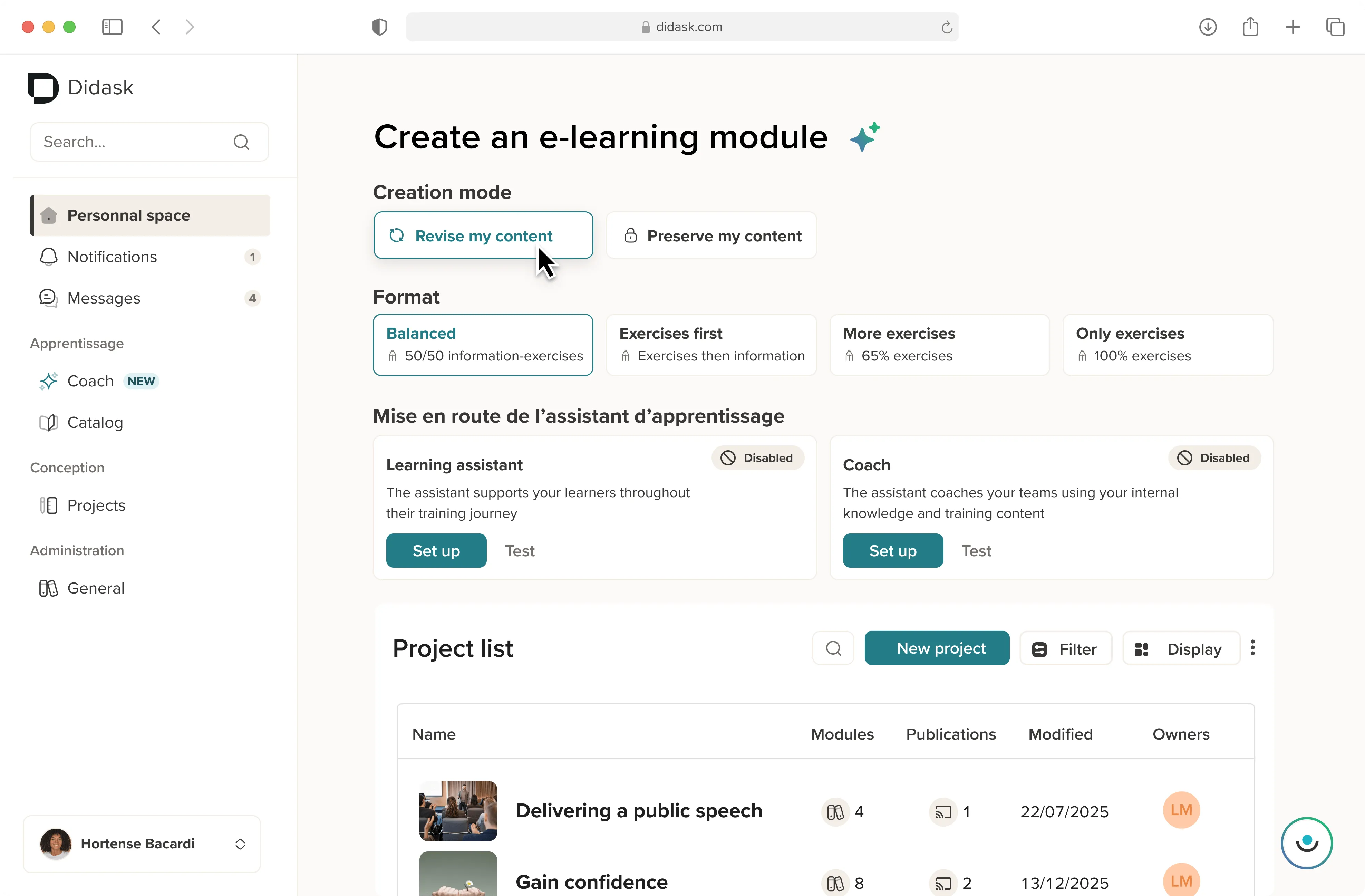
They still need the tools to harness this expertise without being asked to become an instructional designer. This is precisely what Didask's pedagogical AI enables: a manager flags a relevant mistake observed in the field. The platform then generates an interactive practical case, with corrective feedback, ready to use. A trial-error-feedback learning mechanism, consistent with the recommendations of cognitive science. The manager's field knowledge turns into structured training content, with no specific training in pedagogical design. To explore this further, discover how to train your salespeople with AI.
.png)
Worth noting
A salesperson who knows their manager will observe and discuss what they learned in the following weeks engages differently in their training. Managerial involvement is built before the programme starts, not after.
Make the system last over time: from event to continuous process
Most sales training programmes are designed as events. A kick-off session, a few online modules, perhaps a day of in-person training. Then nothing for six months, until the next annual session.
This model has a structural flaw: it ignores what cognitive science knows about memory. As early as 1885, the work of psychologist Hermann Ebbinghaus showed that without reactivation, more than 50% of learned information disappears within a few days (Ebbinghaus, Uber das Gedachtnis, 1885). This is not a problem of salespeople's motivation, it is how the human brain works. A one-off programme, however well designed, does not produce lasting behaviour change.
Moving from an event logic to a continuous-process logic concretely looks like this: short modules available on demand, spaced reactivations on key notions, regular role-plays anchored in real work situations. Not one hour of digital learning per quarter, but support integrated into salespeople's daily routine, that does not require pulling them out of their prospecting or account-management activity.
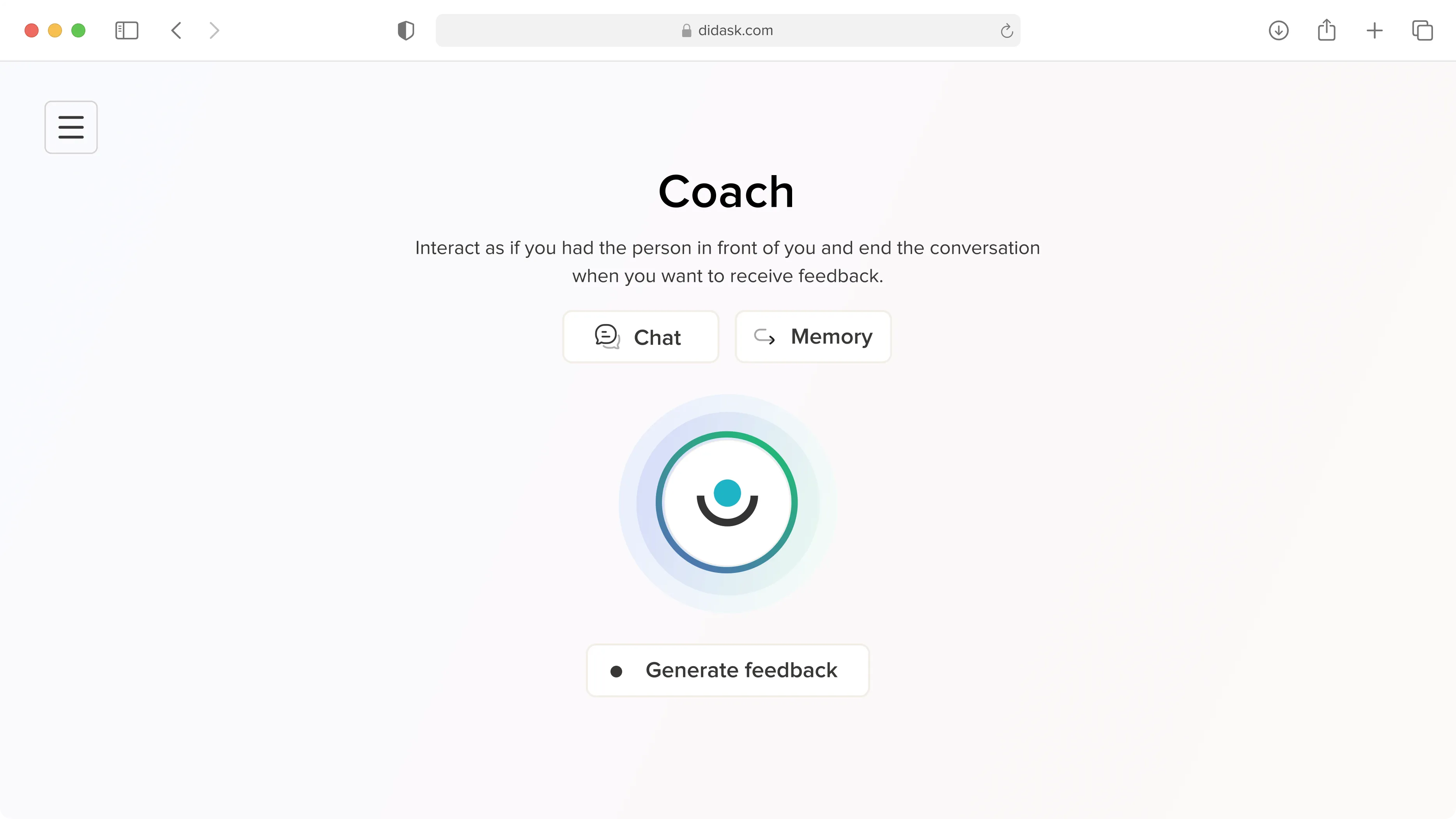
This is what mobile learning and learning in the flow of work make possible: a salesperson on the move can review a module between two meetings, practise on a case before a difficult conversation, or access a targeted resource at the precise moment they need it, directly from their work tools. This is the approach behind Didask Coaching, which embeds support directly into teams' flow of work. The accessibility of training stops being a topic of discussion and becomes a daily reality.
Measure the impact on real commercial indicators
A sales training programme is not steered by module completion rates or participant satisfaction at the end of a session. These indicators measure the training, not its impact on field performance.
The real evaluation of a system reads on two levels: intermediate behaviours and business results. On behaviours: are salespeople practising active listening more during the discovery phase? Are they handling objections differently than before? On business results: conversion rate, sales cycle length, average deal size growth, reduction in ramp-up time.
This dual reading requires having defined the indicators before the programme launches. This is the missing link in most training plans: you deploy, you measure satisfaction, you conclude that "it went well". Without a baseline, without targets defined upfront, it is impossible to demonstrate anything.
Good to know
Platforms like Didask Training make it possible to steer each salesperson's upskilling: mastery rate per skill, progress on practical cases, identification of persistent gaps. At Didask, 94% of learners report that the training had a positive impact on their real work (source: internal survey, 1,780 learners, Nov. 2025). Cross-referenced with CRM data, this information makes it possible to manage a sales team with the same rigour as a pipeline.
Conclusion
Training a sales force is not about organising sessions. It is about building a system that turns knowledge into behaviours, automatic responses that hold up under the pressure of a real meeting, facing a difficult prospect, in a situation no one anticipated.
This means starting from the right questions: which mistakes do our salespeople actually make in the field? Which behaviours do we want to see change? How do we ensure managers relay and anchor what was learned? How do we measure the impact on the commercial indicators that truly matter to the company?
It is these questions, not the choice of formats or the volume of content, that make the difference between a training programme that produces field results and a spend with no follow-through. The tools now exist to answer them seriously: mobile learning, AI coaching, learning in the flow of work, design guided by pedagogical AI. This is the approach behind Didask Training.
.webp)
.webp)

.webp)



.png)