


Sales coaching is ongoing, one-to-one support that develops a salesperson's skills in the field. It starts from real sales situations: prospecting, client meetings, objection handling. The manager-coach observes, asks questions and gives feedback, then the employee commits to a concrete action plan.
Its effectiveness has been measured, with one condition. Across 1,246 sales representatives in 136 teams, managers' coaching skill predicted annual sales goal attainment (Dahling et al., Personnel Psychology, 2016). When that skill was low, coaching more often actually lowered results.
Didask is a French all-in-one training platform built on cognitive science. Its Didask Coaching offer gives every salesperson an AI coach, directly inside the company's work tools.
This guide covers the mindset and skills of a good sales coach, and the techniques that improve sales performance. It also covers building trust, follow-up tools and how to roll coaching out across your whole sales force.
What is sales coaching?
Sales coaching is a personalised support approach that helps a salesperson improve through practice, observation and feedback. It aims to change behaviour in sales situations, not to transfer knowledge.
It covers three families of skills:
- Technical: prospecting, client needs discovery, pitching, objection handling, closing.
- Behavioural: listening, stance with prospects, managing stress and relationships.
- Organisational: managing time, the pipeline and priorities between accounts and opportunities.
Our guide to essential sales skills details each of these families.
.png)
The reference definition
"Coaching is unlocking a person's potential to maximise their own performance. It is helping them to learn rather than teaching them." John Whitmore, pioneer of workplace coaching and co-creator of the GROW model, Coaching for Performance.
Sales coaching vs sales training: what is the difference?
Sales training passes methods on to a group, over a short period. Sales coaching supports one person over time, while they apply those methods in the field.
The two complement each other. Training without follow-up fades fast: the forgetting curve, described by Hermann Ebbinghaus in 1885, shows that memory declines quickly without reactivation.
Coaching without training, in turn, lacks shared reference points. For the core methods, read our analysis of the sales techniques to teach in sales training. For the overall programme, see how to design sales force training that delivers results in the field.
Manager-coach or external sales coach: who should coach your salespeople?
The sales manager is the team's first coach, because they know the clients, the market and the targets. An external sales coach steps in as a complement, for a specific need or to train managers.
The data favours coaching delivered from within. A meta-analysis of 17 studies compares coaches internal to the organisation with external coaches. Internal coaches achieve significantly stronger effects (Jones, Woods and Guillaume, Journal of Occupational and Organizational Psychology, 2016). This meta-analysis does, however, exclude coaching by the direct line manager.
The external sales coach has several missions: auditing the team's practices, one-to-one sessions, group coaching and training managers in the coaching mindset. Certifications from the ICF (International Coaching Federation) and the EMCC are the profession's benchmarks.
What are the benefits of sales coaching?
Coaching improves employees' performance, skills and engagement, according to the available meta-analyses. In sales, its effect on goal attainment is proven, provided the coach is skilled.
A meta-analysis led at the University of Amsterdam measured significant positive effects on five categories of outcomes. They cover performance and skills, well-being, coping, work attitudes and goal-directed self-regulation (Theeboom, Beersma and van Vianen, The Journal of Positive Psychology, 2014).
The benefits are shared between three players:
- The salesperson improves on their own meetings, becomes more autonomous and gets up to speed faster after being hired.
- The manager knows the field and each employee's real level better, which strengthens their leadership and helps them allocate accounts.
- The company gets more consistent sales performance, more value from its training investment and a learning culture.
According to Dahling and his co-authors, the effect works partly through role clarity. Coached salespeople better understand what is expected of them, and that clarity supports their performance. Coaching also drives the motivation of a sales team, beyond bonuses.
What skills does a good sales coach need?
A good sales coach observes without judging, asks before advising and gives factual feedback. They also know the sales job, which makes their feedback credible.
Six skills make the difference:
- Active listening: a communication technique that consists of rephrasing and asking questions to understand the other person's point of view.
- Questioning: open questions that lead the salesperson to analyse their own practice.
- Factual observation: describing what was said and done during the meeting, without interpretation.
- Feedback: precise input, tied to an observable behaviour and focused on the next action.
- Goal setting: helping each salesperson set measurable, time-bound improvement goals.
- Field expertise: knowing the clients, the market, the sales process and the job's difficult situations.
Frontline management weighs heavily on team engagement. In the United States, managers account for at least 70% of the variance in engagement across business units (Gallup, State of the American Manager, April 2015).
How do you train your managers in the coaching mindset?
The coaching mindset is learned through practice: observed sessions, role-play between managers and feedback on their own way of coaching. A theory course is not enough to change a directive reflex.
The hardest shift is asking a question before giving the answer. A manager used to prescribing must learn to tolerate silence and let the salesperson search. This know-how is one of the management skills to develop first.
How do you build trust with your salespeople?
Trust grows when the salesperson knows coaching serves their progress, not their evaluation. Keep coaching sessions separate from performance reviews, and always let the salesperson speak first.
The starting point is often fragile. Out of nearly 15,000 employees surveyed in the United States, only 16% rated their last conversation with their manager as extremely meaningful (Gallup, January 2026).
Five practices build trust:
- Separate coaching from evaluation: a coaching session never leads to a sanction or an imposed numerical target.
- Guarantee confidentiality: what is said in a session stays between the coach and the salesperson.
- Accept mistakes: an analysed mistake is a source of learning, as trial-and-error learning shows.
- Start with self-assessment: the salesperson analyses their performance before hearing the coach's observations.
- Keep your commitments: an announced follow-up session must happen, or the programme loses credibility.
Which sales coaching methods actually work?
Effective methods put the salesperson into action: they analyse their practice, come up with their own solutions and practise. Four formats cover the essentials: the GROW model, call shadowing, role-play and continuous feedback.
The GROW model applied to sales
The GROW model is a four-step framework for running a conversation: Goal, Reality, Options, Will. Popularised by John Whitmore, it structures each session around questions the salesperson answers themselves.
Its effectiveness rests on the generation effect: information you produce yourself is remembered better than information you receive (Slamecka and Graf, 1978). The coach guides, they do not prescribe.
.webp)
GROW example: a deal lost at the decision committee
Goal: "What do you want to achieve with this account in the next cycle?"
Reality: "What exactly happened at the last committee?"
Options: "What answers could you have given to the CFO's objections?"
Will: "What concrete action will you commit to testing next week?"
Call shadowing and field coaching
Call shadowing means listening to a call or joining a salesperson at a meeting, then debriefing straight away. It is the format most rooted in real experience, because the feedback is about a situation that actually happened.
In retail and FMCG, field coaching takes the form of a joint store visit. The manager observes the negotiation with the department manager, the shelf check and product merchandising.
An effective debrief follows three steps:
- The salesperson self-assesses: what worked, what they would do differently.
- The coach shares factual observations.
- Together, they build a precise action plan with a deadline.
The most common mistake is reversing this order. Giving the answer before the salesperson's own analysis takes away their ownership.
Role-play and simulations
Role-play lets salespeople practise without risking a real client: prospecting calls, booking meetings, price objections, purchase negotiations. The salesperson rehearses, gets feedback, then tries again. The format also helps them learn a new offer before its launch.
AI makes these simulations available at any time, with a simulated counterpart that reacts to the salesperson's answers.
Continuous feedback
Short, regular feedback has more effect than a quarterly review. In the United States, employees who receive meaningful feedback are 67% to 70% engaged, compared with 22% to 26% for the others (Gallup, January 2026).
Gallup specifies that 15- to 30-minute conversations are enough, as long as they are regular. The same principles apply to feedback in training: precise, fast and action-oriented. Cognitive science points the same way: the spacing effect shows that learning spread over time is retained better (Cepeda et al., Psychological Bulletin, 2006).
How do you set up a sales coaching programme in 5 steps?
A sales coaching programme is built in five steps: set goals, assess skills, build an individual action plan, establish routines, then track progress.
- Set the goals. Link coaching to the sales strategy and to a specific business issue: conversion rate, sales cycle length, ramp-up of new hires. Let each salesperson define their own improvement goals.
- Assess skills. Observe each salesperson in real situations to identify areas for improvement. Needs differ by sales profile (SDR, AE, AM) and seniority.
- Build an individual action plan. Keep two or three improvement areas at most, each tied to an observable behaviour.
- Establish routines. Schedule short, regular sessions, call shadowing, role-play and a group slot to share best practices. Coaching must appear in the calendar, or reporting will swallow it.
- Track and adjust. Measure how much is put into practice and adapt the plan at each follow-up. Finally, build the programme into your skills development plan.
To connect this programme with your training initiatives, see our method to build a sales training programme.
How do you evaluate the effectiveness of sales coaching?
To measure the impact of coaching, track two levels: the coaching activity itself, then sales performance. The first level explains the second, and lets you act before results drop.
Coaching is rarely the only cause of progress. Compare salespeople already coached with those not yet coached, over the same period. The choice of sales KPIs determines how reliable this reading is.
The coaching session evaluation grid
A session evaluation grid checks that coaching follows the method, and helps train managers. It fits in five criteria:
- The session goal was defined at the start.
- The salesperson self-assessed before any input from the coach.
- The coach's observations are factual, not judgmental.
- A concrete, dated action plan was built together.
- A follow-up point was set before the end.
Which tools support sales coaching?
Sales coaching relies on four families of tools: the CRM, call analysis, observation grids and training platforms with an AI coach. The right choice depends on where your salespeople work.
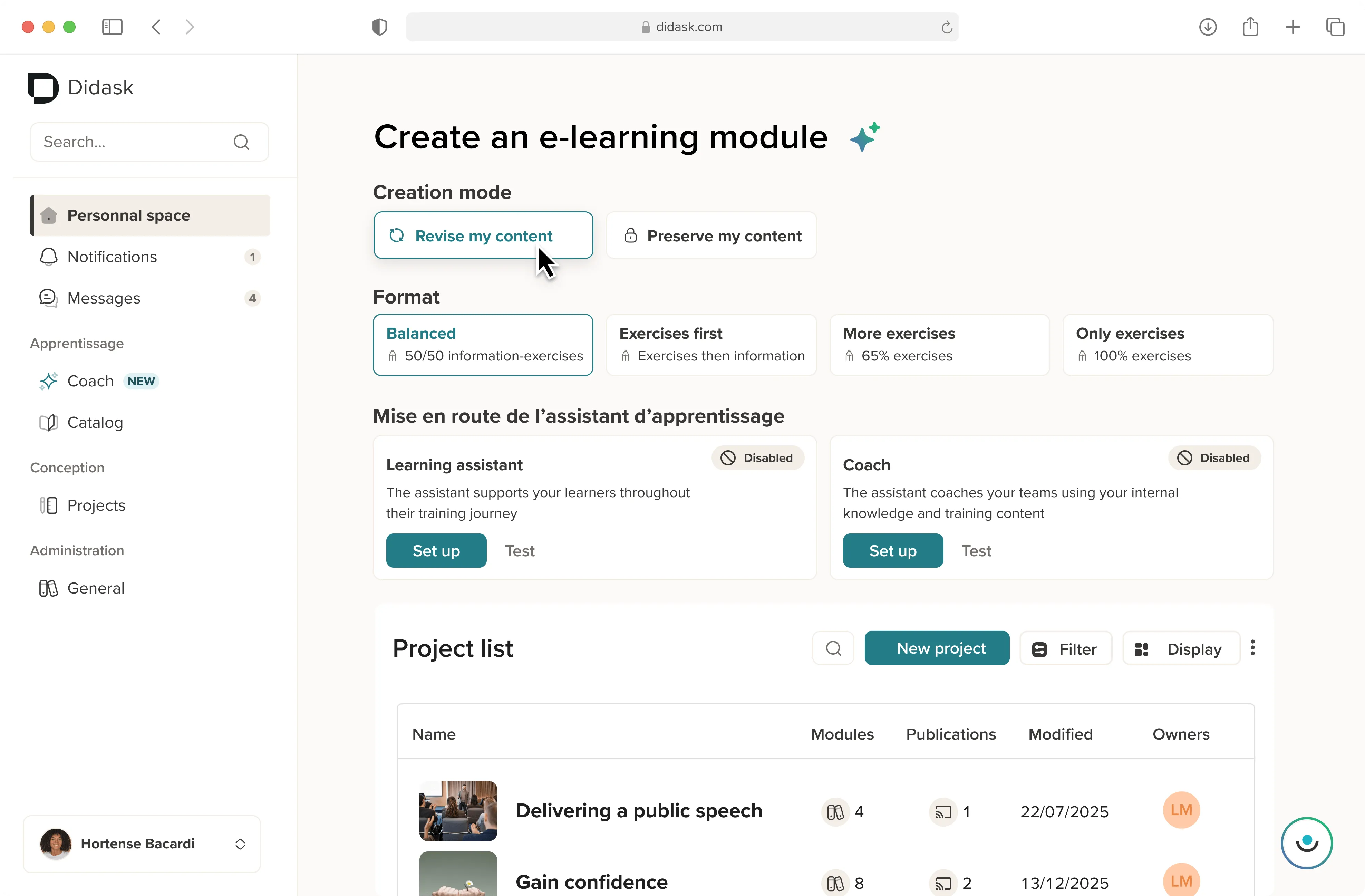
Didask brings training and coaching together in a single platform. Didask Training creates and delivers learning paths. Didask Coaching supports each employee day to day and integrates with business tools, including the CRM.
The point is to learn in the flow of work, at the moment the need arises: before a call, after a rejection, while preparing an offer.
How do you coach an entire sales team, not just a few salespeople?
Human coaching runs up against the manager's time. To cover the whole team, hand day-to-day practice to an AI coach and keep the manager's time for high-stakes situations.
Teams are getting bigger. According to Gallup, a manager oversees 12.1 people on average in 2025, compared with 8.2 in 2013 (Gallup, January 2026, US data). A weekly session per salesperson then becomes hard to sustain.
Jim Harter, Gallup's chief scientist for workplace and wellbeing, puts the weight of team size into perspective. His conclusion: "Manager talent trumps span of control." The quality of coaching therefore remains the first lever, even in a large team.
The 2 Sigma problem
Researcher Benjamin Bloom, of the University of Chicago, showed that a student tutored one-to-one outperforms 98% of students in a conventional class. One-to-one tutoring is therefore the most effective method, but also the most expensive to deploy (Bloom, Educational Researcher, 1984).
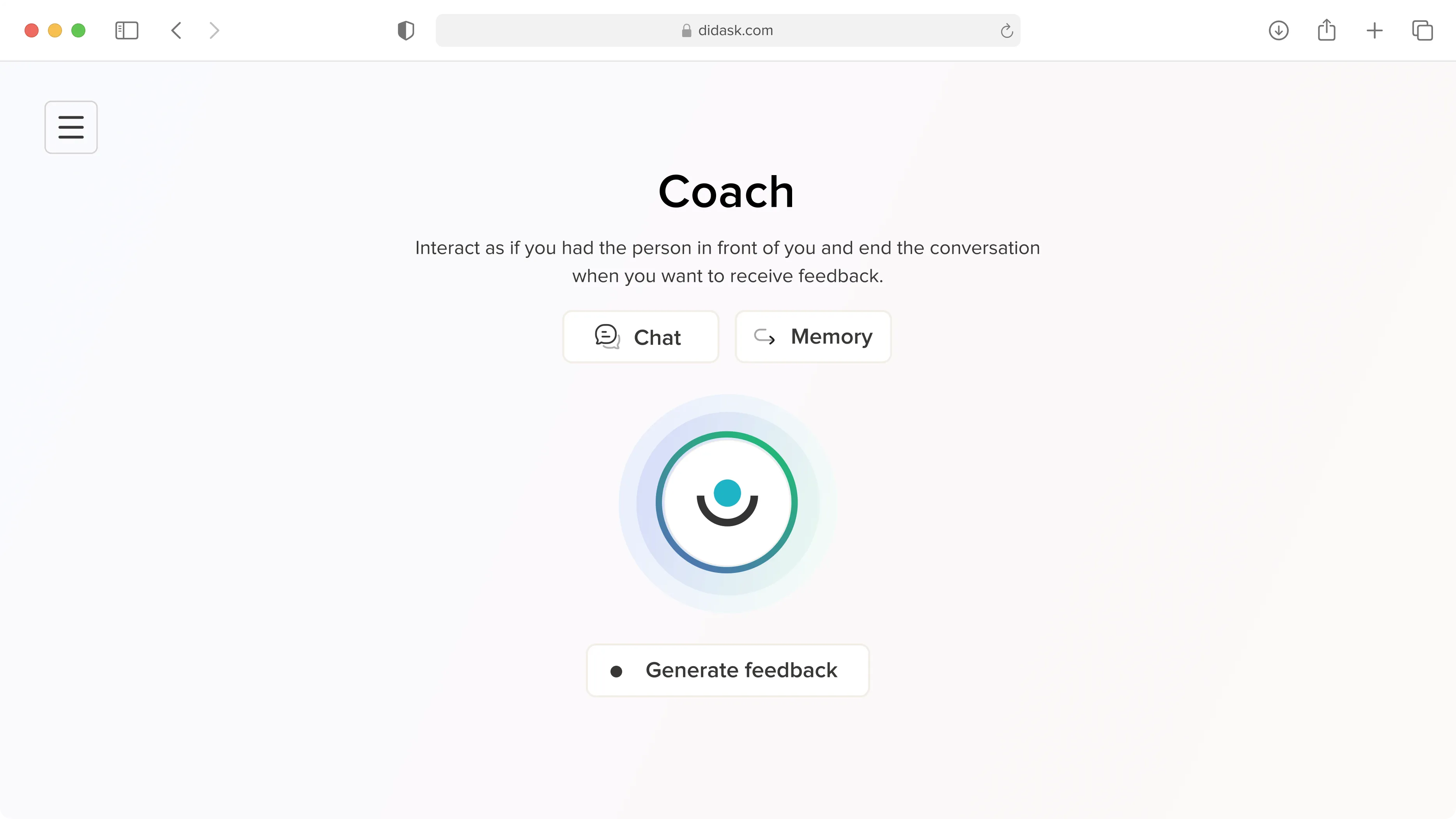
An AI coach is a conversational assistant that supports employees in their work. It answers, asks questions and gives personalised feedback based on the company's documents and resources. It makes part of the one-to-one tutoring described by Bloom possible at scale.
Didask Coaching is used several times a week by 56.1% of learners after one month (410 learners, October 2025). 84% of Didask Coaching users rate its answers as consistently relevant and contextualised (410 learners, November 2025).
Didask Coaching in a sales scenario
A salesperson has just simulated a discovery meeting. The AI coach replies: "You identified the budget need well, but not the economic buyer's stakes. How could you have explored that point?" The salesperson rephrases, the coach validates or redirects. The manager is not needed for this practice.
What the AI coach does not replace
An AI coach excels at repeated practice: pitches, follow-up emails, objection handling, meeting preparation. It is available at any time and adapts to each salesperson's level.
It does not replace shadowing a real client, supporting a strategic deal or handling emotionally charged situations. The strongest approach is hybrid: AI for day-to-day practice, the manager for strategic support and the relationship.
.png)
Client case: Canal+ International
Canal+ International uses Didask to train travelling salespeople in nearly 40 countries. The digital training path was rolled out in 12 countries to 500 learners.
"In our Didask modules, the situations described are common, frequent and based on real cases," says Virginie Rochard, training manager for the sales department (translated from French). Read the testimonial.
Where should you start with sales coaching?
Start small and measurable: one goal, one method, one pilot team. Sales coaching delivers results when it is regular, well run and followed up.
Three actions are enough to get started this month:
- Train your managers in the GROW model and the three-step debrief.
- Set up a monthly call shadowing session and a short weekly check-in with each salesperson.
- Give the whole team a way to practise between sessions, so coaching no longer depends solely on the manager's calendar.
Sales coaching is not reserved for top performers or small teams. The question is no longer whether it works, but how to make it accessible to every one of your salespeople.
.webp)
.webp)
.webp)


.webp)


.png)