



In France, musculoskeletal disorders (MSDs) are the leading cause of occupational disease: they accounted for 88% of the occupational diseases recognised in 2024. Behind this figure are thousands of employees exposed every day to repetitive movements, constraining postures, poorly controlled physical efforts. PRAP IBC training (Prevention of Risks linked to Physical Activity, Industry, Construction, Retail and office-activities stream) exists precisely to change that, by making each employee a concrete actor in their own prevention. That said, deploying this system effectively is another matter. This article gives you the keys.
What is PRAP IBC training?
PRAP IBC is a certifying training system, governed by the INRS (French National Research and Safety Institute) according to the V9 framework (January 2021). Its objective: to make each employee able to identify the risks linked to their physical activity, analyse their work situation and take part in prevention in their company. Important: this is not a top-down training where people are told how to move correctly, but a system that turns the employee into a field actor.
Two streams coexist: the IBC stream, intended for the industry, construction (building and public works), retail and office-activities sectors, and the 2S stream (Health and medico-Social). Same philosophy, different audiences.
.webp)
Worth noting
PRAP IBC and PRAP 2S share the same conceptual framework, but their practical content diverges significantly. An IBC-certified employee is not trained in the specific actions of the health sector. Check that your accredited training body does offer the stream suited to your sector.
PRAP IBC vs posture and movement training: a confusion to avoid
Many HSE managers (Health, Safety, Environment) still confuse the two systems. Posture and movement training transmits movement instructions, often in a generic way. PRAP IBC involves a global approach: the employee observes their real work situation, identifies the risk factors, and formulates concrete improvement proposals. It can lead to organisational, technical or human changes. And above all, it is certifying, which posture and movement training is not.
Who is PRAP IBC training for, and is it mandatory?
The sectors and audiences concerned
The IBC stream covers a very wide scope: manufacturing industry, construction, retail, logistics, office activities. Any employee whose work involves a significant share of physical activity is concerned: manual handling, carrying loads, repetitive movements, constraining postures, vibrations. No prerequisite is required for the trainees. On the other hand, the effectiveness of the system rests on a genuine commitment from the company: without the involvement of management, improvement proposals remain a dead letter.
What the French Labour Code says
PRAP IBC is not mandatory by name in all sectors. It is article L.4121-1 of the French Labour Code that grounds its essential character: the employer is bound by a legal obligation of result on the physical and mental health of their employees. The CARSAT (Pension and Occupational Health Insurance Fund) and the INRS strongly recommend this system. In the event of an accident or occupational disease, the absence of documented prevention can engage the employer's liability for inexcusable fault. To go further on the legal framework, you can read this article on regulatory training.
.png)
Key point
The employer's inexcusable fault (article L.452-1 of the French Social Security Code) can be retained if the employer was aware of the danger without taking the necessary measures. A documented PRAP approach, integrated into the DUERP (Single Occupational Risk Assessment Document), is a concrete protection, and a useful mention during any inspection.
Programme, duration and certification of PRAP IBC training
The detailed programme (INRS V9 framework)
The V9 framework structures the training around three areas of competence:
- Position yourself as a prevention actor: understand the stakes of workplace accidents (WA) and occupational diseases (OD), know the general principles of prevention, identify your role in the company's approach.
- Observe and analyse your work situation: rely on how the human body works (anatomy, physiology, effort economy) to identify the determining elements of physical activity and the risk factors specific to your post.
- Take part in controlling the risk: formulate concrete improvement proposals and contribute to the prevention action plan.
It is this progression that distinguishes PRAP IBC from a simple awareness session: the trainee produces an analysis and proposals on their real work situation.
Duration, format and certification
The training lasts 14 hours minimum, that is 2 days in person, with groups limited to 12 trainees. It is possible to split these hours into sessions of 3 to 4 hours over 1 to 3 consecutive weeks. The PRAP IBC actor certificate, issued by the Health Insurance Occupational Risks network / INRS, is valid for 24 months nationally.
Worth noting
The refresher is mandatory every 2 years (1 day, 7 hours). Without renewal on time, the certificate expires. This is a deadline not to underestimate when you manage several dozen certified people.
And the PRAP IBC trainer?
Becoming a PRAP IBC trainer is a path in its own right: 10 days (70 hours) spread over 3 to 4 non-consecutive weeks. The trainer certificate is valid for 36 months, with renewal every 3 years (3 days). The prerequisites include experience in prevention and an ability to run training for adults. Two statuses exist: the trainer in an accredited company, who trains only the employees of their own structure, and the trainer in an accredited body, who can host external trainees.
How much does a PRAP IBC training cost?
The prices are free, set by each accredited body. Without a verifiable source for precise ranges, it is better to request several quotes. The total cost of the deployment often exceeds the catalogue price: absence from the post for 2 days, multi-session logistics, the cost of the internal trainer if you make that choice.
Good to know
PRAP IBC training can be funded via the branch OPCO (Skills Operator) or the skills development plan. Find out in advance: funding lead times can lengthen the schedule.
The 3 mistakes that undermine the effectiveness of your PRAP approach
Training without involving management
This is the most frequent mistake. A certified employee can identify risk factors and formulate improvement proposals, but without managerial relay, these proposals stay in a drawer. PRAP IBC is part of a global approach that involves senior management, middle management and ideally the works council (CSE). Without this commitment, the training effort produces no impact on MSDs.
Treating PRAP as a regulatory tick-box
Many companies train to "be compliant", without measuring the real impact. The result: MSDs do not fall, certifications pile up, and the training manager ends up justifying a budget with no results. The objective is therefore not just to obtain a certificate, it is to produce concrete improvements integrated into the DUERP and the prevention action plan.
Neglecting the maintenance of skills between two refreshers
24 months between each renewal is a long time. Without spaced reminders, a large part of the knowledge erodes quickly (Ebbinghaus's forgetting curve). Regular digital reminders, short role-plays, periodic quizzes make it possible to keep the reflexes active between two in-person sessions.
Key point
The spacing effect and the testing effect are two powerful cognitive levers for maintaining skills over time. They are at the heart of the pedagogical approach of the Didask platform.
How to effectively deploy PRAP IBC in your company
Step 1: anchor PRAP in your global prevention approach
Before scheduling a single session, link the training to your DUERP: identify the priority posts and work situations, define measurable objectives, involve the works council (CSE) upstream. Training is not an end in itself, it is a lever in a broader approach.
Step 2: organise the logistics at scale
Schedule the sessions in groups of 12 maximum, anticipate the absences over 2 days, decide early between an accredited internal trainer and an external body. Integrate the renewal schedule every 2 years from the start. Finally, be careful: managing the certification deadlines of several dozen people without a dedicated tool means exposing yourself to compliance gaps.
Step 3: complement the in-person sessions with a digital system
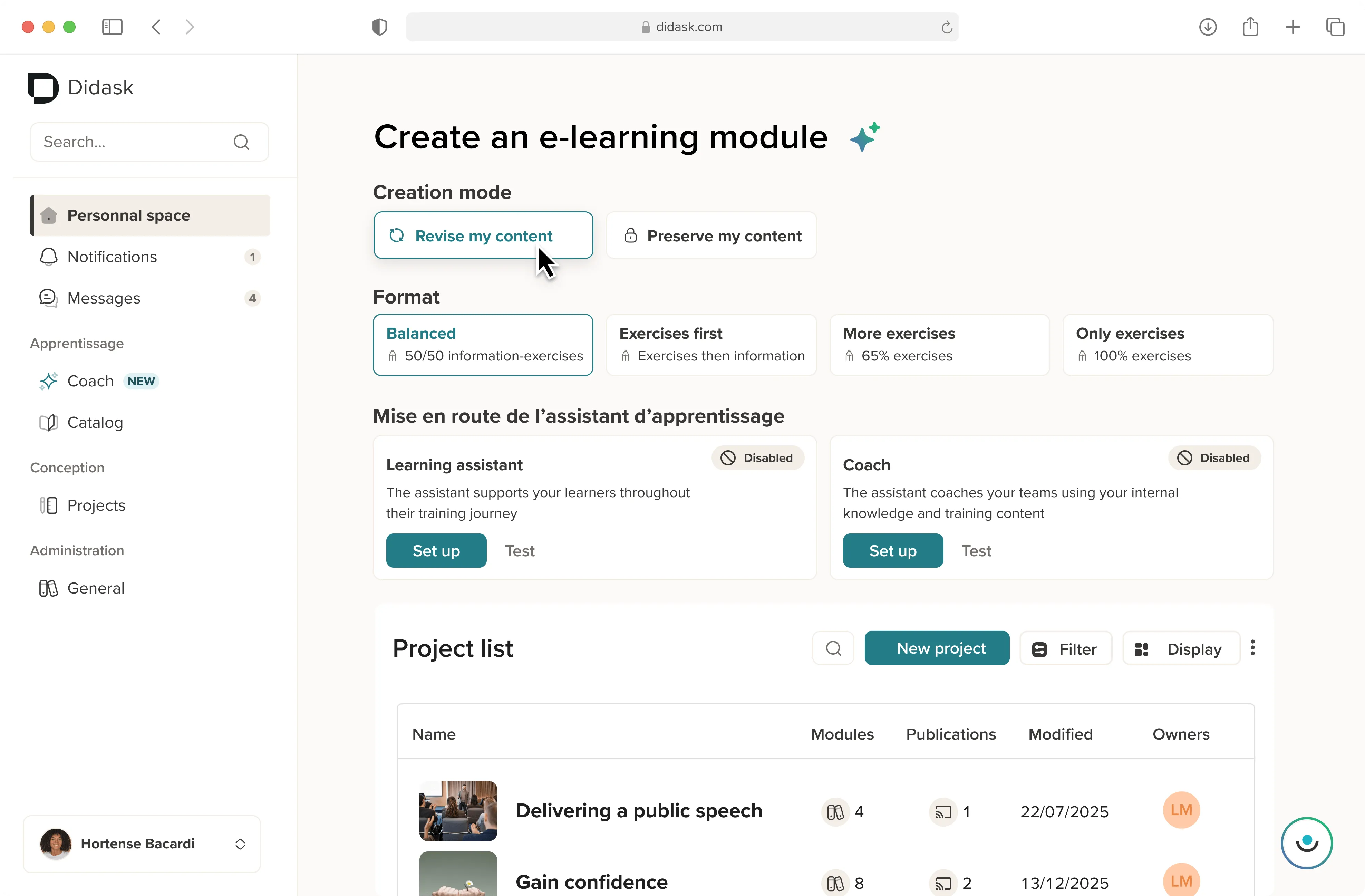
In-person sessions remain mandatory for certification. But digital intervenes effectively upstream (awareness, theoretical preparation) and downstream (anchoring of reflexes, spaced reminders, role-plays). It is this blended model that maximises the transfer of learning to the field. Didask's pedagogical AI also makes it possible to design these modules quickly, with no prerequisite in training engineering, while respecting the pedagogical requirements.
Tip
An effective blended system is structured in three stages: upstream digital awareness (MSD stakes, regulatory framework, prevention principles), certifying in-person training (situation analysis, certification tests), spaced digital reminders to keep skills active.
Conclusion
PRAP IBC training is a prevention investment, not an administrative formality. Its real effectiveness depends on three things: the commitment of management, the rigour of the post-training follow-up, and the quality of skills maintenance between two renewals. Companies that treat PRAP as a continuous process can see their MSDs fall durably. The others accumulate certificates with no results. It is up to you to choose which camp you want to be in.
.webp)
.webp)


.webp)


.png)