


Want to transmit your expertise effectively to boost your team's skills? The Didask solution gives you the opportunity to do just that! It is also perfectly suited to helping customer service advisors and sales staff adjust their behaviours and relational skills in a professional context.
Customer relations: major accounts have already bet on digital training
As Geoffrey Conan, Head of Development at Didask, explains, several training topics are addressed across the broad spectrum of customer relations. This includes:
- Valrhona: the Commercial Director of the Europe zone aimed to train her team on the new commercial policy — in other words, a new way of selling the famous chocolates;
- Canal+: BtoC sales staff based in Africa were trained to sell a new product range;
- Orange: telephone advisors (on platforms such as call centres) were trained in listening skills and customer guidance.
- Fondation de la Haute Horlogerie (FHH): staff were trained in welcoming and sales posture in boutique settings, in the context of luxury products (specifically, watches).
Geoffrey highlights in this regard one of the distinctive features of the Didask solution. "Our solution offers a built-in methodological framework, which structures the entire design process from start to finish. What makes the Didask tool unique and specific is that we support you from the reflection phase, whatever your training topic. We indicate an angle of approach, to address complex topics involving a relational dimension in a very straightforward way, as is the case with customer relations."
How to get started with a digital training programme for sales teams?
Whether due to the effects of the health crisis or challenges specific to your organisation, the digitalisation of training is becoming a priority. In this regard, Philip Moore, Head of Pedagogy at Didask, explains: "You are going to face a major challenge: certain elements from your in-person training will not be replicable in a digital format".
Generally, you start from a digital support, such as a PowerPoint, which will however present a few drawbacks.
- Content length: with sometimes more than a hundred slides, the amount of content can feel rather "heavy";
- Generic recommendations: generic messages about sales staff behaviour or golden rules to follow will not necessarily help your teams understand the meaning of this information in real work situations;
- Non-interactive content: you transmit information to your learners about the right behaviours to adopt in the sales process. They think they've understood everything, and yet… once they find themselves in a real situation with a client, they may not be able to apply the message. This is what is known as the illusion of mastery.
"It is important to provide interactive content, where learners themselves make the effort to ask: "faced with this client, in this situation, what would I do?" That is where our solution comes in." as Philip explains. Indeed, Didask's role is to enable you to easily and quickly generate a digital training experience for your sales teams that is simple, concrete and interactive, while getting straight to the point.
Role-playing scenarios: a trump card for learning
Didask training designed for sales staff is presented as a list of finely segmented modules, each lasting around 10 to 15 minutes: a real advantage for an enhanced learning experience! The core of the learning experience takes place through concrete role-playing scenarios specific to the world of sales, in which learners must make choices.
The scenario is followed by a question to the learner, with different response options. Based on their choice, the learner receives pedagogical feedback. Philip adds: "The aim is to ask: what might happen if I make this choice in this specific situation? What is the right behaviour to adopt?" Following this feedback, a key message relating to the case study just covered is presented to the learner. Additional information can be added in the explanation following the key message, helping the learner understand the main recommendation. Once the learning module is complete, the learner leaves with a conclusive summary in the form of a list of key messages. At the end of the experience and optionally, the learner can take on micro-challenges — daily challenges they can set for themselves.
Designing a sales training programme: get started!
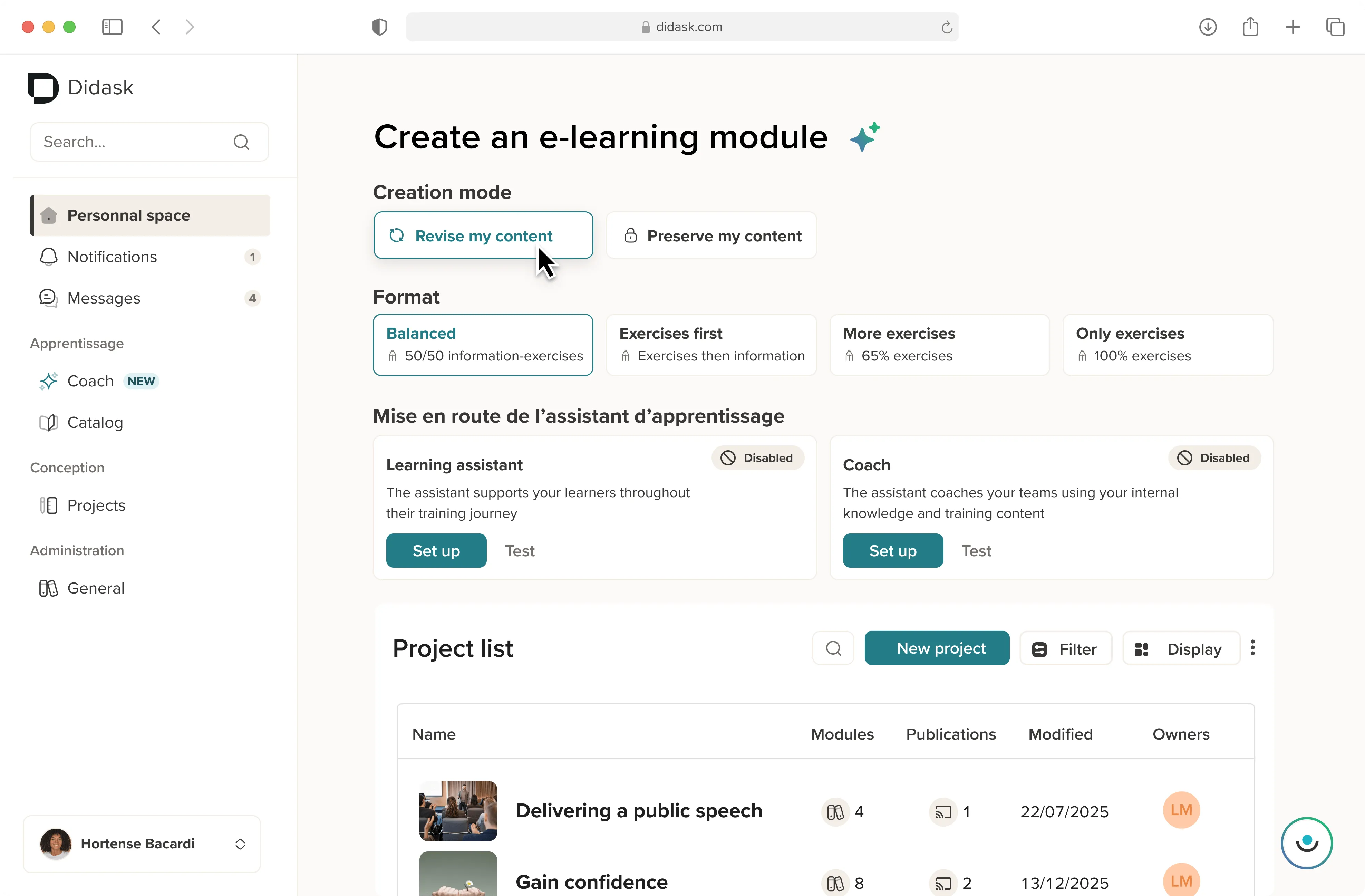
It's time to use the Didask authoring tool to design all your digital modules! Philip outlines how it works: "In the 'Library' section, you answer basic questions about what you are going to cover in your digital modules. Here, Didask takes a particular approach: we focus on the elements that have the greatest impact on your learners — in other words, the relevant errors". These are the mistakes your learners might make in real work situations if they have not been trained.
The idea is to list the potential errors your sales teams might make, and pair them with the expected changes in behaviour. For each "error–expected change" pair, you can create a practical case study that encourages the learner to adopt the desired behaviour. Starting from this error-based logic, according to Philip, means avoiding the trap of the obvious.
"If you didn't run this training, things could happen with your clients that you would not want (...). When creating interactive scenarios based on role-play, the risk is making exercises that are too simple, where the answer is known in advance! (...) This is not effective at all. If you practise and know all the answers, you lose the benefit of digital learning and don't hit the mark."
The "Editor" section also has a methodical framework, allowing you to quickly design your practical case study and make your scenario exercise very concrete. At every stage, you must keep in mind the error to avoid and the behaviour your learners should adopt. "We offer templates for sales training (...). In other words, it is a complete training programme already fully built within the tool. You have pre-filled scenarios, with elements that are easy to modify and edit (...). This gives you a starting point from which to build your cases and move much faster."
E-learning solution: what are the advantages for sales training?
As a commercial trainer, you benefit from how easy the Didask e-learning tool is to get started with. You therefore do not need any particular pedagogical or technical skills to create effective e-learning. As Geoffrey points out, "Our tool is designed for people who need to share their expertise quickly and effectively, whether they are subject-matter experts or senior sales staff. They are not necessarily professional educators!"
Finally, you benefit from a considerable time saving at a controlled cost, while still addressing highly complex topics. Geoffrey explains that with Didask, it takes "around 5 days to create one hour of e-learning, whereas international studies on the subject tell us that with a slightly less guided authoring tool, it takes on average around twenty days".
Good to know: Didask was founded by a group of researchers from the ENS. Their goal was not to spread "best practices" or popularise science. They wanted to enable everyone to create cognitively effective learning experiences. With nearly a hundred clients (major groups, associations, consulting firms), Didask currently has around twenty employees.
.webp)
.webp)
.webp)



.webp)

.png)