


A Structured Methodological Framework and Step-by-Step Guidance to Digitalise Your Training Quickly and Train Your Learners Effectively
It is sometimes difficult to approach certain training topics with good pedagogy — and even more complex to address them in eLearning. What's more, you're often lost among the many existing tools and methods. How should you proceed? A focus on the Didask authoring tool and its integrated methodological framework, which guides you step by step towards digitalising your training.
The Methodological Framework Makes the Course Designer's Experience Fluid and Fast, While Guaranteeing Learning Quality
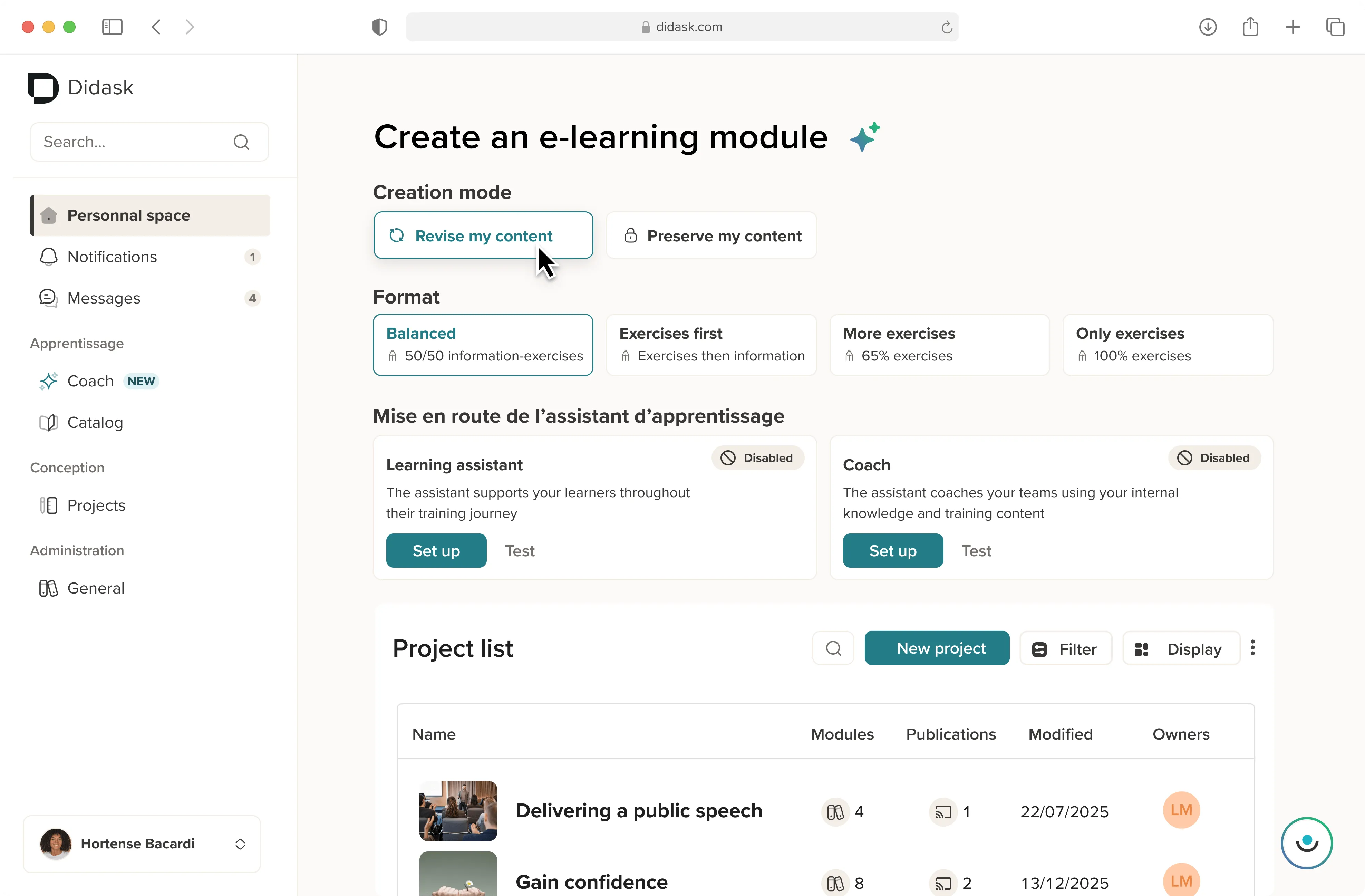
Whether you are a trainer, instructional designer or responsible for managing one or more training content pieces, the Didask authoring tool guides you, step by step, through all the stages required to create the desired learning experience. From initial pedagogical reflection through to publishing to the target audience (learners) and monitoring their learning data, you are guided and advised to ensure you produce engaging training experiences for your target audience — and above all, experiences that are pedagogically active. Whatever your level of technical or pedagogical expertise, the solution guides you through 4 key stages:
1 — Carry out genuine pedagogical thinking directly within the solution, using a learning model based on the desired changes in learners' states. Thanks to this guided method, the instructional designer uses the solution directly to curate their expertise and select the concepts on which learners need to progress (based on common errors observed in practice). In this sense, the solution acts like a pedagogical compass, guiding anyone who wants to share knowledge from the very start of their training project, helping them organise their ideas and quickly produce a relevant pedagogical breakdown.
2 — Produce interactive scenario-based exercises methodically, guided by the production framework developed by our cognitive science researchers. By following the pre-identified steps in this framework, the designer saves considerable time while being guaranteed to produce effective, impactful exercises. Guidance is offered at each stage of the designer's production process, so that the learner and the quality of their learning remain at the heart of every decision.
3 — Publish and distribute content simply and quickly within a ready-to-use Learning App, guaranteeing an interactive and personalised experience. The designer organises their learning modules and publishes them easily in just a few clicks. Thanks to automated formatting, they can focus their time and attention on what matters most: sharing their expertise.
4 — Evaluate and interpret the impact of their training using the aggregated statistics provided by the solution. The designer can track learner engagement and draw insights — such as identifying a misunderstood concept. They have an overview of the collective mastery rate, dropout rate, and time spent by learners on each exercise. The aim, once again, is to get as close as possible to the most common learner errors and identify pedagogical hot spots, so as to focus on continuously optimising training content.

Integrated Methodological Framework: What Are the Benefits for eLearning Content Quality?
The methodological framework is a structure that guides the designer's thinking to ensure the quality of learners' learning.
This learning model, within which the designer is guided, is the fruit of research by our cognitive science experts. All its components and principles are made available to designers in an accessible and engaging way, so as to maximise the pedagogical impact of their digital training.
For example, immersions in realistic scenarios — which the designer is supported in producing — promote the memorisation of concepts and their application in everyday professional life. The designer is also supported, by the solution, in incorporating a sufficiently sustained level of cognitive effort to ensure a rich learning experience for their learners.
Furthermore, the sequenced format that the integrated method proposes for designers to produce is perfectly suited to the new learning habits observed among learners and necessary for their continuous development: a short, concrete and engaging learning experience.
The designer will also be guided, by the methodological framework, to focus on one concept to transmit at a time — and one only — in order to limit learners' cognitive load.
Didask's integrated methodological framework therefore guides the design work step by step for anyone embarking on a training digitalisation project. By focusing attention on what matters most (pedagogy) and facilitating what matters less (the technical side), it makes it possible to create effective, engaging Learning Apps for learners: a 100% digital experience that encourages practice, reflection and lasting skills development!
.webp)
.webp)
.webp)





.png)