


With the rise of digital usage, FOAD (Open and Distance Learning) is establishing itself as an essential modality for training organisations and companies wishing to train their staff with full flexibility.
But what exactly is meant by FOAD? What are the challenges for learners and training managers? And how does Didask, as an LMS tool and training platform, effectively support this transition?
What is FOAD?
Definition and foundations
FOAD is a training programme in which learning takes place, in whole or in part, online or remotely, without constraints of place or time. It is based on the idea of breaking the unity of place and/or time: the learner is not necessarily in the presence of the trainer, nor at the same time as the others.
In other words, FOAD combines distance learning methods (digital tools, resources accessible online) with the open aspect (freedom of organisation, personalised pace). It can include asynchronous modules (courses, videos, quizzes) as well as synchronous sessions (virtual classrooms, webinars).
FOAD is recognised in France's vocational training regulations, notably in the DGEFP circular no. 2001-22 of 20 July 2001, and strengthened by recent vocational training legislation.
Distinctions: FOAD, e-learning, blended learning
- The term e-learning is often used to refer to any type of digital training, but without necessarily implying support or assessment. FOAD, by contrast, includes these pedagogical and administrative dimensions.
- Blended learning (or mixed-format training) combines face-to-face and distance learning phases, often in a complementary logic. A FOAD programme can be 100% remote or include some in-person or virtual classroom sessions depending on needs.
FOAD thus offers great pedagogical flexibility, allowing training organisations or companies to adapt the programme to each learner, vary conditions (online courses, virtual classrooms, digital resources) and reduce logistical constraints.
Why choose FOAD for your company, employees and trainers?
Open and Distance Learning is establishing itself as a modern and effective response to companies' and organisations' new training needs.
A solution adapted to new training needs
Companies must continually develop the skills of their employees to adapt to technological and organisational change. Yet time constraints, geographic dispersion and professional obligations often make in-person training difficult to organise.
FOAD offers a flexible and accessible solution: employees can follow their courses remotely, from any location, at their own pace and according to their schedule. It is a genuine lever for professional development, allowing training organisations to digitalise all or part of their programmes and companies to build flexible, personalised internal learning pathways.
Flexibility and accessibility: an asset for everyone
For learners, FOAD brings valuable freedom: following online modules according to their availability, without fixed attendance constraints. This flexibility is ideal for employees in work, remote workers, or those far from training centres.
For trainers, it is also an opportunity: they can reach a wider audience, offer varied pedagogical modalities and track each learner's progress more precisely through digital tools.
Cost reduction and optimised training time
Another major benefit of FOAD lies in the reduction of logistical costs: no more travel, room hire or accommodation. Learners connect remotely, limiting work interruptions and optimising their working time.
This organisation is particularly advantageous for multi-site companies or teams spread across several regions.
Interactive and diverse training
Thanks to digital tools (videos, quizzes, virtual classrooms, simulations, forums), FOAD encourages interactive and engaging pedagogical practices.
Learning becomes more dynamic: exchanges with instructors, personalised feedback, formative assessments… All levers that stimulate engagement and reinforce programme success.
The diversity of modalities (asynchronous, synchronous, self-paced or supported) also makes it possible to adapt training to all profiles and all company contexts.
A lever for large-scale skills development
Finally, FOAD facilitates the deployment of vocational training at scale without sacrificing pedagogical quality. Courses are personalised, learners progress at their own pace, and trainers provide continuous support through live sessions or tutoring.
This approach not only improves the uptake of learning, but also optimises training ROI while reinforcing employee motivation and autonomy.
How to effectively organise a FOAD programme?
Laying the groundwork: defining pedagogical and technical objectives
First and foremost, it is essential to define clear educational objectives, map the targeted skills and consider technical constraints (connectivity, devices, compatibility). Learners must also be informed about the remote modalities, estimated durations and available resources, as required by regulations.
Choosing the right learning platform (LMS)
The choice of an LMS is central. The learning management system must offer:
- a user-friendly interface for both learners and trainers;
- tracking, reporting, quiz and virtual classroom features;
- the ability to organise courses, personalise modules and mix formats;
- technical and pedagogical support.
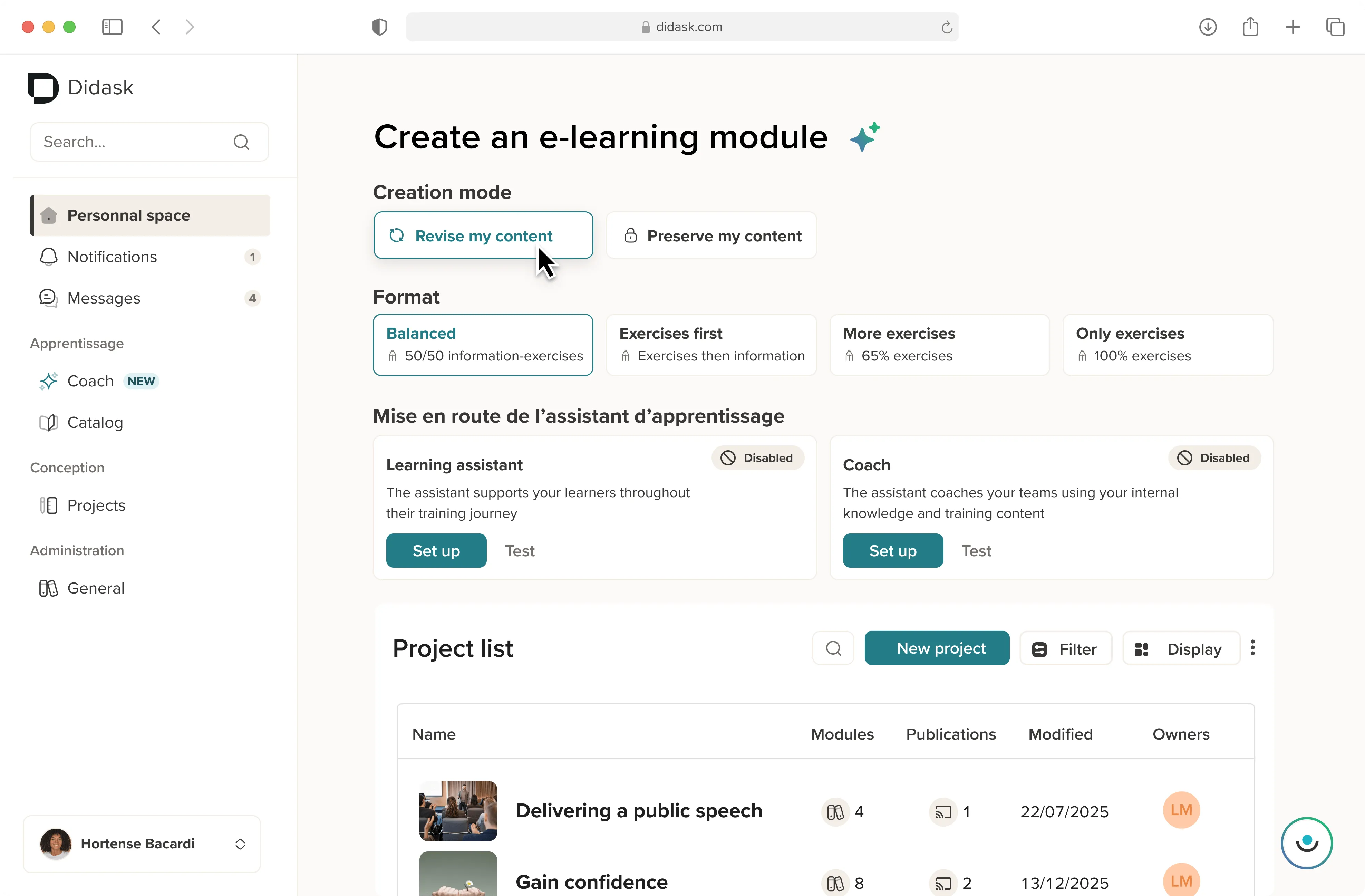
This is where the Didask LMS comes in: it allows organisations and companies to create, manage and deliver FOAD programmes seamlessly.
Structuring the programme and personalising modules
The programme must be sequenced into progressive modules, with activities (quizzes, case studies, exercises, discussions) and assessments. Modules should be adapted to different profiles, making some content optional or differentiated.
Tutoring, online contact points or live sessions can be integrated to strengthen support. Finally, skills tracking must be structured around interim and final reviews.
Frequently asked questions about FOAD
What is the duration of a FOAD programme and how do you follow it?
Duration varies according to objectives, learning volume and profiles. A FOAD programme can range from a few hours to several months, depending on the professional pathway targeted. Learners follow modules at their own pace, according to their schedule.
The platform structures the programme: each module has an estimated duration and assessments to validate progress.
How is FOAD funded?
FOAD can be funded through standard vocational training mechanisms (OPCOs, CPF, skills development plan, etc.). FOAD is recognised as a training modality, provided the legal requirements are met (pedagogical support, prior information, assessments, etc.).
Some OPCOs accept funding for FOAD programmes, provided the training organisation presents a compliant programme.
The legislative and regulatory framework for FOAD
FOAD is defined by the French Labour Code (art. L. 6353-1) as a flexible training programme comprising individualised learning, access to resources and knowledge remotely.
To be eligible for funding, a FOAD programme must guarantee:
- pedagogical and technical support for learners;
- clear information on remote activities;
- formative or certificative assessments;
- traceability of progress
How does Didask facilitate the implementation of a successful FOAD programme?
Didask offers an operational solution to design, deliver and track effective FOAD programmes. Here's how:
1. Integration of the Didask training catalogue
The Didask training catalogue is ready to use and covers many domains. Organisations can integrate these modules into their FOAD programmes, adapt them and combine them into bespoke pathways. This accelerates the deployment of effective programmes without starting from scratch.
2. Centralised and modular platform
The Didask platform makes it possible to structure programmes, manage enrolments, organise modules, add multimedia resources and quizzes. Trainers have access to detailed dashboards to track learner progress, identify sticking points and intervene with tutoring.
3. Pedagogical and technical support
Because a good FOAD programme requires support, Didask provides technical assistance (help, troubleshooting) and instructional design advice to help organisations build effective modules, adapted to learners, with relevant formats (blended learning, synchronous, asynchronous).
4. Compliance with regulatory requirements
Didask integrates the mechanisms needed to meet legal requirements: activity traceability, reviews, assessments and reporting. This facilitates obtaining funding via OPCOs or other public mechanisms.
5. Innovation and scalability
The platform continually evolves to integrate new practices (microlearning, adaptive learning, social learning) and allows FOAD programmes to be updated based on learner feedback and business needs.
FOAD represents a revolution in the world of vocational training: it delivers greater flexibility, accessibility and efficiency. When well implemented, it enables organisations to strengthen employees' skills without sacrificing operational productivity.
For organisations and companies wishing to adopt this modality, Didask provides a complete solution. By combining the strengths of FOAD with the features offered by Didask, you have a powerful lever to design high-performing learning programmes, engage your learners and successfully deliver your training strategy in the digital world.
.webp)
.webp)
.webp)





.png)