
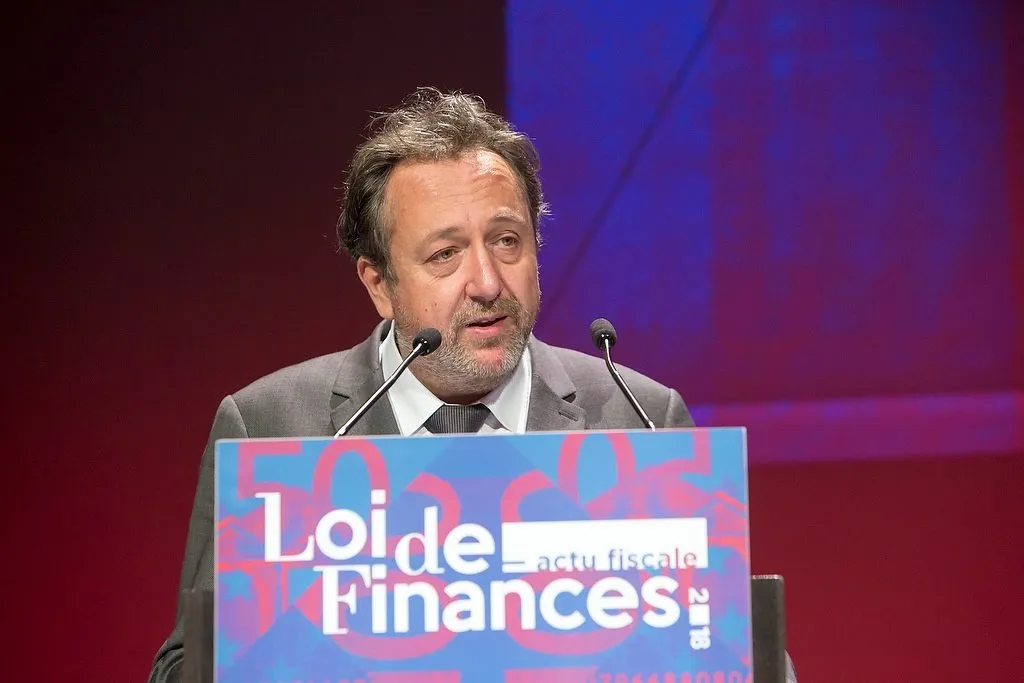

The evolution of the accounting profession and the role of effective training, by M. Benoudiz, president of the Order of Chartered Accountants
Interview with L. Benoudiz, president of the Order of Chartered Accountants
Laurent Benoudiz, president of the Order of Chartered Accountants, explains the evolution of the accounting profession. The digital revolution is pushing many professions to redefine themselves, and accounting is no exception. To guide firm employees towards a successful transition, Laurent Benoudiz emphasises the importance of training with real impact.
What are the current challenges facing the accounting profession?
Laurent Benoudiz – Today, an accounting firm devotes most of its time to producing financial statements and tax and social security returns, to the detriment of clients' management advisory needs. Our revenue is therefore largely made up of accounting, tax and social production work — rather than advisory or support services, even though, like Monsieur Jourdain, we perform them daily without identifying or billing them.
The automation of processes with the arrival of increasingly effective online solutions is impacting our business model. If we do not demonstrate to our clients the services we provide beyond accounting production, they will inevitably question our relationship. We therefore need to identify the value we bring and rethink our profession accordingly. This is a crucial issue because, in the medium term, the very survival of our profession depends on it.
How do you intend to respond to the challenge of the profession's digital transition? Are you optimistic about its effects, or rather fatalistic like Laurent Alexandre?
L.B. – We believe Laurent Alexandre is mistaken when he argues that only augmented human intelligence will be able to compete with artificial intelligence. His approach conflates the different components of intelligence and implies they are equivalent, whereas reality is far more complex. Personally, I believe it is relational and emotional qualities that will make the difference once AI has made intelligence commonplace.
Today, 95% of French businesses are small businesses. If they remain as numerous tomorrow, they will still need human advice and human support. That is the need we primarily wish to meet, and it is to serve that need that we will draw on artificial intelligence and big data.
Rather than asking ourselves what will change, we have chosen to focus on what will not change over the next 10 or 20 years: our clients' expectations in terms of legal, tax and social security protection, management support and advisory services for their projects. Our clients want to be supported in their management and advised on their projects. Yet a great many firms have lost sight of these needs — and it is easy to understand why: overwhelmed by growing administrative complexity, drowning in reporting and deadline pressure, they simply had no choice.
To succeed in the digital transition, we must therefore return to our fundamentals, remind ourselves that ours is an advisory profession and that our purpose is not to serve the state administration but our clients. If this message is clearly understood by my colleagues, it remains to be communicated to our employees!
Why did you choose to work with Didask?
L.B. – To transform our employees' approach to their work, we needed a different kind of training: one that works and delivers results! We therefore reviewed the available solutions, and Didask's pedagogical approach immediately convinced us.
We designed a 10-day training programme comprising 5 modules of 2 days each: 1 day online and 1 day in person. We called it "e-coll: from production to support". The aim is to help our employees evolve — those who successfully handle clients' monthly administrative tasks — towards developing client advisory skills. Preparing the VAT return must no longer be the goal of the monthly meeting, but rather one of the tasks to complete before meeting the client to discuss how their business is performing.
To bring about this change, technical skills need to be acquired, but above all behavioural skills. Didask, with its thoughtful pedagogical approach and its new, supportive learning interface, seems to us the right solution to meet this challenge. The early results we are seeing with the first trained groups seem to prove us right, to our great satisfaction and that of Didask!

Other articles on training in the accounting profession
– Better training to transform the accounting profession, interview with Philippe Barré, founder of Pluriel Consultants
– Case study: an effective programme to help the accounting profession transform
1: E-coll, a demanding training programme for the digital transformation of the accounting profession
2: Accounting profession: the method used to create modules that precisely meet the profession's needs
.webp)
.webp)
.webp)

.webp)



.png)