
%20(1).webp)

Sandra is starting a new job in a new company. She has the energy of the beginning... and a stranger above her head: how does it work here? The first impression will be crucial for the rest of his employee experience.
From the outside, onboarding often seems like a formality: a bit of administration, presentations, a visit to the premises, integration interviews, a few docs, a team lunch. And then, “it's going to do it.”
Except that's rarely where it gets stuck. It gets stuck when Sandra has to “produce” for real: understand who to ask what to ask, avoid beginner mistakes, find her place without stepping on everyone's feet, and deliver something right without spending her evenings there. If onboarding is flawed, everyone pays for it: Sandra (stress, feeling useless), the manager (mental load, rework), the team (friction), and the company (lost time, early departures, early departures, turnover, late performance).
Successful onboarding is therefore not “making a good impression”. It's ensuring a good entry into real work, without burning the person or saturating the team. This is a crucial step that plays a critical role in retaining talent.
The objective of this article is simple: to offer concrete instructions for use. A method for framing what “successful” means in your home, then a clear checklist of the essential steps to take, without jargon, without a gas factory, and without telling each other stories.
What does “successful” onboarding mean exactly?
There is a simple way to make a mistake: to believe that an onboarding was successful because the welcome was warm and “everything has been said”.
In reality, onboarding is successful when one thing is true, without debate: the person is able to calmly do the job for which they were recruited. That is the definition of a successful integration.
Onboarding: making work possible, not just transmitting information
Onboarding, in the useful sense of the term, is all that allows a new employee to:
- to understand what is expected of him (priorities, scope, level of requirement, mission),
- to know how it works here (tools, rules, decision circuits),
- to integrate corporate codes and culture (what is valued, what is not, “how do we do things here”),
- to produce its first results without multiplying avoidable mistakes,
- to quickly identify the right relays (who helps on what, who validates what, who arbitrates what) within the organization.
In other words: the challenge is not to “deliver news”. The challenge is to reduce the unknown at the moment when the real work begins. That's what makes the difference between a lost newcomer and a new operational employee.
When does it start? As soon as we anticipate (really)
This therefore starts well before the first day in the company, at a time when the employer must take care of two dimensions in parallel. We then talk about preboarding (or pre-boarding).
The land: ready equipment (computer, telephone), access to software, access to software, workspaces, useful documentation, planning for the first weeks. The workstation and the office must be operational.
Humans: manager, new team, HR, buddy or sponsor... ready, available, and in agreement on who does what (otherwise, everyone thinks it's “someone else”).
This is often where the difference between a smooth finish and an “empty” finish comes into play. Not with the intention, in the preparation beforehand. And even for very “square” organizations, with an onboarding process that is already well-established and partially automated: each arrival represents an event. You still have to check that everything is ready, that the key people are there, and that the reality has not changed since the last integration.
.png)
Preboarding: laying the groundwork in advance
Preboarding refers to all actions taken between the signing of the employment contract and the first day at the company. It is a crucial phase for creating a positive first impression and reducing the anxiety of the incoming employee. In practice: send a personalised welcome message, share the welcome pack with practical information, finalise the administrative paperwork (electronic signature), and make sure the workstation will be ready. A candidate who feels supported before they arrive is an engaged new employee from day one.
And it doesn't end when Sandra knows the CEO's first name
It ends when she reaches observable autonomy: she knows how to do the expected work, within the expected standards, with the right level of support, and in a setting where she feels good. Social integration is as important as operational integration.
The good reflex is to avoid vague definitions (“she is integrated”, “it is going well”) and to ask yourself a very concrete question: what should Sandra be autonomous on in 30, 60, 90 days... and how will we know it? This approach makes it possible to measure the effectiveness of the process.
If there is no clear answer to this question, onboarding becomes a mixture of goodwill and improvisation. And that mix can be expensive for the business in the long run.
Step 0: Define your “proofs of autonomy” (the thing that changes everything)
Before carrying out a checklist, you have to answer a very simple question: autonomous on what, exactly?
Otherwise, onboarding becomes a series of actions “because you have to do it”, without direction. This is a crucial phase in the implementation of structured onboarding.
The idea is to aim for observable evidence. Elements that allow us to say, without poetry: yes, Sandra can work here. This observation makes it possible to objectively assess the start of work.
The 5 “moments of truth” of the post
In any job, there are 5 or 6 situations that come up all the time and that immediately reveal if someone has taken the lead. For example:
- start a task (where is the right info?)
- ask/have validated (to whom, how?)
- manage an unexpected event (emergency, bug, customer)
- working with others (dependencies, coordination, team building)
- deliver (what does a “good” deliverable look like here?)
To identify them, rely on people who really know: managers and business experts in each sector. They are the ones who see the difference between “it was done” and “it was well done”, and they are the ones who will be able to assess autonomy without telling each other stories.
Concretely: 30 minutes of meeting, for 2 or 3. The manager (essential) + a business expert and, if possible, the person who will be a mentor or sponsor. Each lists the situations where new employees fail, hesitate or waste time. Then, we keep the 5 most frequent ones.
The important point: don't ask them to invent a course. Give them a framework and simple tools to follow up (expected evidence, 30/60/90 milestones, checkpoints). The objective is to make their life easier and not to add an extra project. This support strategy is essential.
Turning these moments into evidence
For each truth moment, we keep a testable statement:
- “Sandra knows how to do X alone (or with this level of help)”
- “Sandra avoids the Y error”
- “Sandra uses Z in the team rules”
Example: “deliver” is not proof. “Submitting a report in the right format, validated the first time” is one of them. It is a concrete performance indicator.
The 30/60/90 day mini-plan
Spread your evidence over time:
- D+30: essential bases, adaptation to the new working environment
- D+60: common cases, with regular feedback
- D+90: real autonomy, including managing the unexpected
This plan doesn't have to be perfect. He needs to exist and evolve: he is the one who transforms onboarding into a path to autonomy, rather than a stack of rituals. This is the best way to ensure a gradual increase in skills.
The essential kit (3 bricks) for a really successful onboarding
If you only have to keep three things, keep these: a checklist, a single source of truth, and a job learning journey. These three elements form the basis for effective onboarding.
1) A checklist (short): who does what, when, and to get what
The checklist is not just another document. It is a steering and management tool: who is responsible, when, and what proves that it is really done. In practice, this checklist follows a very simple sequence: preboarding → first day → first week → points D+30/D+90.
.webp)
Tip: invest in engaging communication
Social integration matters just as much as operational integration. Plan informal moments of connection (team breakfast, coffee with the buddy), use internal social networks or Slack to introduce the new arrival, and encourage team members to make themselves available. This kind of thoughtful communication strengthens the sense of belonging and accelerates adaptation.
2) A single source of truth: a practical guide to what needs to be transmitted
The single source of truth is mainly used to transmit information: how it works, the points of reference, the rules of the game. It is an essential resource for welcoming newcomers in a structured way.
This single source should be a practical guide to continuous improvement, not a document graveyard. It must answer the questions that really come up:
- Who to contact according to the subject (job/tools/HR/IT)
- Tools & access: Where to go, how to request a right, who unlocks what
- Rituals: regular meetings, communication channels, implicit expectations
- Standards: formats, templates, examples of deliverables
- Culture: What is valued, the history of the company, the employer brand
- Glossary: acronyms and internal codes
- Compliance and legal aspects: legal obligations, electronic signature of the employment contract, administrative part
And she must live! Each time a new employee arrives, we collect 3 irritants (“I looked for this for 20 minutes”, “I didn't know who to ask”, “I discovered that too late”) and we update the guide. Otherwise it becomes fake. And a wrong guide costs more than an absent guide.
3) A job learning path: the heart of onboarding
This is where a lot of onboardings fail, even when they are very “square.” Because they are confusing two things: being informed and knowing how to do it.
You can know the procedure and still get stuck. You can have “read the doc” and still be stuck in front of a real case. This is why successful onboarding must be thought of as a training course, in the sense of structured skills development, built with practice, tests, and feedback.
Designed with managers and business experts (otherwise, it's a failure)
This career path must be built with business experts and managers, because they are the ones who know the challenges of the position, its difficulties or the typical mistakes. Their participation is crucial for effective training.
The challenge is not asking them to “write a course.” The challenge is to outsource the design to them, by giving them digital tools and a platform that make creation easy even without pedagogical skills (and that exists). It is a solution that increases the efficiency of the process.
What does an apprenticeship that works in onboarding look like?
We will prefer short, concrete sequences and most often online for practical reasons. Cognitive science in particular, recommend practical cases close to reality, with regular and benevolent corrective feedback, and a high degree of personalization according to the progress of the new recruit or his previous level.
It's simple, but it changes everything: the new employee does not “consume information”. He is training to do the work. This active adaptation improves productivity and satisfaction.
Training tools that make a difference
For truly effective onboarding, you need real training tools, capable of:
- absorb and deal with pedagogical complexity (progression, repetition, feedback, consolidation, personalization),
- allow us to move quickly (because everyone is overwhelmed) and the latest advances in artificial intelligence are valuable here,
- adapt finely to the constraints of recruits (rhythms, availability, mobile, micro-sequences, remote or face-to-face work),
- precisely monitor progress (what is acquired, fragile, not acquired) using learning data.
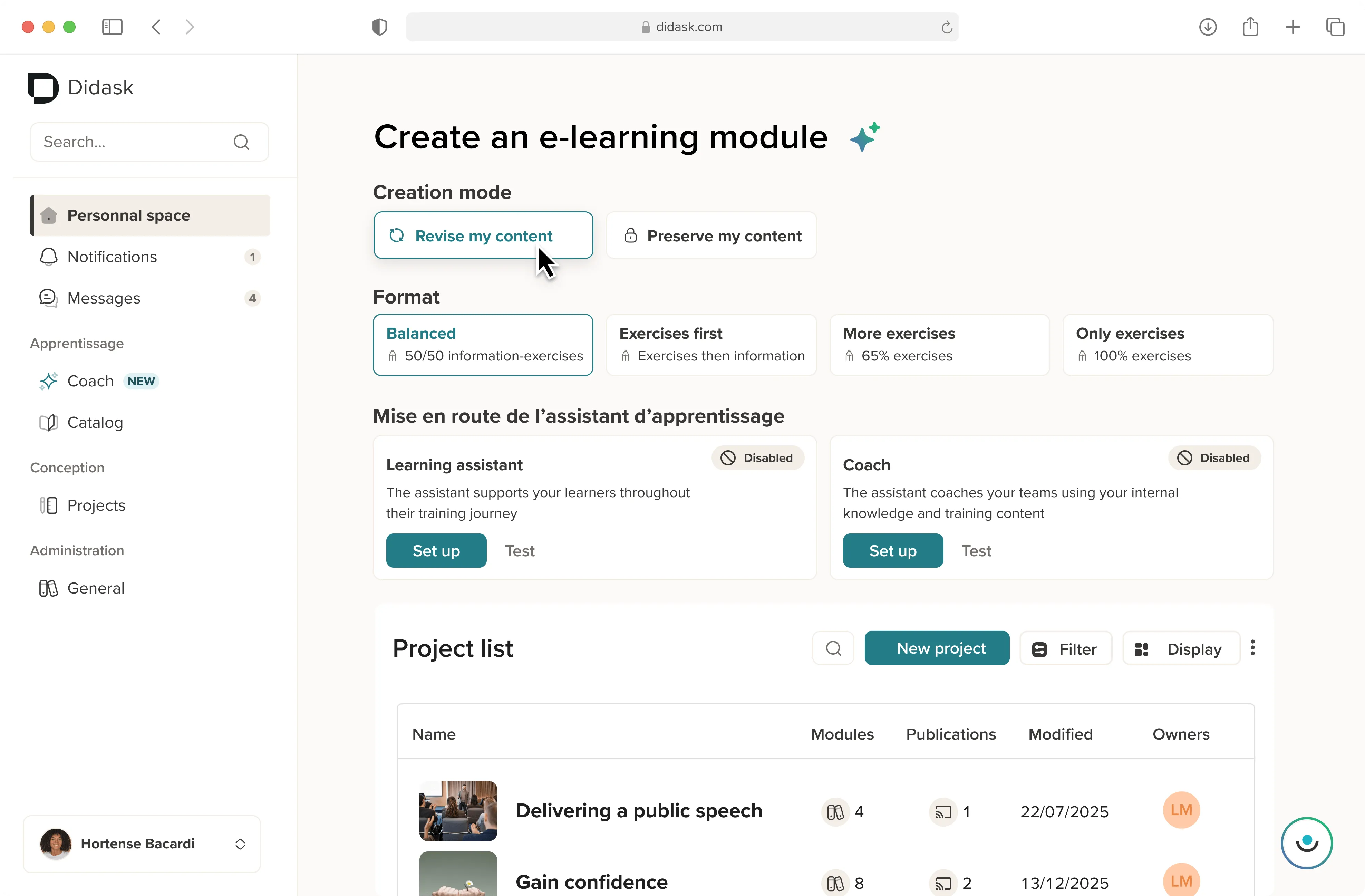
This is where LMS training platforms do well, like Didask, which, thanks to its educational AI, ticks most of the boxes. These features make it possible to implement a personalized development program for each member of the team.
Measuring the effectiveness of your onboarding
To assess whether your process is working beyond gut feeling, track these performance indicators: the retention rate of new employees at 6 months and 1 year (turnover), time to effective autonomy, satisfaction level via an integration review, and the volume of questions and support tickets during the onboarding period. This data allows for continuous adjustment and a better employee experience.
Successful onboarding is not about “human welcome” only, but about the company's ability to move a person from “new” to “useful and serene” status, without exhausting him or her, and without exhausting the team. It is a strategic challenge for retaining talent in the current job market.
The good news is that it's not a mysterious art. It is a system, a structured approach.
A checklist to make sure nothing falls between two chairs. A single source of truth for information to be findable. And a learning journey so that Sandra did not only “receive”: she learned how to do, within the standards of the job. The training time is thus optimized.
And above all: it's getting better. Each time the employee arrives, we recover what has stuck thanks to informal moments of exchange and feedback, we adjust, we simplify. Because perfect onboarding doesn't exist. But an onboarding that progresses and that offers an ideal experience, yes!
Ready to transform your recruitment and onboarding process for new employees? The effect on engagement and retention can be seen in the first few months.
.webp)
.webp)
.webp)



.webp)

.png)