
.webp)

Nadia arrives at her new company on a Monday morning. She takes up her position as a customer service team manager in a digital services company. She has already managed many people, knows the job, and there is nothing to suggest that taking up a position poses a particular risk.
The onboarding of recruits managers, leaders, CEOs... never concerns a single employee. It shapes the commitment of employees, the quality of management and, ultimately, the performance of the team. However, in many companies, new managers are treated like all other new employees with standard onboarding.
It is a mistake.
Integrating a new manager is not the same as welcoming one more employee. It means preparing and structuring the future impact of leadership on a team. And this requires a specific integration system, designed as a strategic lever for success for the collective. This essential integration of new managers constitutes a fully-fledged onboarding approach, whose keys to success go well beyond the simple transmission of information.
These findings raise an essential question: how to design an onboarding system that maximizes impact while reducing design time?
Why the onboarding of managers is a strategic issue
When Nadia takes over as head of customer service, her arrival doesn't just change the organization chart. It immediately changes the daily lives of its fifteen employees.
From the first week, his team is looking for landmarks. How does it prioritize requests? What place does it give to listening, to autonomy, to flexibility? How does she react when faced with an error? How does she give feedback? These signals, sometimes subtle, influence the collective dynamic and the way in which employees engage, take initiative and express their talent or, on the contrary, withdraw. The relationship of trust is beginning to be built... or to be weakened.
The challenge of his program successful onboarding is therefore not limited to his understanding of internal tools or processes. It is about his ability to quickly embody a clear and coherent framework for his colleagues. A major challenge!
.png)
Key point
According to Gallup, 70% of the variation in team engagement is attributable to the manager. Manager onboarding is therefore a direct lever for collective performance.
This level of impact makes the integration phase particularly strategic. A new manager or leader who is poorly supported when taking up a job can, unwittingly, create areas of uncertainty or undermine employee confidence. Conversely, a structured onboarding plan facilitates alignment, clarification of responsibilities, and the establishment of a healthy work dynamic.
It is precisely this collective scope that distinguishes the onboarding of new managers from a standard integration process. It's not just about welcoming a new employee, but about orchestrating a leadership transition. The success of taking on the job of a manager is therefore based on a structured implementation and practical support from the first week.
What distinguishes the onboarding of a manager from that of an employee
Let's go back to the case of Nadia.
When a new employee joins customer service, their onboarding is mainly aimed at allowing them to understand their position, tools and missions. He learns to integrate into an already structured team, to master the processes and to contribute progressively to the results.
Nadia, on the other hand, does not fit into a team. She takes responsibility for it.
From the very first days, she must arbitrate priorities, clarify objectives, manage the first possible tensions, establish her management style, take a leadership position. She is not only in the learning phase: she is immediately in a position of influence and must ensure.
Classic onboarding is often based on the transmission of information: presentation of the company, training in tools, discovery of internal procedures. For a manager, that's not enough. The challenge goes beyond understanding the processes. It is about posture, legitimacy and the ability to create a relationship of trust.
In practice, these differences can be summarised in the following way:
For Nadia, this managerial transition is not a simple adaptation: it requires a structured process, because its impact on the team is immediate and lasting. Successful onboarding does not only mean being operational. This means understanding management expectations, identifying informal balances within the team, and finding the right positioning between continuity and transformation.
This is why onboarding managers requires a specific, more demanding and more structured process.
The risks of insufficiently structured managerial onboarding
Let's imagine that Nadia's onboarding is limited to a presentation of internal tools, a meeting with HR and a list of goals to be achieved.
Quickly, she finds herself alone facing complex questions and decisions. Do we need to change the organization of the team? Reframe an employee from the first week or wait? Without a clear framework or support, it risks acting too quickly, or delaying the necessary arbitrations.
Insufficiently structured managerial onboarding exposes the company to several risks.
First, a risk of losing credibility. If initial decisions are misunderstood or perceived as inconsistent, trust can be permanently eroded. However, when taking a managerial position, legitimacy is built very early on.
Then, a risk of disengagement. A team that doesn't understand priorities or sees strategic vagueness can slow down or fall back. The impact on collective performance can be rapid. One onboarding Insufficiently prepared can thus compromise the commitment of employees, weaken the collective dynamic, or even scare away talent.
Finally, a risk of isolating the manager. Without formalized milestone points or structured feedback, Nadia may struggle to adjust her posture or identify weak signals. This lack of follow-up reduces his ability to learn in a phase that is nevertheless decisive.
.webp)
To note
The first few months of a managerial appointment are decisive for credibility and team dynamics. Structured support during this period significantly increases the chances of success.
These issues are not trivial. The SHRM (Society for Human Resource Management) emphasizes that the onboarding of managers should be designed as a specific process, structured around structured steps ranging from the initial diagnosis to the continuous evaluation of results.
In other words, the integration of a new manager cannot be improvised. It requires rigorous implementation, regular monitoring, adjustments over time, and adequate tools.
It is precisely to avoid these excesses that a specific onboarding of managers is essential.
To design a managerial onboarding that truly transforms rather than informs, it is essential to rely on effective teaching methods and a structured methodology.
How to structure the onboarding of managers in concrete terms
If you want to secure the handling of Nadia's position, onboarding cannot be limited to an administrative checklist. It must be organized as a genuine managerial integration process, designed over time.
The objective is to build successful onboarding, designed as a real integration process for new managers.
1. Perform an initial diagnosis
Even before the manager arrives, it is essential to clarify the context: what are the team's priority issues? What are the existing stress points? What are management's explicit and implicit expectations?
This diagnosis makes it possible to adapt the onboarding process to the real role, rather than applying a standardized process. This integration management stage makes it possible to adapt management to the real context of the organization.
2. Explicitly clarify the scope and priorities
A new manager needs a clear vision of his mandate: short-term goals, room for manoeuvre, indicators of success. Formalizing these elements from the first week reduces areas of uncertainty and facilitates alignment.
3. Organize structured meetings with key stakeholders
The integration of a manager does not only concern his team. Meeting support functions, peers and management allows you to understand the actors and the management culture of the company. This stage promotes social and relational integration, which is essential for success.
4. Provide targeted managerial support
The development of managerial skills does not have to be implicit. Leadership, communication, conflict management, steering: these dimensions require specific reinforcement, even for an experienced manager.
A structured training system, in person or via a digital learning platform, makes it possible to support this increase in skills in the first weeks.
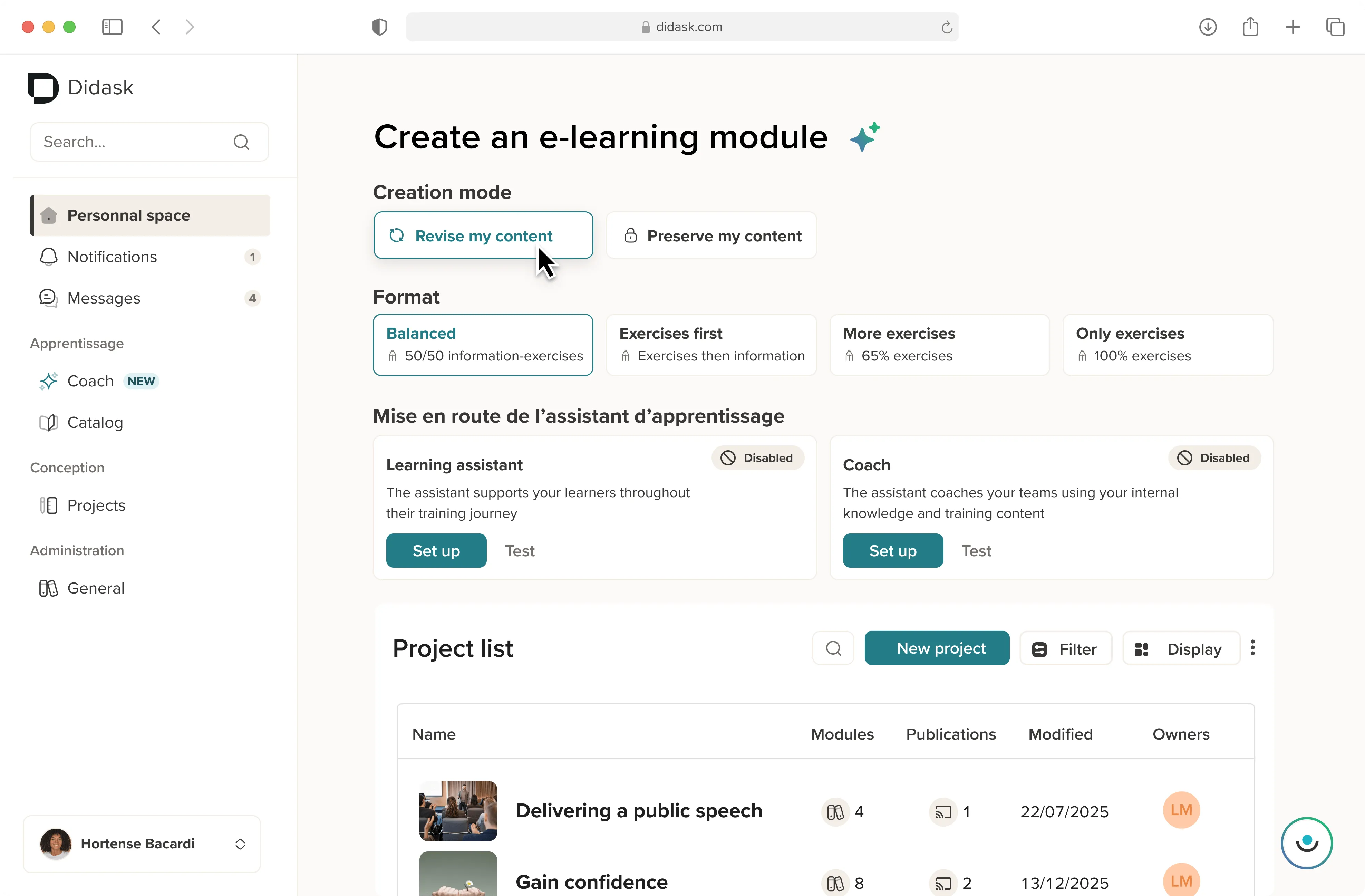
It is precisely in this type of situation that a solution like Didask can play a role. By transforming internal expertise into structured learning paths, adapted to the role and accessible in real time, the company can effectively support managers. Such a onboarding tool contributes to structuring the employee experience and to securing the skills of managers over the long term.
5. Establish regular and formalized follow-up
The onboarding of managers does not end in the first month. Stage points at 30, 60 and 90 days allow you to assess the understanding of the position, the quality of integration into the team, and the necessary adjustments.
This regular follow-up secures the transition and reinforces the relationship of trust between the manager and the management.
For Nadia, such a process does not guarantee the absence of difficulties. But it reduces areas for improvisation and transforms taking a risky job into a controlled transition. It is this structure, from diagnosis to follow-up, that makes the difference between formal onboarding and effective onboarding.
Conclusion
The onboarding of managers is not an ancillary system. It conditions the quality of management, the stability of the team and collective performance.
In Nadia's case, it's not just about her technical skills or experience. What will make the difference is how their arrival is prepared, accompanied and monitored. A structured integration process gives it guidelines, clarifies its mandate and secures its first decisions.
Treating manager onboarding as a simple extension of a standard career path is to underestimate its real impact. Conversely, considering it as a strategic lever makes it possible to transform a transition phase into an opportunity for alignment and commitment.
The implementation of a clear and structured onboarding process is now a key responsibility of management and human resources. In the end, integrating a manager is not only about welcoming a new collaborator. It means organizing the conditions for effective leadership, in the service of collective success.
.webp)
.webp)
.webp)
.webp)



.webp)

.png)