


One Onboarding A failure costs an average of €7,000 per recruit lost. However, most of the available templates simply list administrative tasks.
The real challenge remains ignored: the real increase in skills of the new employee. This article proposes a different approach, rooted in cognitive science, to design integration paths that produce measurable results.
Why traditional onboarding models fail
Traditional onboarding approaches share a major flaw: they ignore how the human brain works. Administrative checklist, PowerPoint presentation, or overloaded welcome day rarely produce the expected results.
Cognitive science explains why these methods don't work sustainably.
The illusion of the exhaustive checklist
Multiplying information on the first day causes cognitive overload. Working memory can only process 4 to 7 items simultaneously.
Beyond that, the brain saturates. Excess information is simply not retained, no matter how important it is.
An effective model should space learning over time. Spaced repetition allows a lasting anchoring of knowledge, unlike the informational “force-feeding” of day 1.
The top-down presentation trap
The “corporate presentation” format places the newcomer in a passive position. However, active learning produces results that are much better than passive listening.
Without a concrete scenario, the information remains abstract. On the contrary, pedagogy through error allows knowledge to be anchored by confronting the learner with practical cases.
The 5 onboarding models you need to know
Each onboarding model responds to specific contexts and constraints. Here is a clear typology to identify the one that corresponds to your organization.
The administrative model (baseline)
This model covers the bare minimum: signing the contract, handing over the equipment, creating system accesses. It constitutes an indispensable base but insufficient on its own.
Adapted to structures with high turnover and low business complexity, it does not allow a real increase in skills.
The social model (buddy system)
The sponsorship system assigns a mentor to the new collaborator. This approach promotes cultural integration and the creation of relationships within the team.
Its main limitation lies in the dependence on the quality of the sponsor. Transmission remains informal and unstructured, with varying results.
The immersion model (learning by doing)
Learning by action quickly immerses the recruit in his missions. It is suitable for experienced profiles who are able to learn independently.
The risks are real: learning bad practices, high stress, costly mistakes without appropriate support.
The model structured in stages (30-60-90 days)
This model of integration plan sets progressive goals over three months The gradual increase in load avoids initial cognitive overload.
Its rigidity is its main weakness. It does not adapt to the real level of each recruit and applies the same rhythm to all.
The adaptive model based on cognitive science
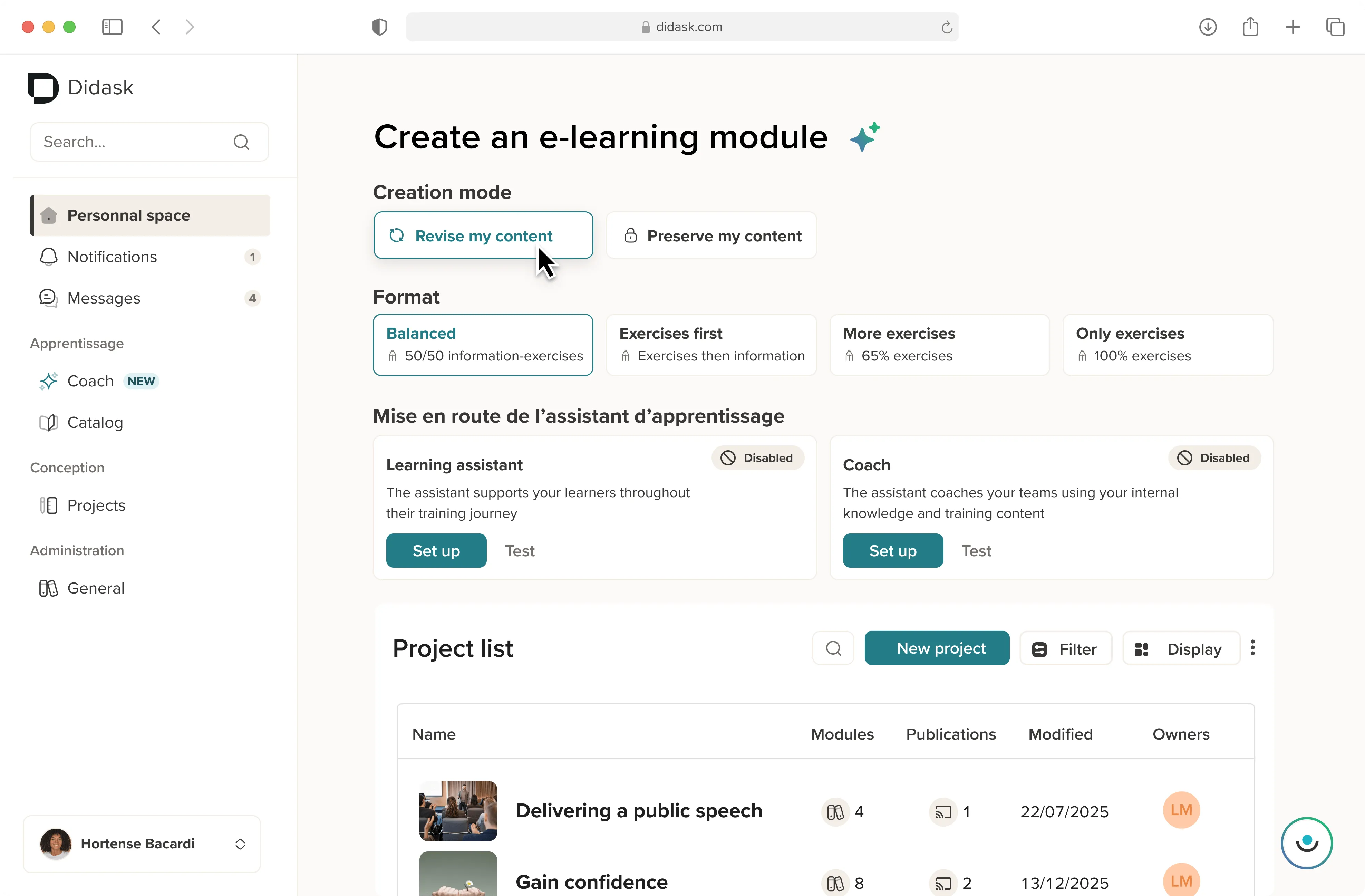
This approach combines the best of the other models with the addition of personalization. A positioning test assesses the initial level of each employee.
The course is then adjusted using educational AI. Learning by error with personalized feedback and spaced repetition ensure that skills are anchored.
.png)
Good to know
The 5-step cognitive path: Motivate (give meaning) → Deconstruct (identify mistakes) → Memorize (anchor knowledge) → Apply in low-stakes situations (exercises) → Apply in real situations (on-the-job).
How to choose the right onboarding model for your business
The choice of model depends on several factors specific to your organization. A decision framework makes it possible to identify the most relevant approach.
Good to know
Key questions before choosing: What is your annual hiring volume? How complex are the roles to fill? What training resources are available? What company culture needs to be conveyed?
Selection criteria according to your context
Large companies favor structured and adaptive models to ensure compliance and manage the multiplicity of businesses. Standardization remains essential on a large scale.
SMEs seek efficiency with limited resources. Tools that allow business experts to create content themselves are becoming essential.
Startups often combine immersion and a buddy system for rapid integration into a strong culture. Agility takes precedence over formalization.
Combining several models: the hybrid approach
Effective onboarding generally combines several approaches depending on the phases. The administrative model secures the base, the buddy promotes social integration.
The adaptive model then takes over for skills development. This combination covers all the needs of the new employee.
Building your onboarding model step by step
A structured integration process is divided into four distinct phases. Each one meets specific objectives and mobilizes concrete actions.
Phase 1 - Preboarding (D-15 to D-1)
The integration starts before the arrival of the employee (it is the preboarding). Send the welcome booklet, prepare the workstation, inform the team of the upcoming arrival.
Offer initial training content independently: company presentation, values, organization chart. This phase reduces anxiety and optimizes D-day.
Phase 2 - Welcome and discovery (Week 1)
The first week lays the foundations without overloading. Personalized welcome, meeting the team, visiting the premises, presenting the tools form the basis.
Early business apprenticeships remain limited and structured. The aim is to create a sense of belonging, not to teach everything in five days.
First week checklist: welcome and presentation of the team, delivery of equipment and access, visit of the premises, meeting with the manager and the mentor, first training modules (maximum 2 hours/day), end of week end point.
Phase 3 - Skills Development (Months 1 to 3)
This phase concentrates most of the professional training. The modules are progressively followed by regular simulations.
Feedback from the manager and the mentor accompanies each stage. Weekly points allow you to adjust the pace according to real progress.
Phase 4 - Accompanied autonomy (Months 3 to 6)
The employee takes on increasing responsibilities. Support is gradually being reduced while remaining available.
The assessment of achievements confirms the mastery of key competencies. Adjustments are still possible if certain points require reinforcement.
The tools to digitize and personalize your onboarding
Technological solutions make it possible to scale up while maintaining quality. Each type of tool has a specific function.
LMS platforms for the training of newcomers
One LMS structure the training part of onboarding. The essential choice criteria: ease of content creation, personalization of courses, monitoring of progress.
The ability to generate detailed statistics makes it possible to identify bottlenecks and to continuously improve the program.
The contribution of educational AI in onboarding
Educational AI is transforming the creation and distribution of integration courses. It makes it possible to quickly generate adapted content from existing resources.
Each recruit benefits from a career adjusted to his level thanks to the positioning test. One-on-one feedback fixes errors in real time.
Good to know
AI-powered learning reduces onboarding path creation time by a factor of 10. Subject matter experts can transform their raw content into structured training without prior instructional design skills.
Measuring the effectiveness of your onboarding model
An onboarding program should produce measurable results. Quantitative and qualitative indicators allow us to assess its real performance.
The essential KPIs
Several KPI are to be followed. The retention rate at 6 months and 1 year is the main indicator. Time-to-productivity measures the time before full autonomy on the workstation.
The satisfaction of new hires, the rate of validation of training courses and the cost per integrated collaborator complete the scorecard.
Methods for collecting feedback
The questionnaires at D+30 and D+90 collect the feedback hot and then cold. Qualitative interviews deepen areas of improvement.
Analysis of training data identifies problem modules. The astonishment report captures the newcomer's fresh eyes.
Good to know
3 essential questions to ask: "Do you have the information you need to perform your tasks?" - "Do you feel integrated into the team?" - "What would we change for future hires?"
Examples of successful onboarding journeys
The concrete cases illustrate how different organizations structured their integration according to their specific constraints.
Onboarding in a large company: structuring on a large scale
Large groups face standardization and compliance challenges. The multiplicity of jobs requires differentiated paths.
An adaptive LMS meets these challenges by offering a common base personalized to each profile. Centralized statistics ensure monitoring at scale.
Onboarding in SMEs: efficiency with limited resources
Without a dedicated training team, SMEs must optimize each resource. Tools that allow business experts to create content themselves are becoming essential.
Educational AI quickly transforms existing documents into structured courses. The rise in skills is accelerating without massive investments.
Remote onboarding: the specificities of remote working
The remote context requires specific adaptations. Maintaining social ties requires team rituals and regular exchanges.
Autonomy in learning is based on content that is accessible at all times. Asynchronous communication tools complement synchronous interactions.
An effective onboarding model combines structure and personalization. It relies on cognitive science to anchor learning in the long term.
Digital tools make it possible to scale up without sacrificing quality. Educational AI accelerates creation and adapts courses to each employee.
The question is no longer whether to transform onboarding, but how to do it effectively. Organizations that invest in integration reap the benefits in terms of retention and performance.
.webp)
.webp)
.webp)




.png)