


In a context where companies seek to optimize each euro invested, Measuring the effectiveness of a training course is no longer an option: it is imperative.
Les KPI training allow you to transform raw data into useful indicators to pilot, adjust and prove the impact of your educational actions.
How to choose and monitor these indicators? And how the training platform Didask is a concrete solution for monitoring your indicators.
Why are KPIs essential to measure training performance?
Key Performance Indicators training play a role in landmarks to find out if your education actions really contribute to company goals. They allow you to:
- move from resentment to measurable: you don't pilot what you don't measure;
- alert on poorly performing or poorly designed training courses;
- justify the budget, investments and ROI (training) to decision-makers;
- guide continuous improvement efforts, through feedback loops;
- link learning to business results (quality, skills development).
The KPIs thus form the training dashboard : they provide operational, strategic and comparable visibility from one session to the next.
Without a key indicator, your training plan may look like a series of scattered actions, with no clear link to employee needs or company goals.
Adapt your KPIs to the strategic goals of the company
A Key Performance Indicator should not be generic, but aligned with your business goals : operational, quality, talent retention, cost reduction, agile posture.
For example:
- if your priority is toincrease productivity, in particular, you will follow the post-training scope (skills put into practice, skill gains);
- if you aim for internal pride or HR attractiveness, qualitative KPIs (satisfaction, progress, motivation) become a priority;
- if you have to report to top management or funders, you will insert the ROI as a key KPI.
In other words, do not combine all the indicators : choose the Key Performance Indicator training courses useful to your challenges and build adapted dashboards.
Training KPIs: the main families of indicators to follow
To properly manage your courses, it is essential to combine different types of learning KPIs. Together, they offer a global vision: efficiency, commitment, costs and quality. Here are the main families of indicators to monitor, along with the most relevant Key Performance Indicators to measure in 2026, to be adapted according to your goals and your skills development plan.
1. Performance indicators: efficiency and results
They measure the gap between the goals set and the results obtained after the training. They make it possible to concretely assess whether the increase in skills has a real consequence on the achievement of employees and on the results of the company.
- Pass/completion rate
- = (number of people who have completed the training/number registered) × 100
- → Indicates the proportion of employees who have validated or completed their course.
- Rate of application of acquired skills
- Measures the ability of employees to implement their new knowledge in a real situation.
- Post-training productivity gain
- Compare the achievement before and after learning on operational criteria (quality, productivity, processing time, etc.).
These indicators reflect the real effectiveness of training in the field — beyond simple satisfaction.
2. Descriptive and monitoring indicators: commitment and participation
They reflect learners' behavior during the education process. They are essential for understanding the level of employee involvement in the learning plan.
- Rate of participation in training sessions
- = (number of participants/number of targeted employees) × 100
- → A low rate may indicate poor communication or lack of buy-in to the project.
- Rate of access to training
- = (number of employees who accessed content/total targeted number) × 100
- → Measure the distribution and attractiveness of your training system.
- Abandonment rate
- = (number of people who have left the current training course/number enrolled) × 100
- → Allows you to identify courses that are poorly designed, too long or poorly adapted to the requirements of the participants.
- Number of hours of training per employee
- = total hours/number of employees trained
- → Indicates the average level of investment and helps balance the internal training plan.
These monitoring indicators make it possible to quickly identify areas for improvement in the education process and to optimize collaboration in future sessions.
3. Cost and performance indicators
Because all training is an investment, it is crucial to measure economic performance. These Key Performance Indicators directly link the budget committed to the efficiency obtained, thus making it possible to assess the profitability of the system.
- Training cost per employee
- = (total budget/number of employees trained)
- → Useful for comparing internal vs external devices, or even the costs between services.
- Return on investment (ROI) of training
- = (net benefits — training cost)/training cost
- → It is the most “telling” KPI for management, because it connects learning and business value.
- Total budget invested by type of training
- Allows you to manage the arbitrations of the Didask training catalog according to the effectiveness observed.
In 2026, modern tools such as an LMS tool will make it possible to automate the collection and visualization of these financial elements, making it easier to calculate the ROI in real time.
4. Qualitative indicators: satisfaction, progress and impact
Qualitative indicators complement quantitative measures by giving a human and emotional vision of training. They reflect the perception, quality, progress and scope of learning in the daily lives of employees.
- Participant satisfaction rate
- → Collected via post-training questionnaires, it assesses the clarity of the content, the pedagogy, the reception and the relevance of the materials.
- Skills progression rate
- → Measures the level of evolution between pre-test and post-test or between intermediate evaluations.
- Application of skills in the field
- → Checks the concrete implementation of knowledge in the workplace, in the short and medium term.
- Perception of professional impact
- → Internal surveys to measure whether employees feel an improvement in their productivity or their confidence.
5. Emerging indicators: towards a more dynamic measurement
Learning analytics and data-driven learning practices are creating new, finer and more strategic indicators:
- Time-to-skill: average time required for an employee to reach a defined level of autonomy;
- Overall engagement rate: combines collaboration, interactions and consistency in learning;
- Training-job adequacy index: correlation between the content monitored and the skills actually mobilized in the missions.
These modern indicators allow training organizations and companies to manage their action plans in an agile and predictive manner.
To build an effective dashboard, there is no need to multiply the numbers: 5 to 8 well-chosen key indicators are enough to obtain a complete and usable vision. The main thing is to ensure that each indicator serves a clear purpose : improving quality, strengthening cooperation, controlling costs and maximizing the scope of training.
How to follow the training KPIs with specialized tools?
The role of an LMS (Learning Management System) in managing KPIs
An LMS tool is designed to centralize educational elements, automate collection and produce reports.
It makes it possible to:
- real-time monitoring of indicators (access rate, progress, dropouts);
- the production of personalized dashboards for each level (trainer, manager, management);
- the import/export of data to HR or management tools;
- the integration of satisfaction surveys and post-training evaluations;
- automatic alerts in case of critical KPIs (e.g. high dropout rate).
The benefits are clear: reduce manual management time, guarantee the integrity of the data and make the measurement alive, not fixed.
Integrate KPIs into your talent and skills management tools
It is relevant to connect the LMS to your HR system, PLM, talent management software, in order toenrich the indicators (internal mobility, promotion, business efficiency).
Thus, your Key Indicator training does not live in silos, but become part of the overall process of skills management.
The advantages of the Didask LMS platform
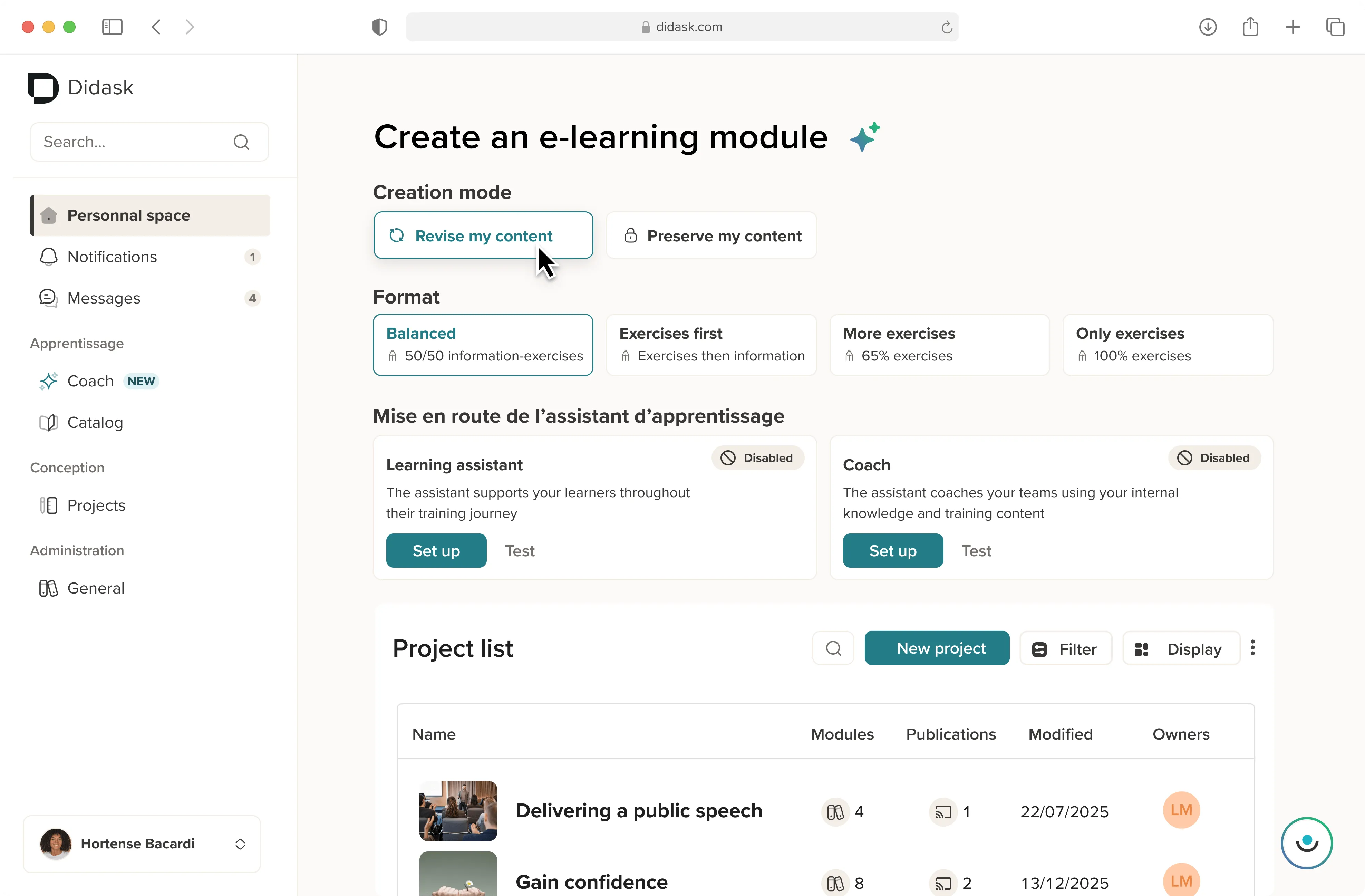
Didask, as an LMS platform, not only offers the design of personalized training courses, but also integrated reporting modules :
- instant monitoring of participation rates, accesses, completion;
- direct integration of satisfaction surveys into the training flow;
- exporting raw data to Excel or API to create dynamic cross-tables;
- tables adapted to the needs of corporate training organizations or services;
- Access to Didask training catalog, written by experts in their field.
Thanks to these functions, Didask allows move from data collection to actionable measurement and to have a operational dashboard to adjust your goals.
Best practices for successful training KPIs
- Choose indicators that are directly related to your goals — do not multiply the indicators unnecessarily.
- Set clear thresholds and targets for each indicator (for example: completion rate ≥ 90%).
- Implement data governance : who collects, who analyzes, who decides.
- Manage the indicators regularly, not only in the annual report.
- Use appropriate tools : an LMS like Didask makes automated monitoring possible.
- Change the indicators over time according to your priorities and results.
- Communicate KPIs to internal stakeholders (especially trainers and managers) to unite around the objectives.
In 2026, Measuring Key Performance Indicator training has become a prerequisite for rigorously manage the quality, impact and budget of your educational actions. For educational organizations as well as for businesses, only well-targeted and technical indicators (cooperation, cost, ROI, satisfaction, application) make it possible to transform figures into decisions.
With a platform suchlike Didask, you will be able to centralize your data, produce dashboards, aggregate the results of Didask's training catalog and make your KPIs alive, accessible at all levels of the organization.
By integrating key indicators at the heart of your approach, you Move from action to measured effectiveness and you place training as a strategic lever for developing skills and value in your company.
.webp)
.webp)
.webp)

.webp)


.png)