


Designing a Digital Training Course: Key Determining Steps
Several myths circulate about eLearning — or rather about how long it takes to design learning modules. Creating a training course is said to be both very time-consuming... and very quick! In reality, estimating the time needed to develop an eLearning module is a fairly delicate task. Yet everyone seems to agree on one point: speed is essential, especially in the current climate.
eLearning design must be fast — that's precisely the challenge. However, estimating the time spent designing your digital training course will depend partly on the subject matter and its implications at the scale of your organisation, teams or employees. Structuring learning modules is not merely a technical question: achieving a satisfactory result requires a shorter or longer working period, depending on the complexity of the training topics. Moreover, eLearning design is broken down into key determining stages, each of which matters:
- Step 1: identifying the pedagogical objectives
- Step 2: choosing the formats and media to use in your training module
- Step 3: design proper — i.e. writing the content
- Step 4: production (formatting and multimedia creation)
- Step 5: implementation (organising online materials, publishing and monitoring)
Most EdTech market players focus primarily on the technical side of the design process — namely production (formatting and multimedia creation) and implementation (organising online materials, publishing and monitoring). Unfortunately, bypassing any one of these steps ends up costing more time overall rather than saving it. As for designs that take longer than expected, this is partly because course creators try to say too much — which is very human, but counterproductive. Your eLearning will only be truly effective and time-efficient if you do not neglect any of the steps listed above, and if you focus on what's essential.
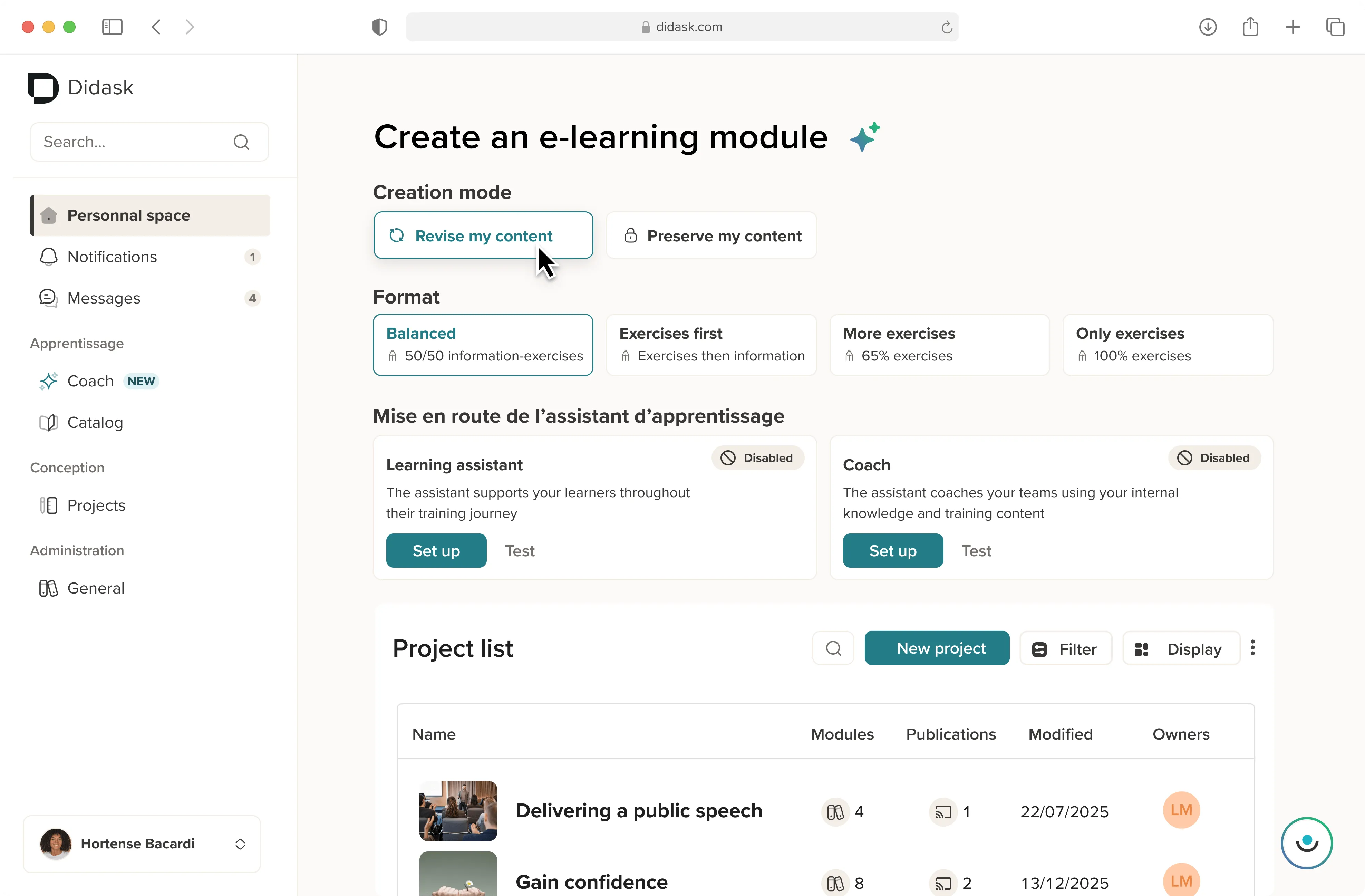
Didask's approach to digital training design allows you to meet today's demands: our solution does not compromise on the quality of your training and enables you to work through each step carefully.

The Didask solution, through its guided approach, enables experts to focus solely on their area of expertise — the true added value of any training — leaving aside the technical aspects of eLearning design. Our goal is to help you optimise your expertise and transform it into a genuinely high-quality eLearning experience. Given the urgency of the situation, the digitalisation of training within organisations is becoming a key driver of resilience. It's about reacting quickly, but thinking differently — so as to design high-quality, engaging learning modules.
.webp)
.webp)
.webp)

.webp)



.png)