



In the modern world of work, mastering so-called “technical” skills has become a major asset for any employee. But what are they really?
This is what we are going to see today by trying to understand how to identify them and how to value them!
What is a technical skill?
Technical competencies refer to the set of skills and practical knowledge necessary to effectively perform a task specific to a position in a professional setting. We also talk about ”Hard Skills“, as opposed to behavioral skills, say ”Soft Skills“.
Technical skills include factual knowledge, such as mastering software, computer programming, project management or even the use of a tool specific to a profession.
Conversely, behavioral skills include emotional intelligence, the ability to work in a team, or the spirit of collaboration.
These two types of skills are complementary and essential to the performance of a company.
Why are technical skills crucial in the workplace?
Importance of technical skills for operational efficiency
Mastering technical skills allows tasks to be completed accurately and quickly, improving operational efficiency.
A manager or an employee, regardless of the field in which they work, if they have solid hard skills, will be able to successfully carry out their professional projects, optimize their work and contribute to the overall success of the company to which they belong.
Measurability and continuous improvement of technical skills
While behavioral skills may be more difficult to assess, technical skills are easy to measure.
To know if an employee meets a list of defined criteria, all you have to do is rely on specific and universal points. Between two profiles during a recruitment session, or even, with a view to an increase, the objectivity provided by technical skills is essential.
Strengthening competitiveness and innovation through technical skills
Teams with solid technical skills are able to design innovative solutions and contribute to the digital transformation of the company.
This reinforces competitiveness on the market and makes it possible to develop professional projects with high added value.
What types of technical skills exist in the world of work?
In the world of work, there are as many technical skills as there are jobs.
Each position requires specific skills. For example, a computer developer must master different programming languages, such as HTML and CSS, a designer must know creative software such as InDesign or Canva, while a technician must know how to use tools adapted to his needs. All of this is technical knowledge.
At the same time, some skills are said to be transversal and adaptive. Halfway between hard skills and soft skills, the latter are not specific to a particular job, but to the entire professional world in general.
For example, this is the ability to analyze data, or to use collaborative and planning software, such as Teams, Trello or Asana. These skills allow employees to work on a variety of projects and adapt to varied professional contexts.
How do you identify the technical skills needed for a position?
While certain technical skills are particularly in demand on the job market, it is important to focus on those that are really useful to the company on a daily basis.
But in concrete terms, how do you know the needs of your sector?
A detailed analysis of the structure and objectives of the company as well as the missions related to a position will make it possible to determine what are the priority technical skills to be found in candidates and employees. An in-depth diagnosis will make it possible to target areas for improvement through individualized training plans.
This identification will then be useful at several levels.
During recruitment, for example, it will be used to assess technical skills. An essential step to quickly know if a candidate has the necessary skills or not for the desired position. Verification can be done through technical tests, simulations or the analysis of projects carried out previously, but will always make it possible to compare the career of a candidate with the expectations of the position.
How to keep the technical skills of employees up to date?
Tools and methods are constantly evolving. What is true today may be obsolete tomorrow. But before implementing apprenticeship programs, it is important to regularly assess the level of employees in order to know exactly what to offer, what are the points to be strengthened and the progress expected. To do this, conducting a skills assessment once or twice a year can be useful.
Once this study has been conducted, continuing training, via e-learning or practical workshops in physics, will precisely offer employees the opportunity to train themselves in the use of new tools, acquire new abilities and remain competitive on the job market.
To help your partners reach their goals, you can browse the vast Didask training catalog. You will find different programs depending on the situation and the project to be carried out. Using our tool, you will also be able to build personalized plans, thus promoting the professional development and personal within your company.
The benefits of technical skills management in business
Optimizing productivity and performance
Good management of your team's technical skills increases productivity, improves the quality of work provided and allows everyone to carry out the various projects more effectively.
Improving employee satisfaction and retention
On the other hand, the valorization and monitoring of technical skills contribute to strengthening the motivation and commitment of employees while promoting their loyalty.
Appropriate professional training offered regularly is a key factor in creating a stimulating and pleasant working environment.
Adaptability in the face of technological developments and new challenges
Finally, in a constantly evolving entrepreneurial world, the good management of technical skills makes it possible to adapt to the digitalization of tools and emerging technologies such as artificial intelligence, among others.
How to promote your technical skills on a resume and in a cover letter?
Each employee has technical and behavioral skills that are specific to their background and experiences. The latter deserve to be highlighted. But in concrete terms, how can you promote technical knowledge on a resume or in a cover letter?
Concrete projects, whether real or fictional at first, are ideal for illustrating one's abilities. In addition to the overall presentation of the project, it is advisable to mention the software used, the related certifications if applicable, and the impact of the achievements on the personal and professional career.
How can Didask support you in setting up technical skills training courses?
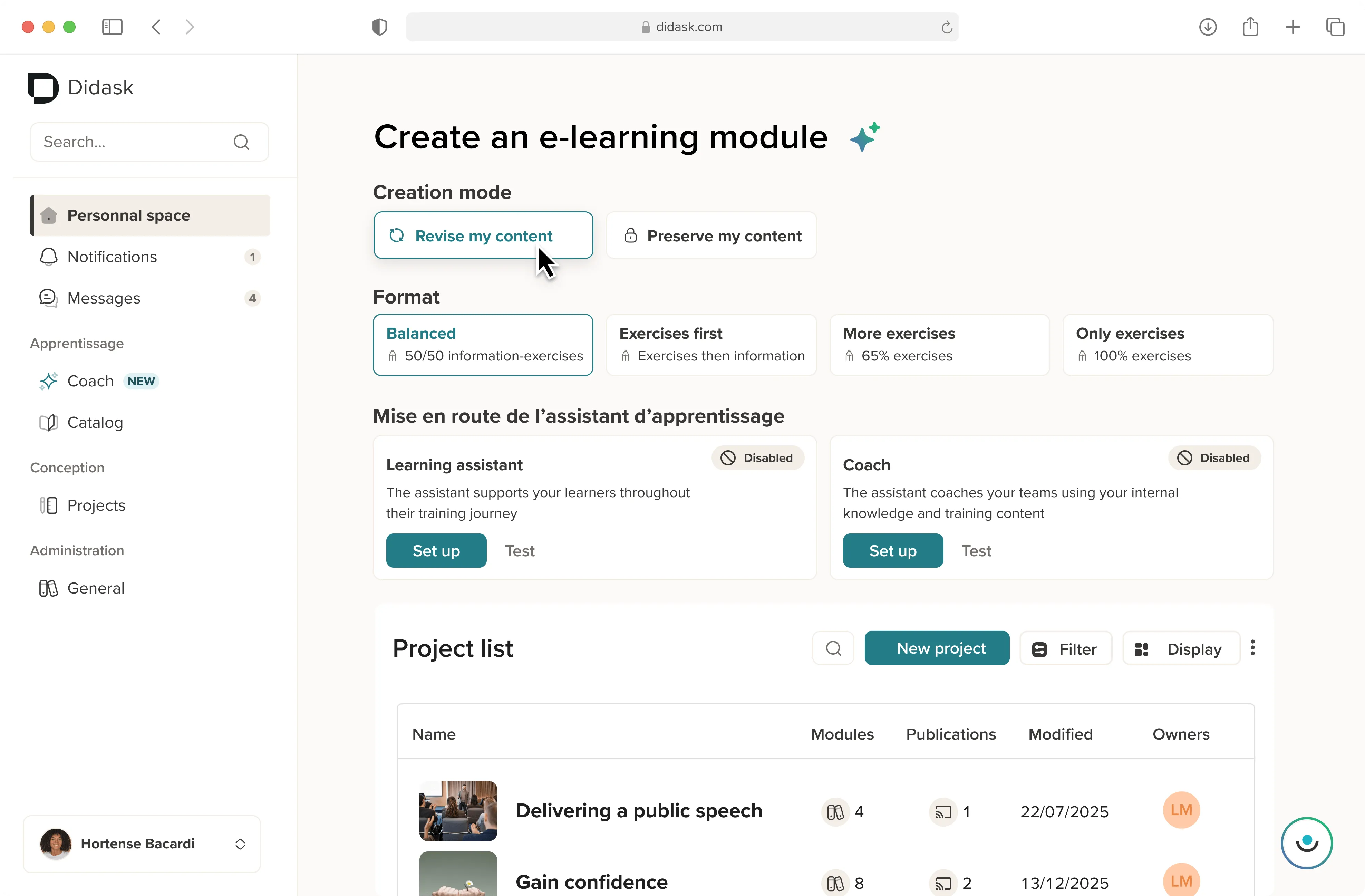
Didask is our innovative educational solution for companies and training organizations. We provide you with a tool for monitoring and supporting vocational training allowing you to gamify your career paths, monitor the evolution of your employees, and set up targeted learning actions.
Concretely, with Didask, you will be able to:
- identify the technical skills needs of your team,
- create tailor-made training courses, adapted to the level and position of employees,
- offer interactive modules (quizzes, case studies, scenarios...) ),
- monitor learners' progress in real time thanks to detailed reports (frequency of connection, concepts covered, percentage of progress, etc.),
- and measure the effectiveness of the paths created to plan corrective actions in order to fill the differences in levels observed.
Do you want to set up training courses aimed at the acquisition and development of technical skills within your company? Didask can be useful for you!
Want to know more? Get in touch with a member of our team to find a solution adapted to your needs!
FAQ
How to distinguish transversal technical skills from technical skills specific to a profession?
Specific technical skills are directly related to the tasks of a particular job, such as mastering a programming language for a developer. Transversal technical skills, for their part, concern know-how applicable to several professions, such as data analysis or the use of collaborative software (Teams, Trello). They facilitate professional adaptability to various contexts.
What indicators can be used to objectively assess an employee's technical skills?
To assess technical skills, one can use practical tests, scenarios, the analysis of completed projects, as well as performance indicators such as speed of execution, the quality of the work provided and the precision in the use of specific tools. These criteria allow for a measurable and justified evaluation.
What are the benefits of continuing training dedicated to technical skills in the company?
Continuing training allows employees to keep their knowledge up to date in the face of technological developments, to acquire new skills, to improve their efficiency and motivation, and thus to strengthen the overall competitiveness of the company. It also promotes employee loyalty by offering a stimulating work environment.
How does digital transformation influence the evolution of the technical skills required in business?
Digital transformation leads to the emergence of new tools and methods that require constant updates of technical skills. For example, mastering collaborative software, artificial intelligence knowledge, or even the ability to manage digital data are becoming essential, requiring employees to adapt quickly to meet new challenges.
What criteria should be preferred in order to properly choose a technical skills training program adapted to your needs?
It is advisable to choose a course that corresponds precisely to the level and professional objectives, offering up-to-date and practical content (e-learning, workshops, simulations). The educational monitoring tool should make it possible to regularly assess progress and adapt the program. Finally, a certifying or recognized training course reinforces the credibility of what has been achieved.
.webp)
.webp)
.webp)





.png)