


Your organisation is running a transformation programme and you are responsible for designing and planning the training strategy needed to make it a success. You had planned everything: a skills development strategy, measurable objectives with a timeline, identification of the employees to target, focus groups with middle management, calls for tender to training design agencies… Yet, several months after the training ended, the results are not there. Your employees are struggling to apply the new practices and shift their frames of reference, even though they completed the training… which is still available in your LMS! What if, through all of this, you had underestimated the impact of pedagogy?
Pedagogy: the forgotten element of transformation projects?
First of all, you are not alone: according to the latest McKinsey study published in 2022, more than two thirds of respondents believe that their company's transformation plan has failed. The report's authors point to several causes: weaknesses in methods for engaging employees, a lack of coherence between incentives and the new policy to be implemented… Reading the report, naturally focused on project management, one cannot help but notice that one cause nobody talks about is pedagogy. And that may be where one of the key problems lies.
First, rest assured: by "pedagogy", we do not mean debates among experts about the best skill development model ("Bloom's taxonomy or the 80/20 rule?"). We mean the full set of techniques that answer the question: "how do you effectively move employees' knowledge from point A to point B?"
And that is precisely the challenge of any organisational transformation: whatever its nature and scale, it requires employees to adopt new priorities and methods in their day-to-day work. Your employees will need to make the journey — sometimes long and obstacle-strewn — from where they are today to where you want them to be. But depending on your company culture, the gap between your starting point and your destination, the employees involved, and the path to be taken will be different from that of your competitors. That is because your employees face specific cognitive challenges. Viewed from this angle, driving change becomes a question of pedagogy.
The place of pedagogy in your transformation plan
Didask supports several organisations that use our solution to initiate transformation programmes, and when we start working together, we notice that transformation policies tend to rely primarily on communication plans rather than training plans.
Too many training programmes still look like a series of videos punctuated by a few knowledge-check quizzes, with answers that are often obvious… making them appealing communication objects, potentially very inspiring. But once completed, they do not enable employees to develop real skills. Employees themselves are well aware of this, as evidenced by the low competency outcomes in such training programmes.
We notice that one step is almost systematically overlooked: identifying the cognitive challenges that need to be addressed to enable employees to reach their objectives. Do they underestimate the importance of what they need to accomplish? Do they struggle to automate the procedures you want them to apply? Do they lack knowledge about the rationale and implications of the transformation you are driving? Do they hold pre-existing beliefs that need to be deconstructed? Far from being a minor point, this question of cognitive challenges determines the effectiveness of your transformation plan: the approach and modalities you use will differ depending on the challenges to be addressed.
An effective transformation plan… when time is short
Yet every player in the training ecosystem — from the manager to the frontline trainer — knows full well that effective training does not simply transmit information. Any professional will tell you that of course, you need to start from the learners, get them to practise, and personalise. The issue here is not a lack of skill, but a lack of resources. Transformation plans are generally complex, with many dimensions to consider. And there is a tendency to go for the quickest option, ultimately defaulting to a "content-first" mindset: the video first, the meetings first, the slides first… with the consequences we all know.
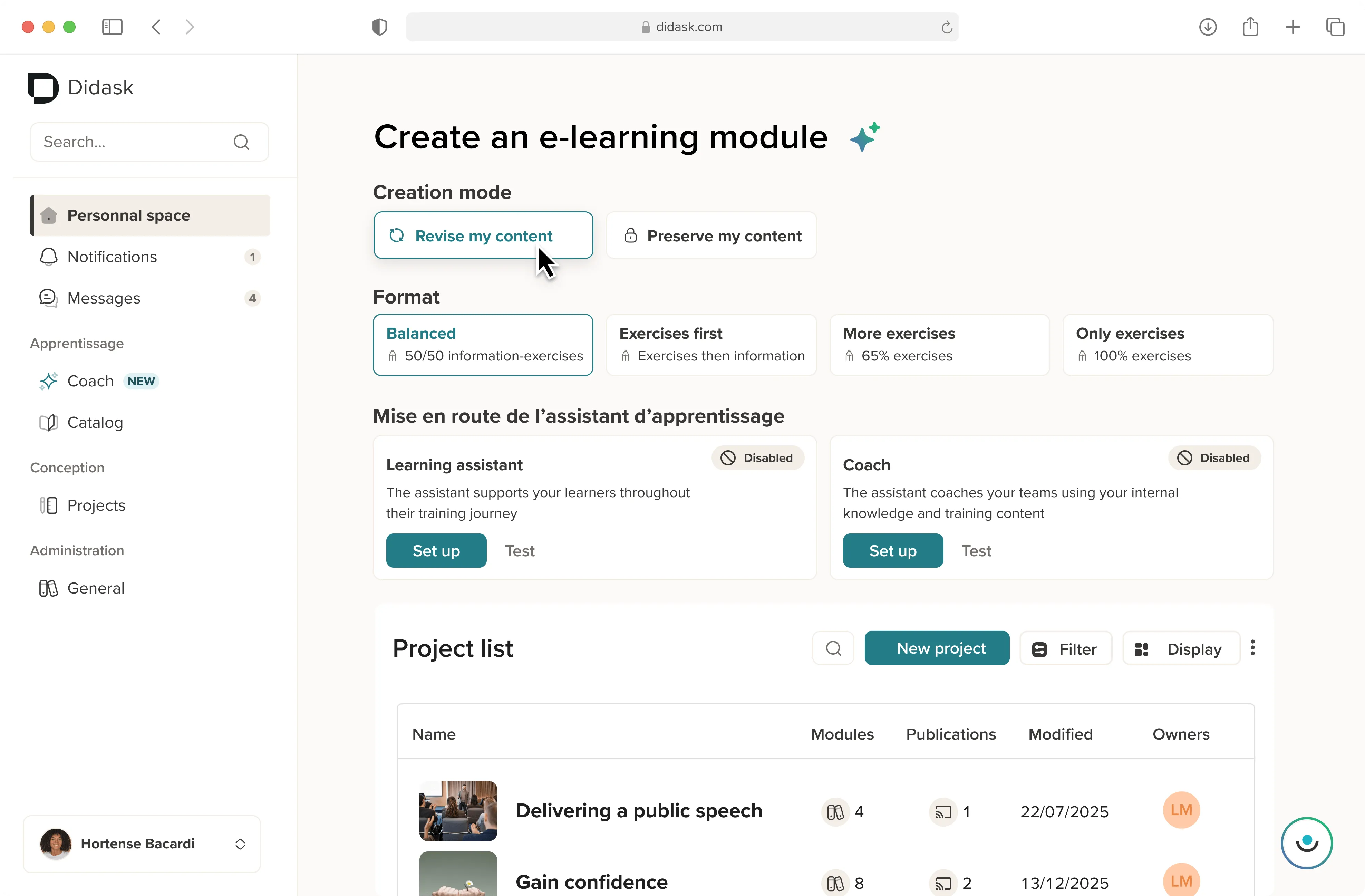
In this situation, Didask can support you. Built on the latest advances in machine learning and cognitive science, our pedagogical artificial intelligence helps you transform your content into learning formats that will effectively build your learners' skills. Starting from raw material, it identifies the underlying cognitive challenges and generates an initial training proposal. Your instructional design teams then simply adjust what needs adjusting, apply your branding, and hit "Publish".
Our instructional engineers and clients are already using our pedagogical AI and find that it takes them on average 10 times less time to create their training programmes… and this ratio is even more compelling for those for whom digital training is not their core business. With such results, this technology will undoubtedly take your transformation plans to the next level. Ready to step up a gear?
.webp)
.webp)
.webp)





.png)