

What are the solutions for preserving our concentration and protecting our attention at work?
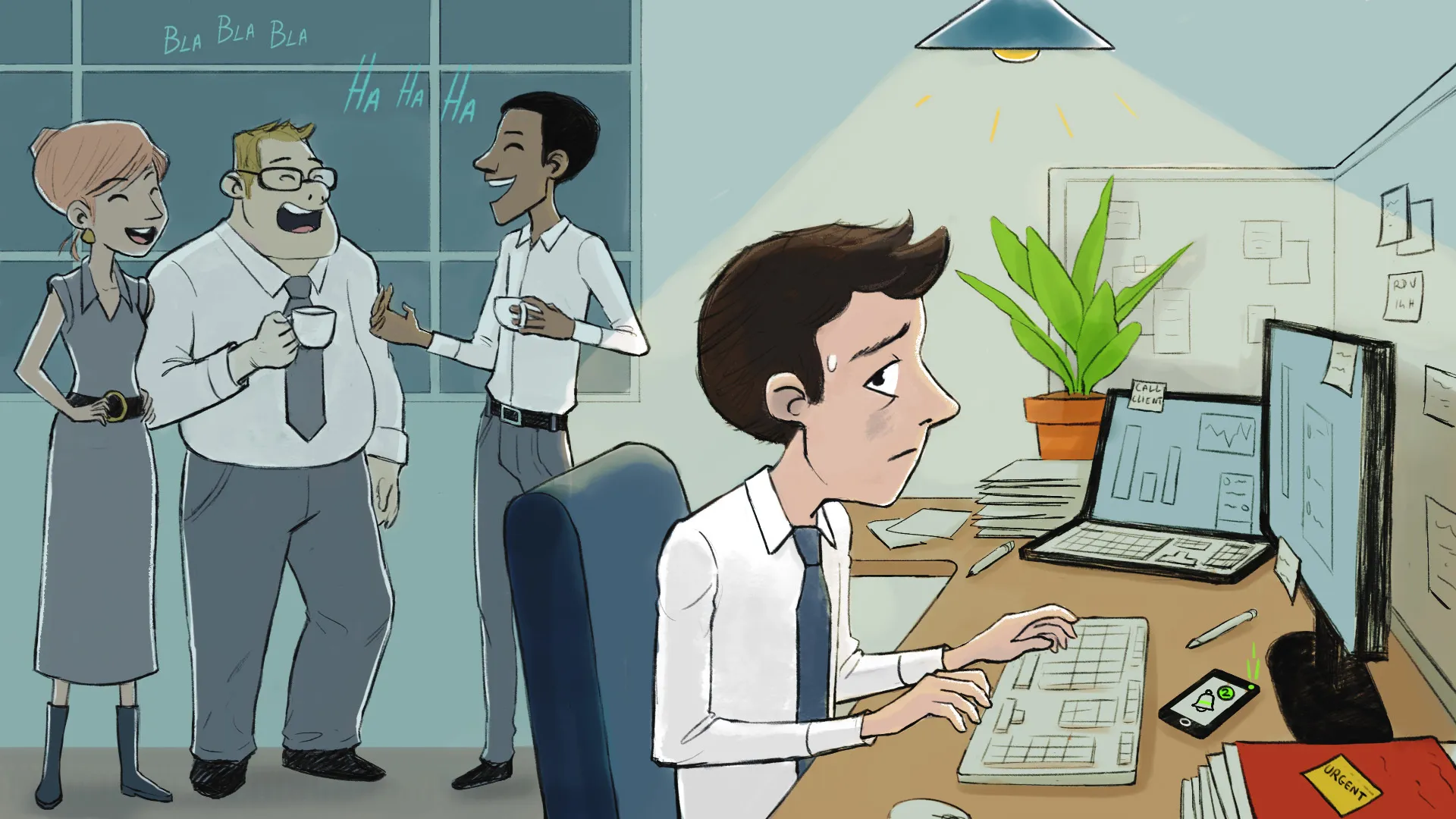
Have you ever received a notification on your smartphone during a meeting? Lost the thread of your thoughts when a colleague starts talking on the phone nearby? Or found yourself thinking about picking up your children while working on a file? These seemingly ordinary situations symbolise an era in which staying focused is increasingly difficult. Digital transformation, the proliferation of communication channels, hyper-connectivity, and the spread of open-plan offices all increase the frequency of interruptions and harm our concentration. Faced with this phenomenon affecting everyone at any hour of the day: what are the solutions for preserving our concentration?
What is attention and what is it for?
Let us start by understanding what attention is. This word has been part of our vocabulary since childhood, when our parents constantly reminded us to "pay attention". Yet its common meaning is not quite the same as its scientific definition. Attention is a filter, which allows our brain to constantly sort what is important from what is not [1]. Do you remember the path you took online to arrive on this page? No? Then you are probably experiencing what could be called a form of "attentional drift" — the moment when, often involuntarily, external or internal elements (receiving an email, a thought about tomorrow's important meeting, etc.) divert you from what you are doing for several seconds.
Why filter? Because the brain is not capable of efficiently processing all the information it receives, and more importantly, of making sense of it all. Have you ever, while reading a good novel before falling asleep, had to re-read the same sentence three times before understanding it? Yet your eyes did read the sentence from beginning to end. In a state of inattention, your brain was unable to engage certain brain areas that allow the meaning of words to be understood [2]. In other words, it is as if the letters disappeared without a trace halfway between your eyes and your consciousness, the words thus losing all meaning. It is because attention allows us to select information and process it more effectively that it is essential to our daily functioning.
Why, now more than ever, must we protect our attention?
As modern work increasingly consists of capturing, processing, and transmitting information, the ability to understand the meaning of that information is crucial. But above all, in this new era of big data and digitalisation, our attention is constantly solicited and finds it hard to resist [3]! It is under an incessant bombardment of information, from the moment we wake up (when our first reflex is to check our phone) to the moment we go to sleep (where we often end the day as we began it, with our phone).
The problem is that, although we are most often unaware of it, our attention is a limited resource. When our brain is required to constantly mobilise its resources across multiple sources of information, we inflict a double penalty on ourselves: we will be less efficient, and our brain will expend unnecessary energy, thereby increasing our level of fatigue (see our article Recognising and limiting mental fatigue through cognitive science). When we talk about cognition at work, the balance between efficiency and well-being is never far away… It becomes clear that in order to fully and effectively engage our brain on important activities, it is now crucial to be able to regulate our attention.
How to regulate our attention? Through experimentation and questioning
So how can we preserve our fragile attention in a world of constant solicitation? First, companies have a role to play by designing tools and workspaces that minimise these interruptions as much as possible. But the main agents of attentional regulation are the employees themselves. Their first lever is to understand how their attention works and what elements weaken it on a daily basis. The next step is to practise "metacognition", which here consists of stepping back and observing what causes them to lose their attentional balance [4]. This awareness must be authorised, and above all encouraged by the organisation itself, by providing employees with the means to understand and manage their attention.
In this hyper-connected world, protecting our attention will depend first and foremost on a collective awareness across all levels of organisations. This is a very reasonable price to pay to ensure quality of work and individual well-being.
REFERENCES
[1]. Desimone R, Duncan J. Neural mechanisms of selective visual attention. 1995; Annual Review of Neuroscience. 18:193–222.
[2]. Dehaene et al. Cerebral mechanisms of word masking and unconscious repetition priming. 2001; Nature Neuroscience. 4:752–758.
[3]. Itti L, Koch C. A saliency-based search mechanism for overt and covert shifts of visual attention. 2000; Vision Research.; 40:1489–1506.
[4]. Fleming, S. M., Dolan, R. J. (2012). The neural basis of metacognitive ability. Philosophical Transactions of the Royal Society. B, 367(1594), 1338-1349.
Further reading
Le cerveau attentif. 2011. Éditions Odile Jacob. Jean-Philippe Lachaux.
Le cerveau funambule. 2015. Éditions Odile Jacob. Jean-Philippe Lachaux.
.webp)
.webp)
.webp)

.webp)



.png)