


The "expected change" is a pedagogical feature built into our authoring tool to guide you in designing practice scenarios. The name may be surprising — this is not a technical innovation, but rather a pedagogical stance embedded in our methodological framework, enabling every trainer or training manager to create online practical cases of remarkable effectiveness to drive learner skill development.
The expected change in a work situation: what does it mean?
The expected change is an "inverted" reflective approach, oriented towards learners' needs rather than what the trainer thinks they want to convey. When learners do not yet have the required skill or skills, they make certain errors (which we call relevant errors) in work situations, or are simply unable to take action and apply the expected behavioural changes. These "relevant, concrete errors" are precisely what the trainer can observe first and use as the foundation for building exercises. From there, they can identify what needs to change and determine what learners should do, with a view to evolving their working practices. As it happens, the Didask solution enables you to implement this concretely — and we will tell you more in this article!
At Didask, learning is a change of state
For Didask, learning translates into a change of state in the learner. They succeed in acquiring a piece of knowledge (knowing the ingredients of a chocolate cake) or a skill (knowing how to make a chocolate cake) that they were previously unaware of. They are able to apply this knowledge not only in a learning context, but also in new ecosystems or through unfamiliar situations. They are therefore able to renew the way they apply their knowledge, combining it with other information.
To find the change, look for the error!
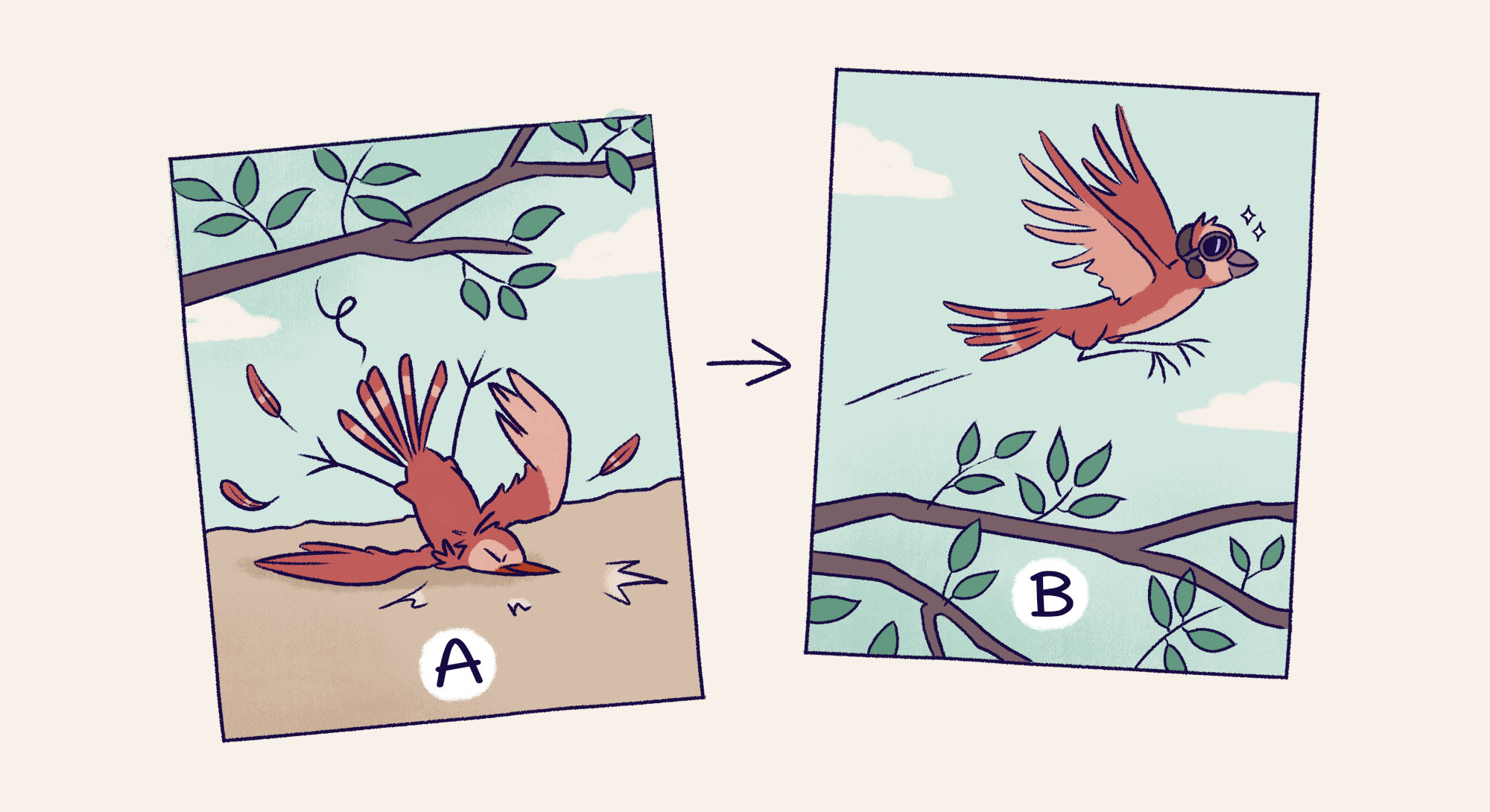
As we mentioned, we perceive learning as a change of state, from point A to point B. More precisely, learning can be likened to a change of state enabling the learner to analyse and resolve a problem or situation independently and conclusively.
You must therefore focus on the observable difference between absent learning (the learner's initial state) and present learning (the final state leading to the expected change), both in terms of theoretical knowledge and technical know-how.
The relevant error is what a learner believes or does when they have not yet been trained / immersed in a learning context. Ask yourself the following questions and take stock in order to identify these errors: "How will a beginner actually behave in this type of situation?" or "What are my learners' sticking points? Why do they find this difficult?"
The expected change is what you would like the learner to think or do, in order to translate what they are learning into concrete actions. You can ask yourself the following questions to identify the desired change: "What happens if the person is properly trained?" or "What would a person with such-and-such a skill do in this situation?"
It is by focusing your attention and thinking on the relevant errors made by your learners that you will be able to clarify your learning objectives and focus on the key concepts to convey.
The expected change: why does it work so well?
In pedagogy, putting the cart before the horse is simply not an option! It would be rather absurd to produce slides for your learners before even knowing what you want to say to them. The same applies to a training manager within a company who decides to deploy some innovation for their future training programme (MOOC, virtual reality, on-the-job learning) regardless of its pedagogical relevance.
In other words, think first about the purpose and learning objectives of your training (the nature of the desired change for the learner, such as mastering a new professional skill), before deciding on the specific learning modalities and the pedagogical sequence itself (including the choice between in-person and distance learning).
Relevant error and expected change: how does this work in Didask?
The Didask pedagogical method proposes designing learning as a change of state, or "expected change", for the learner once trained. This change of state is represented in the Studio section by objective cards: the error represents what your learners are lacking and why they need your intervention. The expected change represents what you would like them to think or do instead. Each card focuses on working through a single error at a time. They must be precise and, as far as possible, reflect a concrete behaviour, in order to generate an impactful exercise.
The practical scenario exercise itself is designed so that its format is easily replicable (trial-error-feedback) to allow learners to understand their mistakes and reach the expected change. This format, both reflective and interactive, is inspired by the best recommendations from cognitive psychology research.
In Didask, the first design step is collecting the expected changes.
Would you like to know more about relevant errors and expected change? We share all our analyses and recommendations in the book "Tous Pédagogues ! Former, enseigner, transmettre…", published by éditions Foucher, written by Svetlana Meyer, PhD and Head of Research, and Philip Moore, Head of Pedagogy at Didask.
.webp)
.webp)
.webp)





.png)