


There is no substitute for a face-to-face exchange. The physical presence, the lively reactions of a trainer, the energy that circulates in a group... All this creates an alchemy that the virtual, despite its promises, cannot replicate. That said, uses have evolved.
Companies and training centers are now looking for more flexible formats, capable of maintaining a good level of learning while taking into account daily constraints. At Didask, we continue to believe in face-to-face training, provided that it is thought of in a mixed approach.
What is face-to-face training?
Face-to-face training refers to a learning format where trainer and learners meet in the same physical place. This shared presence creates direct interactions, group cohesion and a framework conducive to immediate application of knowledge.
Face-to-face remains the preferred mode for working on concrete skills, exchanging in real time and adapting the pedagogy to the rhythm of the group. The formats vary with courses, collaborative workshops, professional situations or practical work sessions.
Face-to-face, remote, asynchronous: what are the differences?
Training is no longer limited to face-to-face training. Businesses today have multiple teaching formats (remote), asynchronous training or Blended Learning). Understanding their differences allows you to choose the right one modality according to the needs of the learners and the objectives of the course.
The advantages of face-to-face for companies and training organizations
For businesses as well as for training organizations, the face-to-face training maintains numerous educational benefits. It is the most natural format for promoting collective learning, strengthening motivation and consolidating practical skills.
A strong group dynamic and a natural commitment
Learners become more involved thanks to the physical presence of the trainer and direct exchanges. The energy of the group maintains commitment throughout the session.
Direct support to resolve misunderstandings
Questions are answered immediately. The trainer adapts its method, reformulates, observes the reactions and adjusts its pedagogical rhythm according to the needs of the group.
An ideal setting for practical and collaborative activities
Workshops, role plays, case studies... practical activities allow you to put what you have learned into action and create concrete learning moments.
A stronger perceived legitimacy by learners
Face-to-face training is often associated with more “real” training, which values The human relationship and adds weight to the certification obtained.
The limits of face-to-face attendance: why it is no longer enough alone today
As effective as it is, the face-to-face training quickly shows its limits when used alone. Businesses are looking for more flexibility, and this format must now rely on other devices.
Logistical costs and organizational constraints
Travel, room rentals, coordination of schedules... face-to-face requires heavy and sometimes expensive organization, especially for large teams.
Difficulty in personalizing learning
Adapting content to each learner is complex. The trainer often manages very varied profiles in a short time.
Risk of fluctuating attention and poor memory
Over several hours, attention fluctuates. Without digital media or post-training follow-up, memorization quickly runs out of steam.
Lack of anchoring between two sessions
Between two sessions, knowledge is not always consolidated. Without remote reinforcement, some of acquired skills fades away.
Face-to-face in a blended system: a performance driver
The future of vocational training is based on The balance between face-to-face and digital. Blended learning precisely combines the richness of classroom exchanges and the flexibility of online learning.
In practice, this means preparing learners through digital modules before the session, then use the time in person to put into practice, exchange and assess what has been learned. This approach promotes active participation, limits the loss of attention and optimizes skills development.
Les training organizations who adopt this method notice better memory, greater autonomy of participants and a lasting impact on corporate performance.
Go here to find out more about the difference between distance and face-to-face training.
Designing effective face-to-face training: best practices
Successful face-to-face training is not just about the content, but about how it is designed. Here are some simple principles to strengthen your educational impact.
Clarifying educational goals
Before the session, define what learners really need to know or know how to do. This makes it possible to adapt activities and assess progress in a concrete way.
Expect frequent interaction times
Alternate listening and practice times (open questions, mini-challenges, group discussions, etc.). The trainer becomes a facilitator rather than a simple transmitter.
Vary activities to maintain attention
Combine workshops, case studies and scenarios. The change of pace helps to maintain the energy of the group and to anchor learning.
Integrate post-session follow-up to reinforce learning
Send resources, offer short distance quizzes or exercises. These reminders promote long-term memory and prolong the dynamic of face-to-face learning.
How does Didask reinforce the effectiveness of face-to-face?
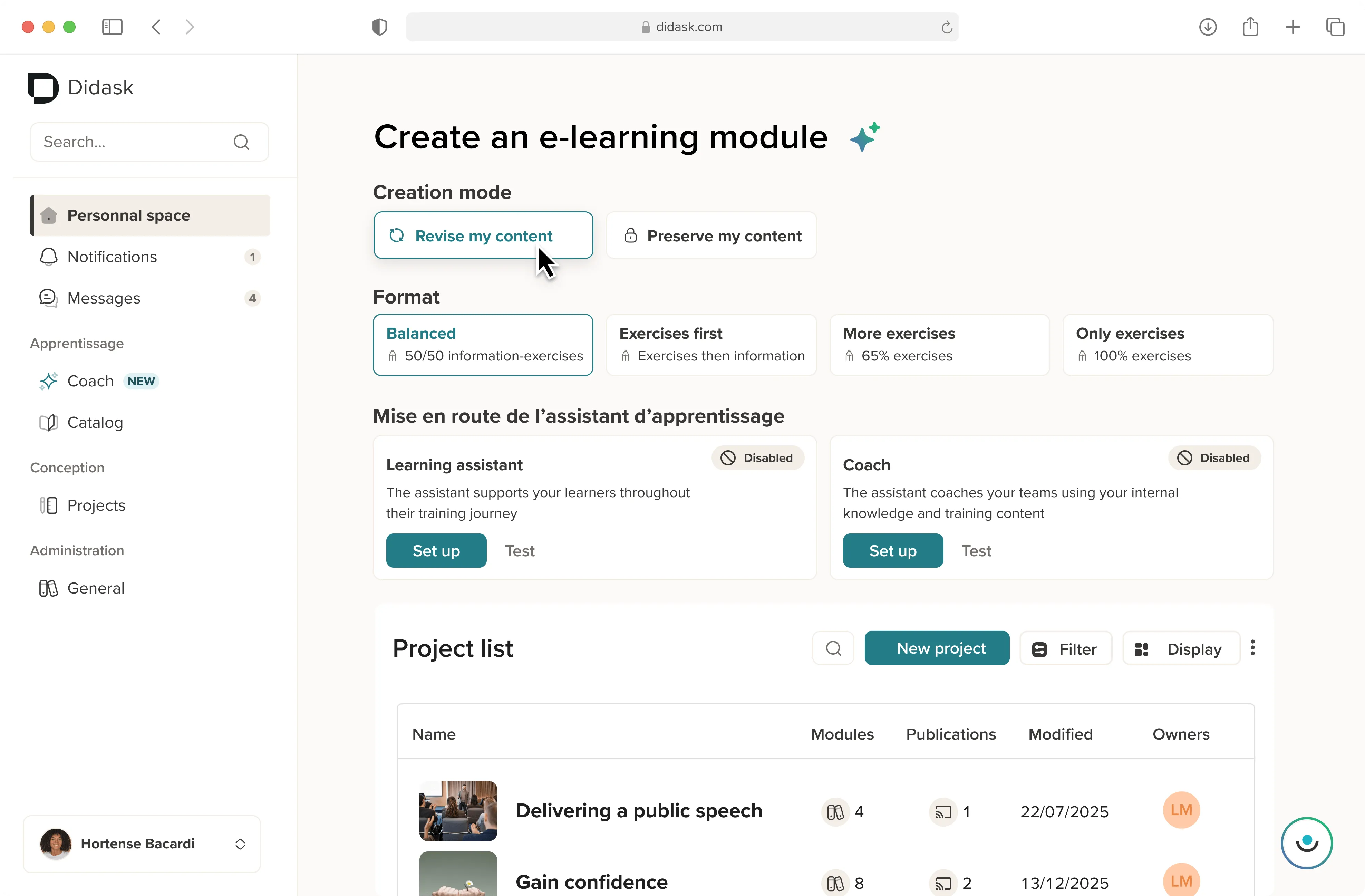
At Didask, we help training organizations and businesses get the most out of face-to-face learning through a cognitive science-based approach. Our platform makes it possible to prepare, animate and extend sessions in a coherent manner, so that each moment of the training has an impact.
Before the training, learners follow short online modules to acquire basic concepts. In the classroom, the trainer can then focus on practice, exchange and feedback. After the session, smart reminders and adaptive quizzes maintain memory and measure actual skill progression.
This Articulation between face-to-face and digital learning promotes a sustainable anchoring of knowledge, while simplifying the work of trainers. This is how Didask transforms face-to-face training into a complete, human and measurable experience.
FAQ: What to remember about face-to-face
How to optimize logistics for face-to-face training in a large company?
To manage the logistics of face-to-face training in a large company, it is advisable to plan the needs for rooms and equipment in advance, centralize registrations via a dedicated platform, schedule sessions in small groups to limit the size and facilitate management, and favor locations that are close or well served by transport. The use of digital tools to coordinate schedules and monitor attendance reduces the risk of errors and optimizes travel.
What is the impact of face-to-face training on learners' motivation compared to other formats?
Face-to-face training generates stronger motivation through physical presence, group energy and direct interactions, elements that reinforce learners' involvement. This collective dynamic is often less present in remote or asynchronous training courses where feelings of isolation or multitasking can reduce attention and commitment.
What complementary digital tools can enrich face-to-face training?
To reinforce face-to-face training, you can integrate preparatory e-learning modules, interactive online quizzes, mobile applications for post-session follow-up, as well as collaborative platforms for exchanges and sharing. These tools extend learning, facilitate the adaptation of content, and maintain memory between sessions.
How can face-to-face training be adapted to the very varied profiles of learners?
Adaptation can be done by offering differentiated activities at different levels, by integrating diagnostic assessment phases at the beginning, and by using various supports (visual, practical, discussions). In addition, an attentive trainer adjusts his pace and offers personalized support, while blended learning makes it possible to complement face-to-face training with individualized content.
What specific skills are difficult to develop in face-to-face training without digital support?
Without digital support, certain skills related to the personalization of courses, to repetition for memory, or to individual autonomy may be less developed. For example, the learning of complex software, the development of reflexes through frequent exercises at home, or the continuous consolidation of knowledge benefit greatly from digital tools that complement face-to-face learning.
.webp)
.webp)
.webp)





.png)