


The world of soft skills has a reputation for being difficult to address in digital learning. But is that really the case, or simply a preconceived idea? Cog'X, a consulting and training agency specialising in the subject, decided to test the Didask solution — with convincing results. Want concrete feedback? Watch the webinar replay "Effectively addressing soft skills in digital learning", featuring Cog'X!
Many experts use Didask's e-learning solution to address a variety of training topics. This is the case for soft skills applied to organisations and the world of work, and for Cog'X. This consulting and training agency shares a key common thread with Didask from the outset: a scientific DNA and cognitive sciences. Whether addressing cross-functional skills or technical abilities (sales or management), digital learning can prove remarkably effective when insights from neuroscience and cognitive psychology are applied wisely — provided you know how and have the right tools!
What exactly is Cog'X? Gaëtan de Lavilléon and Paul Brazzolotto tell you more!
Gaëtan de Lavilléon and Paul Brazzolotto, both experts at Cog'X, explain concretely what the agency does: "We leverage data from research laboratories on how the brain and human behaviour work, to help organisations and their employees improve their ways of working and, ultimately, preserve their cognitive and social resources". Cog'X addresses topics that concern all working situations, as well as more complex ones:
- mental load;
- work pace and recovery times;
- learning;
- collaboration and decision-making;
- managing uncertainty;
- creativity;
How did Cog'X end up in the world of e-learning?
Cog'X's goal? To enable individuals to take action and transform their behaviours and ways of working. This begins with a key moment of awareness: "How does my brain work?". To this end, Cog'X produces short, impactful content that is anything but simplistic, as Gaëtan de Lavilléon emphasises. The agency develops concretely applicable recommendations, delivered through face-to-face training or consulting assignments.
Gaëtan points out that it is important to question the purpose of soft skills, which has become a real professional and societal challenge. "Why is it important to take breaks? Why is it important to behave in a certain way in meetings, or to run a brainstorming session in a particular way?".
It was in this spirit that Cog'X began its journey alongside Didask, in order to disseminate essential knowledge more broadly and meet its clients' needs in a complex and turbulent environment.
What are the demands and challenges of companies working with Cog'X?
Working primarily with large corporations, public administrations and some mid-sized companies (ETI), Cog'X covers various sectors such as banking, culture and media. "The advantage of cross-functional skills is that, by definition, they apply to all professions," explains Gaëtan.
At present, 4 major learning paths have been designed by Didask to meet Cog'X's needs:
- A path on organisational skills (time management, digital tools, cognitive load);
- A path covering collaboration (feedback, social interactions, hierarchy, emotional regulation and understanding);
- A path co-created with a Cog'X partner, focused on individual and collective creativity;
- A final path launched shortly after lockdown, focused on remote working and the ability to adapt to it over the long term.
While many topics remain timeless (management, team collaboration), remote working has become a major and recurring feature of companies since the onset of the Covid health crisis. According to Gaëtan, they "need simple, quick things that are engaging for learners. (...) The solutions we present today seem to meet those expectations, since we offer content whose substance is always scientifically validated (evidence-based). And when talking soft skills, organisations want to give meaning to the recommendations we make, to ensure they are properly implemented".
Why is the Didask solution relevant for addressing soft skills at Cog'X?
The Didask concept was created around 5 years ago. The goal? Applying the findings of cognitive psychology research to online pedagogy.
Didask shares a similar DNA to Cog'X, both in its research-backed approach and in its deep engagement with cognitive science.
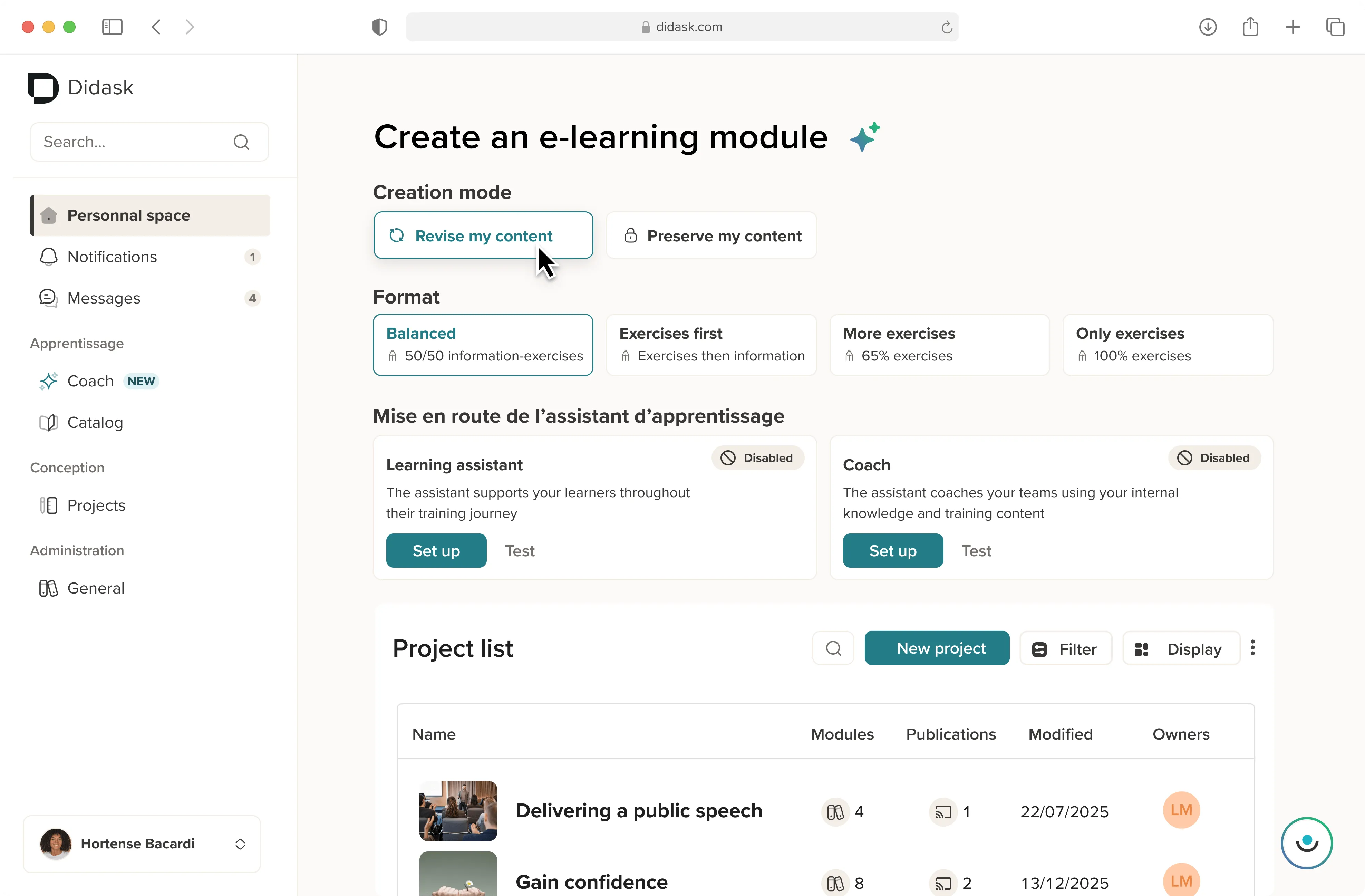
Paul Brazzolotto, an instructional designer at Cog'X and creator of training content on the Didask authoring tool, gets straight to the point: "The idea is to be able to reproduce, (with the Didask e-learning format) what we can do in face-to-face training — namely, a theoretical framework with a set of micro-skills that we convey. That, we can do easily with the Didask tool."
To illustrate how the Didask tool works, Paul chose to present a training path related to team collaboration, designed a few years ago. The structure is as follows: chapters and modules addressing specific micro-skills, with each question presented as a real workplace scenario.
What Paul liked? The Didask "procedure", as he calls it, and its ease of use for both designers and learners. "Since this procedure repeats itself, once you've got the hang of it, it's very easy to create complete learning paths. (...) We're never lost and never have to wonder how we'll teach a new concept. We have this clear architecture that guides us based on the questions. (...) What's interesting is that you can also convey a key message by going further in explaining the concept (through the scenarios)."
Another interesting point in Didask's methodology, according to Paul? Productive failure, which allows learners to try by getting it wrong! "One of the biggest problems when trying to convey information about soft skills in real work situations is that we generally encounter behaviours that aren't always the most appropriate," Paul explains.
This "trial and error" approach involves deconstructing a large number of assumptions and false beliefs. Deconstructing received ideas is one of the topics Cog'X addresses when discussing effectiveness or creativity. This process is an integral part of behavioural change in learners, hence why trial-and-error learning is, according to Gaëtan, a guarantee of effectiveness. A study carried out by Cog'X demonstrated that with "e-learning and blended learning approaches, 3 months later, ⅔ of learners had changed their behaviour."
In conclusion, what makes Didask so special?
Didask's e-learning solution is not simply focused on the technical side. It also incorporates a genuine pedagogical approach, enabling any expert to become an e-learning course designer in turn — simply and effectively. At the same time, its clear, engaging and practical format has a lasting impact on your employees' learning. They are therefore able to concretely apply the knowledge they have been given, in work situations.
The Didask e-learning tool guides your thinking from start to finish, enabling you to confidently share your expertise through personalised content tailored to your employees' needs. The hallmark of the Didask format? Basing learning on productive failure. This reverse-thinking approach allows everyone to remain active in how they learn.
.webp)
.webp)
.webp)

.webp)


.png)