


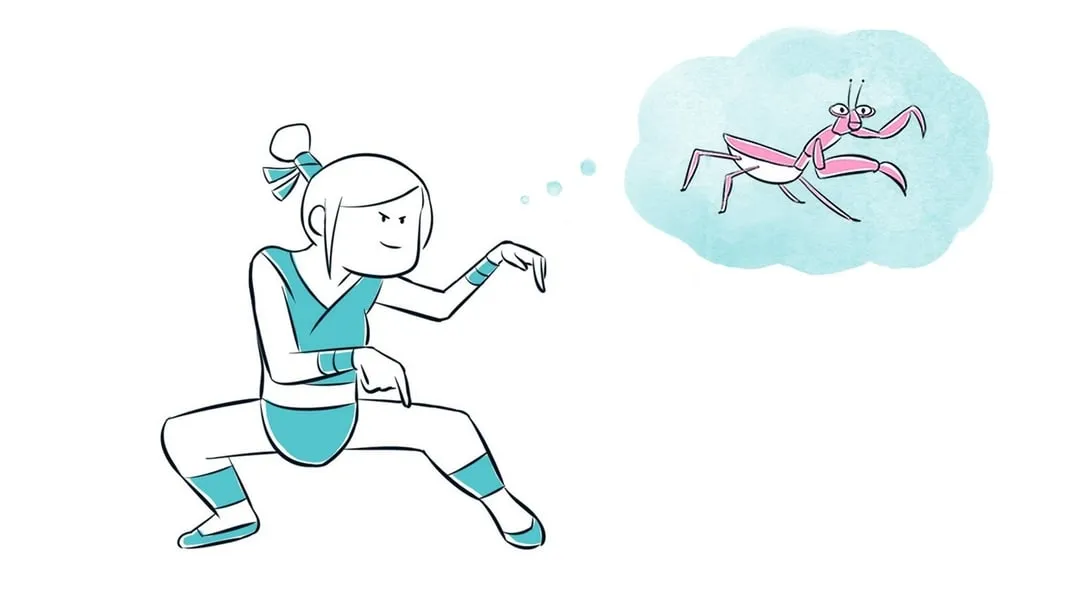

Mental shortcuts: essential pillars of all lasting learning
"But where oh where is Or-ni-car?" If you still remember the list of coordinating conjunctions today, you probably owe it to this strange yet unforgettable mnemonic. Mnemonic devices are a well-known method for helping your learners better retain what they have learned, but there are several other similar techniques.
Take the example of a computer science teacher who, to help students remember the concept of a boolean (a variable that can only have two states: true or false, 0 or 1...) uses the metaphor of lovers: every evening, a suitor waits for his mistress under her balcony. If her bedroom light is off (0), it means they are not alone: it's not the right moment to go up. If the light is on (1), however, he knows he can safely join her on the balcony.
Another example: a trainer wishing to instil in trainees the importance of credibility in negotiations uses a colourful anecdote: a colleague, in the middle of a meeting, theatrically gets up from his seat, heads for the exit and… finds himself blocked by a stubborn door.
All these techniques have one thing in common: they are mental shortcuts. These shortcuts allow us to more easily retrieve the right information, or the right reaction, from our memory when we need it. That is why they are essential pillars of all lasting learning. Whether based on wordplay, semantic proximity, or emotional content, mental shortcuts are indirect routes to accessing a concept in memory by drawing on related but different types of knowledge.
The effectiveness of mental shortcuts in learning is not just intuition. It is solidly supported by research in cognitive science: those who use them are better able to apply what they have learned than those who don't.
Numerous scientific studies support this principle. Here is one of them:
To measure the usefulness of mental shortcuts, researchers asked 60 participants to learn a list of words. They were split into two groups: the first was asked to construct sentences using these words (for example, "the cow crushed my foot before walking towards the hat-shaped hut" for the words "cow", "foot", "hut" and "hat"), while the second was given no particular instruction.
In a test taken shortly afterwards, researchers found that participants who had constructed sentences with the words were able to recall a greater number of words than the group with no instruction. This result may seem surprising: building a sentence and remembering it requires the participant to recall not only the words in the list, but also the linking words. How can we explain their superior performance?
The chaining effect: mental shortcuts connect information together
Mental shortcuts promote information consolidation — but what explains this effect? It seems that linking words to remember in a sentence adds an extra cue to help you recall them. Instead of memorising unrelated words, you can start by retrieving the general meaning of the sentence, then use it as a starting point to find the words that make it up.
What research calls "chaining" of words makes them more memorable than if they stood alone: for our brain, it is easier to recall a chain than all its individual links, notably because each link is connected to the next, which in turn connects to the next, and so on. What holds true for a sentence holds true for other types of mental shortcuts, such as metaphors or illustrations. So when you illustrate your point with a diagram, the diagram and the concept it represents are chained together.

Narration and pathways: mental shortcuts par excellence
The chaining effect is notably what explains the pedagogical value of storytelling. It is easy to find your bearings in a story because each event is part of a chain of cause and effect: Delphine stole Elsa's bicycle → Elsa calls the police → Delphine gets arrested, etc. Our brain spontaneously seeks out this structure where everything is in its place and everyone has a role to play. This helps explain how some of us who struggle to remember their bank card PIN can simultaneously have developed an almost encyclopaedic knowledge of TV series (sometimes knowing the Lannister family tree from Game of Thrones better than their own).
The chaining effect is also what underpins the technique known as the memory palace, in which each item you want to remember is stored in a familiar place (such as your home). You can then retrieve them by following an imaginary route, as if visiting the rooms of your house one by one. For example, to remember the security procedure in the event of a computer incident: the first step is to "identify" the incident, so your first stop could be picking up the "identity" card near the entrance, in the pocket of your jacket on the coat rack. By retracing a logical route, you will better recall all the steps from memory.
Emotions: a double-edged mental shortcut
Another form of chaining involves attaching concepts to an emotion, whether directly experienced or conveyed through an anecdote. Information that triggers an emotion will tend to be better recalled than other information. The emotion can be negative like sadness, or come from humour or surprise. The emotion provoked by an anecdote will naturally guide you to the concept to be remembered: if, in a leadership course, an illustration of bad practice reminds learners of an experience that made them angry, they will be more likely to remember it.
Be careful, however, not to overdo it. Faced with an overly intense emotion, learners will only remember the emotion and will block out everything else they learned at that moment. Research tells us that extreme emotions can even contribute to the creation of false memories, as sometimes happens following traumatic episodes. In training, excessive emotion might arise from an activity so challenging it becomes stressful, or feedback so negative it creates deep damage to the ego.
Furthermore, it is essential to ensure that the emotion provoked is directly related to the concept you want to convey, and does not simply represent a distraction of attention. Educational videos on YouTube, for example, often pile on so many visual gags and purely decorative cultural references that the key messages end up more muddled than clarified.
Find a better path in your memory
Let's conclude with a brief mise en abyme, and try to illustrate the effectiveness of mental shortcuts like metaphors… with a metaphor.
If our memory is a forest, and the mental traces of our learning are the paths that run through it, the mental shortcut is, as its name suggests, a shortcut: a path that, while it may initially seem like a detour (since it passes through an intermediate step, such as the memory of an emotion, to reach its destination), is actually both faster and easier to take than the others. By creating a mental shortcut, you mark out a practical trail to retrieve the fruits of your learning from the forest of your memory whenever you need it.
Practical tips for teachers and trainers
- Provide your learners with a mnemonic device to help them remember your course or training, and above all repeat it several times — repetition is what will help your learners recall it.
- Emotions are your allies — use them to boost recall of your concepts. Be careful not to increase the emotional load too much: the risk is that learners will only remember their feelings at the expense of the concept to be learned.
- Make use of an active retrieval phase in which your learners must make the effort to create their own mental shortcuts.
- Limit the number of different mental shortcuts: given your limited time, it is better to restrict their number but repeat them more often.
REFERENCES
[1] McNamara, D. S., & Scott, J. L. (2001). Working memory capacity and strategy use. Memory & cognition, 29(1), 10-17.
[2] Mather, M.; Sutherland, M. R. (2011). Arousal-biased competition in perception and memory. Perspectives on Psychological Science. 6 (2): 114–133.
[3] Howe., M.L.; Knott, L.M. (2015). The fallibility of memory in judicial processes: lessons from the past and their modern consequences. Memory. 2015;23(5):633-56.
.webp)
.webp)
.webp)





.png)