


One of the pillars of sustainable learning is knowing how to present the information to be learned
To convey a certain concept, is it better to use a video, an animation, an image, audio, or a simple text? What is the most effective? When designing a course or training, the trainer has plenty of options. But for convenience, we tend to be content with the text, whether oral or written.
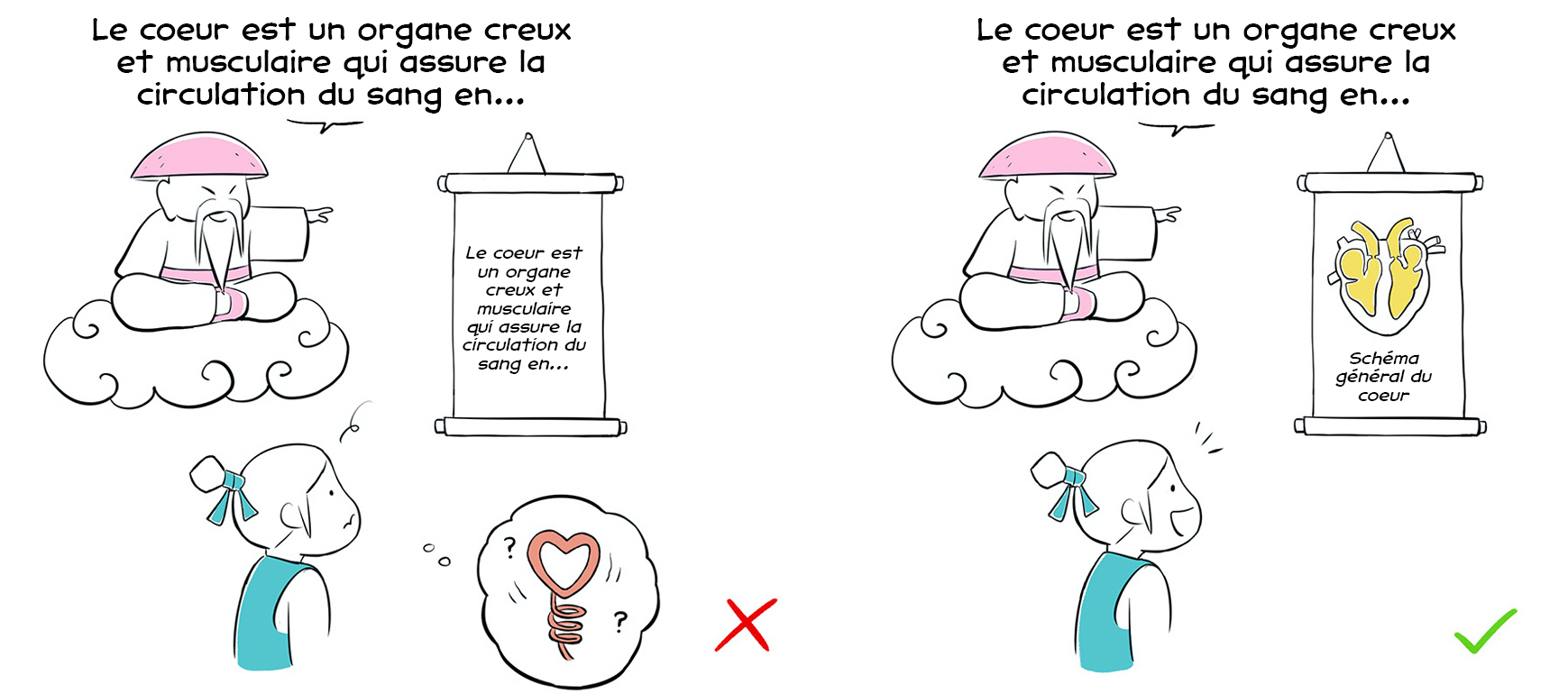
However, it has been proven that multiplying the sensory modalities by which we communicate information (image + audio, for example) greatly improves our understanding and memory.
How can such an effect be explained?
First, transmit learning content via multiple sensory channels (auditory, visual, manual...) highlights various pieces of information that, when linked to each other, lead to a better representation of the concept to be learned. This higher-quality representation will be better understood by The learners and therefore better remembered.
Then, offering learners several sensory modalities to process information distributes the quantity of information perceived by each sense. Indeed, our ability to process several pieces of information at the same time in the same channel, and to maintain them in short-term memory is limited. Multiplying sensory channels makes it possible to Bypass the limits of short-term memory.
An image is worth a thousand words, this effect can be illustrated in the following way. If we consider that long-term memory is a forest and that the concepts to be learned are locations within it, multiplying sensory inputs would be like Multiply the paths that lead to information. The more paths we have, the easier it is to reach the point we are looking for and the better our memory is!

Practical advice for teachers & trainers
- For each concept, Multiply the supports : a text, of course, but also a video or a diagram. It's up to you to decide according to your inspiration and your educational objective (Cf. the article Skills development: how to optimize your training goals?).
- Regardless of the modality used, the materials must contain relevant information. The “decorative” illustrations do not bring anything interesting from a purely educational point of view.
- Target information that you want to highlight. It is better to multiply the sensory supports for the key information in your course rather than to describe each concept in all modalities.
- Beware of redundancy. Many online courses offer videos that say, in much the same way, as the text associated with them.
- Avoid overloading your content. A medium that is too fun or too busy does not allow the learner's attention to be focused on the important points (Cf. the article Mental overload, the enemy of learning).

Source:
[1] Mayer, R.E., & Anderson, R.B. (1991). Animations Need Narrations: An Experimental Test of a Dual-Coding Hypothesis. Journal of Educational Psychology, 83(4), 484.
.webp)
.webp)
.webp)





.png)