


Vocational training has long operated in silos: on the one hand, structured e-learning modules, on the other hand, business knowledge dispersed in documentary databases. The RATP group wanted to improve this scheme. By relying on Didask Coaching, the world's 3rd largest urban transport operator has launched an ambitious experiment: an AI conversational agent capable of unifying these two worlds and personalizing learning in real time.
The RATP Group: 73,500 employees, 270 jobs, a permanent training challenge
Established in 15 countries on five continents, the RATP Group is the 3rd largest urban transport operator in the world. Every day, its 73,500 employees operate 9 modes of transport, from the Paris metro to autonomous vehicles, including trams, buses and maritime shuttles.
This diversity of jobs and levels of mastery creates a considerable training challenge. Keeping the skills of such a heterogeneous population up to date, on subjects that are as technical as they are varied, requires the continuous rethinking of learning methods.
The challenge: unifying formal training and business knowledge
In the world of corporate training, two main areas coexist without really talking to each other: business knowledge management and formal training provided via e-learning modules. The RATP group identified this divide as a barrier to the learning experience.
The objective of the experiment, launched as part of an internal innovation program, was to test whether an AI conversational agent could unify these two worlds: allow a learner to query his training materials and the company's business knowledge bases in a single gesture.
The specifications were ambitious. The coach had to assess the level of the learner, answer his questions based exclusively on the content produced by the RATP Group, and propose training courses adapted to the objectives and the time available of each user.
For the experiment, the RATP group selected an internal technical community of 180 members, at very heterogeneous levels, from beginner to expert. Other topics, such as rolling stock maintenance, have been added to complete the tests. This varied profile made it a particularly relevant test ground for evaluating the adaptive abilities of the AI coach.
Why Didask became a partner
At the time the project was launched, generative AI solutions targeting learners (not course designers) were almost non-existent. After an in-depth benchmark of training players, the RATP group turned to Didask for two decisive reasons.
First, Didask was already actively working on the subject of AI learning coaching, with advanced maturity on the underlying pedagogical issues. Secondly, Didask's anchoring in cognitive sciences applied to training was a decisive factor: the RATP group was looking for a partner capable of going beyond a simple chatbot, and of designing a truly effective system in terms of learning.
.png)
Alexandre Allouche - Blockchain Manager
"The Didask teams were highly responsive in solving the many challenges that arose throughout the project. They also proactively suggested ways to refine our needs and deepen our understanding of the issues at stake, sometimes even changing our minds about our strategy."
A gradual deployment in three modules
The project was divided into several successive phases, each corresponding to a functional module of the AI coach.
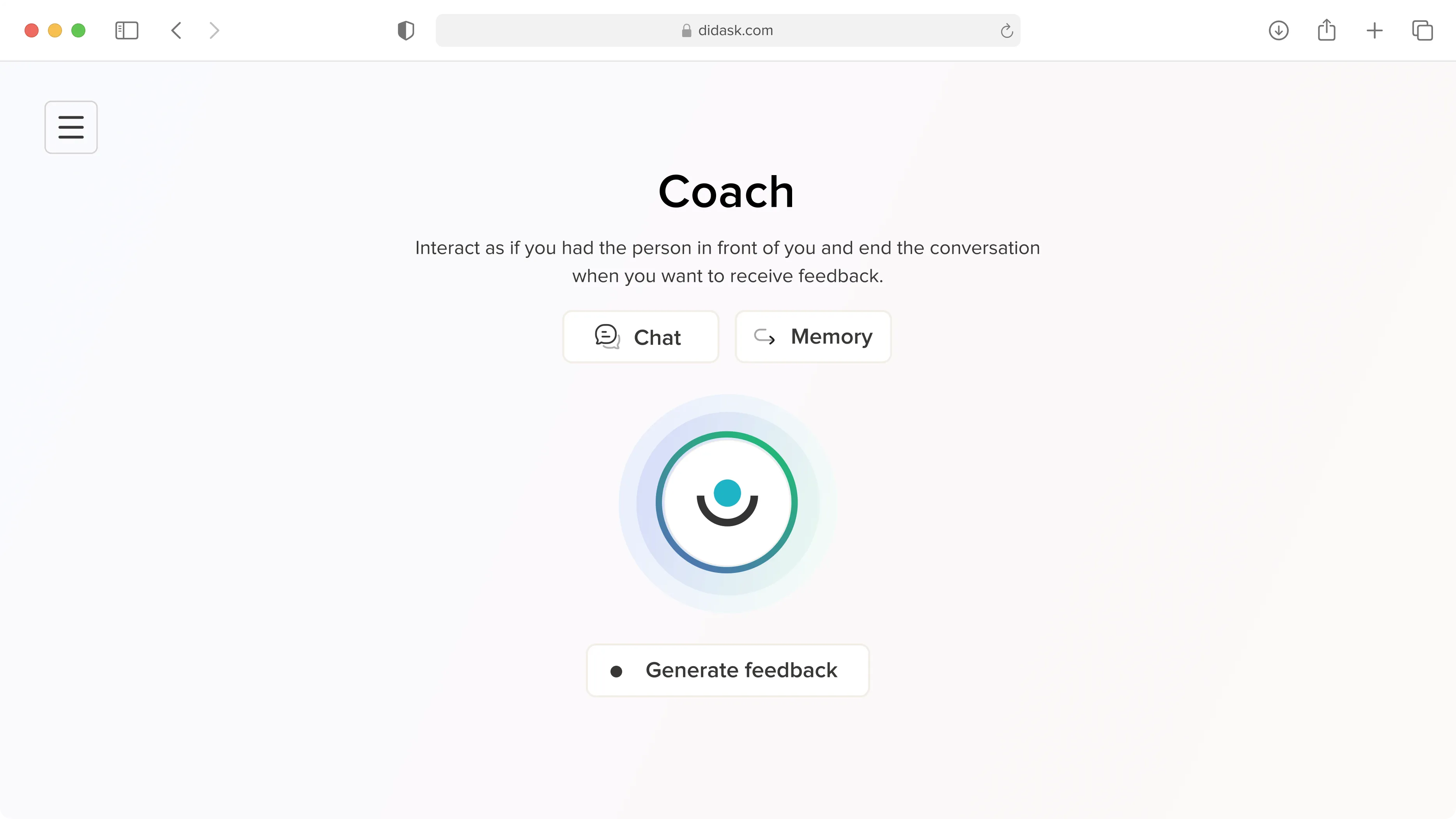
- The first module allows the learner to ask questions and obtain well-sourced answers, based on RATP Group content available in the knowledge base.
- The second module reverses the logic: it is the coach who interviews the learner, to assess and challenge his level on a given subject.
- The third module, the most complex to set up, offers personalized training courses, with a learning duration and a recurrence chosen by the learner himself.
Throughout the deployment, users were involved in the process through dedicated workshops and feedback forms. Their feedback fed into the successive iterations of the tool.
“It is very pleasant to have a single tool to search for information in business knowledge bases and training materials. It greatly simplifies the user experience.” - Alexandre Allouche - Blockchain Manager
The results of the experiment
The usage data collected over the duration of the experiment reveals three positive signals.
The first is the adoption rate: 60% of learners with an active Didask account used the AI coach in the past year, or 36 out of 60 users. For a phase of experimentation on an entirely new tool, this level of commitment is significant.
The second signal concerns user loyalty. Of the learners who used the coach, 86% sent at least two messages. The abandonment rate after a first interaction is therefore low, which indicates that the tool has gone beyond the stage of initial curiosity to generate real use.
The third signal concerns the diversity of exploration. More than 25 separate documents were deemed relevant by the coach to answer at least 10 questions each. Learners did not limit themselves to the same basic questions: they explored the diversity of content available in the knowledge base, from one conversation to another and from one user to another.
Finally, among the spontaneous feedback left via the feedback buttons, 71% are positive. This result is particularly significant: dissatisfied users statistically tend to express themselves more than satisfied users. A rate of 71% on unsolicited reviews is therefore a strong signal.
Alexandre Allouche - Blockchain Manager
"The AI coach doesn't replace traditional content like micro-learning capsules or e-learning modules. It serves more as a support layer, enriching the learning experience or addressing specific, on-the-spot needs."
And now: towards industrialization
The RATP x Didask group's experiment has achieved its primary objective: to demonstrate the added value of conversational AI at the service of learners. Users have greatly appreciated this new learning method, which is both more interactive and more adapted to their real needs.
The analysis of industrialization opportunities is now under way within the group.
Your learners deserve an AI coach rooted in cognitive science. Book a personalized demo.
.webp)
How our customers turn learning
into measurable impact









Get a demo!
We’d love to know how to help you
made scalable

Authoring Tools
Platform
.png)