Why are your current HR tools no longer enough? If you still manage your employees with Excel spreadsheets and manual processes, you're wasting valuable time and risking costly mistakes. Human resources management is rapidly evolving towards a strategic approach where tools no longer simply administer but actively develop human capital. This transformation requires next-generation HR tools that communicate with each other (integrated), use artificial intelligence (intelligent) and measure concrete results (performance-oriented).
Here is why all-in-one HRIS (Human Resources Management Information Systems) promise mountains and wonders but often fail when it comes to specialization. The future belongs to modular ecosystems where each tool excels in its field while integrating perfectly with other solutions.
Essential terms glossary
- HRIS: Human Resources Information System (central software that manages all HR aspects)
- LMS: Learning Management System (online training platform)
- ROI: Return on Investment (what you gain vs what you spend)
- API: Interface that allows two software systems to communicate automatically
- ATS: Applicant Tracking System (software that manages your recruitment)
Domain 1: Administrative management for your organization
Administrative management software is the foundation of any effective HR strategy. Concretely, these solutions replace your filing cabinets and spreadsheets with automated processes that guarantee the legal compliance of your business.
Automation turns time-consuming tasks into automatic processes: instead of spending 2 hours preparing an employment contract, the software generates it in 5 minutes. Managers can thus focus on missions with higher added value within the organization.
SME (under 50 employees)
Choose an all-in-one solution like Lucca + Didask for training.
Essential features:
- Contract management: The software automatically creates your employment contracts from a template, modifies them if necessary and archives them digitally
- Social statements: The system automatically calculates and forwards your declarations to social organizations
- Personal documents: All HR documents (contracts, pay slips, leave) are stored in the same place with secure accesses according to the profiles
- RGPD compliance: The software automatically applies data protection rules (who can see what, how long to keep the information)
Administrative compliance checklist:
- ✓ Electronic signature of documents (no need to print to get signed)
- ✓ Secure archiving with timestamp (legal proof of when each document was created)
- ✓ Traceability of changes (who changed what and when)
- ✓ Compliance with legal requirements (the software knows the law and prevents you from making mistakes)
Tool 1: Time and attendance management to optimize productivity
Scheduling tools now incorporate hybrid work management. Working time management and team planning are becoming crucial in the context of remote work. New ways of organization require a flexible approach to improve performance.
These tools, offering a real-time view, facilitate decision-making and help manage daily activity. Productivity indicators offer a clear vision of individual and collective performance.
An example of software like Lucca facilitates leave management, absence planning, and work organization. Moreover, Didask integrates perfectly with the Lucca HRIS for a complete solution.
Tool 2: Payroll and personnel administration to automate and avoid mistakes
Payroll automation drastically reduces the risk of human error. Modern payroll software directly integrates the variables of time, leave, and bonuses and manage remuneration in a secure manner.
The process becomes fluid: the employee validates his hours on the application → the software automatically calculates the salary → the pay slip is generated → the social declarations are automatically sent to the organizations. Social declarations are generated and transmitted without manual intervention.
Cegid and Payfit, for example, offer a comprehensive solution for payroll management with automatic updates to rates and regulations. This type of system ensures compliance and facilitates the monitoring of regulatory changes.
Payroll automation ROI
Real example: instead of 4 hours per month to process payroll for 20 employees, you spend 1.5 hours. And you reduce calculation errors by 5x. Source: Payfit 2024 study.
Domain 2: Recruiting and onboarding to attract and integrate top talent
Recruiting without tools is not the best solution. You receive 200 resumes by email, you lose them, you forget to respond to candidates... The latest recruiting tools are transforming the candidate experience and simplifying the management of the process. The ATS (Applicant Tracking System) is a software that automatically collects all applications received, sorts them according to your criteria (experience, degree, location) and follows each candidate step by step (application → interview → decision).
The integration of a new employee determines whether they will stay or leave in the first 6 months. A well-designed onboarding process ensures a better employee experience.
- Workato : No-code platform that connects +1000 applications with pre-configured automation “recipes”
- Zapier for Teams : Ideal for SMEs, allows you to create simple automated workflows between your tools
- MuleSoft : Enterprise solution for large organizations with complex integration needs
- Make (ex-Integromat) : Economical alternative with an intuitive visual interface
Middleware ROI: 80% reduction in input errors, saving 5 hours per week on administrative tasks, and instant synchronization of all your HR data. For a company with 200 employees, the investment pays for itself in less than 6 months.
Didask integration tip
Didask offers a comprehensive REST API that enables automated training enrollment and synchronization with your business tools. You can automatically create users, add them to groups, or retrieve their learning data to integrate into your HRIS. This facilitates workflow automation such as enrolling new employees upon arrival or triggering learning paths following annual reviews. Implementation requires developers and consultation of the dedicated technical documentation.
How to choose your HR tools? Methodology and selection criteria
The selection of HR tools requires a rigorous methodology and proven practical advice. The needs analysis always precedes the evaluation of available solutions.
The multi-criteria evaluation grid guides you to make the right choice. The predicted ROI (return on investment) guides the final decision: it compares what you will gain (time saved, errors avoided, productivity) with what the tool costs over several years.
Guide to choosing your HR tools:
- Needs audit: Exactly list your current problems (”We lose 3 hours a week re-entering information“,”We forget candidates“)
- Specifications: Define your non-negotiable criteria (budget, number of users, mandatory integrations)
- Comparative assessment: Test 3-4 solutions with your real teams on your real use cases
- ROI calculation: Precisely quantify the expected gains over 3 years
- Deployment plan: Plan training, data migration, and change management
| Criteria | Weight | All-in-One HRIS | Modular Suite |
|---|
| Ease of integration (everything works together seamlessly) | 25% | 9/10 | 6/10 |
| Functional specialization (excels in its domain) | 30% | 6/10 | 9/10 |
| Total cost of ownership (TCO) (price + maintenance + training) | 20% | 8/10 | 7/10 |
| Innovation / Evolution (regular new features) | 25% | 5/10 | 9/10 |
ROI and budget: how to justify the investment to management?
Calculating the return on investment quantifies the expected benefits in euros and hours saved. Productivity gains and cost savings justify the initial investment.
The presentation to decision-makers highlights concrete business challenges:”This tool will save us 10 hours per week, or 15,000 euros per year in salary costs.“Financial arguments are accompanied by measurable qualitative benefits.
It is necessary to avoid hidden costs (training, maintenance, data migration) and assess the tools well on their total cost of ownership over 3-5 years. The amortization period and maintenance costs should be included in the calculation.
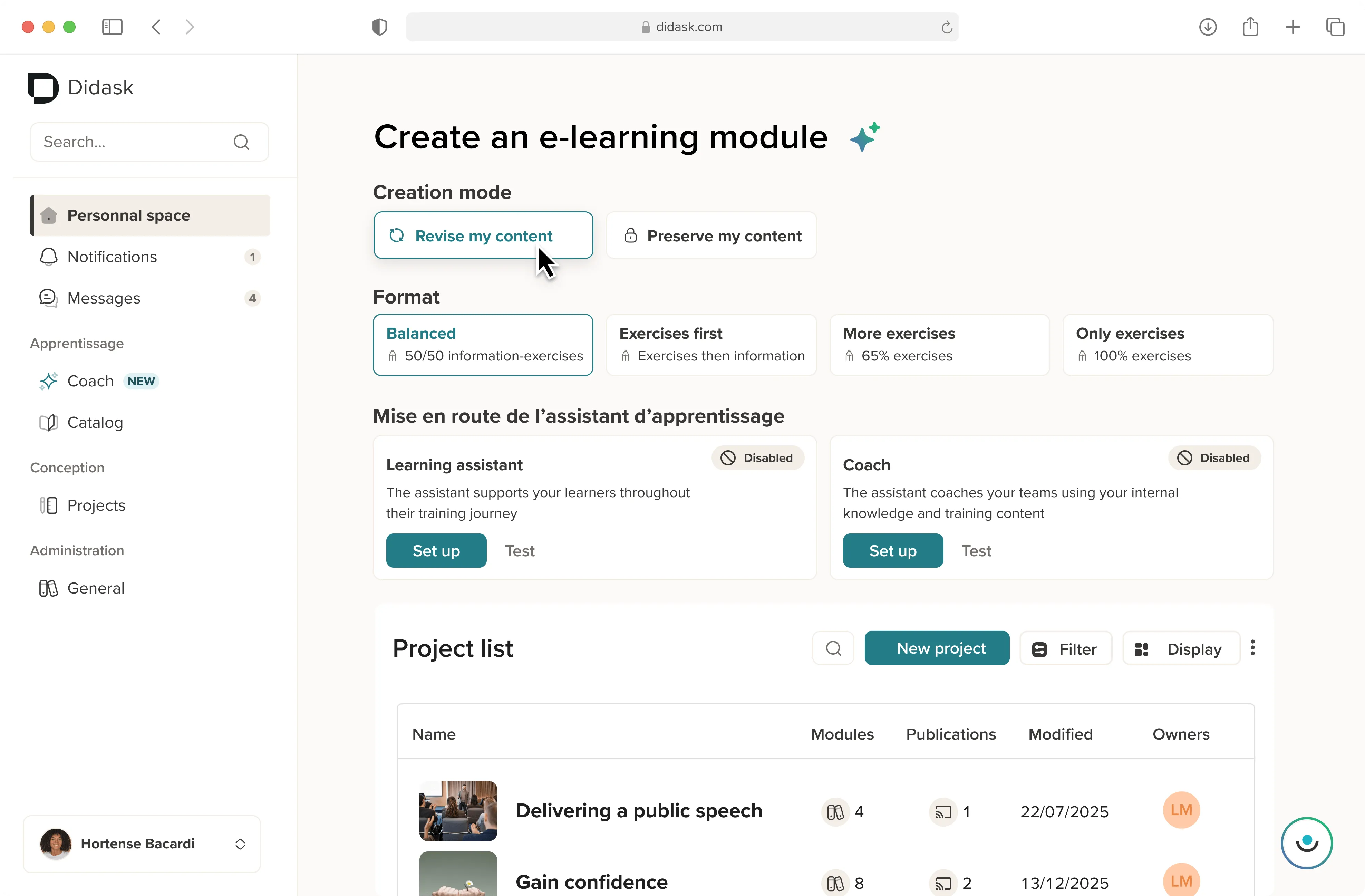
How does Didask transform training at the heart of your HR strategy?
Didask is revolutionizing the creation of training courses: instead of using an agency at €50,000 or spending 3 months creating a module, educational AI transforms your existing PowerPoint into interactive training in a few days. The Educational AI analyzes your raw content (presentations, documents) and automatically creates quizzes, practical exercises and adapted scenarios.
Adaptive learning personalizes the learning experience for each employee in the company: Marie, who masters the basics, quickly moves on to complex cases, while Paul, who is just starting out, receives more explanations and basic exercises. This approach based on cognitive sciences guarantees a rise in real skills.
L'Oréal customer feedback
Didask's digital learning solution enabled us to achieve this through an excellent learning-by-doing and trial-and-error approach, combined with a very easy, concise, and intuitive user experience.
Didask's exclusive competitive advantages:
- Cognitive science: The only platform based on years of academic research in the neuroscience of learning
- Educational AI: Automatic creation of training courses from your existing content (PowerPoint, Word, PDF)
- Adaptive learning: Personalization of your training courses. Each user has an adapted journey.
- Impact measurement: You know exactly where the blocking points are in the formation
- Universal integration: Compatible with your HR tools
Measurable results: 94% proven effectiveness in the field
94% of learners confirm that their training has had a concrete positive impact on their daily work, not fair”I have learned things“but”I do it differently and it's more effective“. This effectiveness is explained by the scientific approach to pedagogy.
Customer testimonies such as L'Oréal and Canal+ demonstrate the concrete ROI of the solution with precise figures: reduction of training time, improvement of field performance, increase in knowledge retention. The granular measurement of impact allows precise management of results.
The best training software must combine ease of use and scientifically proven educational effectiveness. Didask meets these requirements with an intuitive interface and proven results.
Didask performance proofs:
- +94% efficiency certified by end users (vs ~ 30% for classical courses)
- 10x faster to create interactive courses (2 days vs 20 days traditionally)
- 60% of the time training for the same skill level (more effective learning)
- 100+ customers and major accounts (BNP, Orange, L'Oréal, Canal+...) (proof of trust)
Choosing the right solutions today determines your business's ability to adapt and thrive tomorrow.
Training, the central pillar of this transformation, requires tools that match your ambitions: no longer content yourself with training that lulls your teams to sleep. Investing in these tools is no longer an option but a strategic necessity. With Didask, this transformation becomes not only possible but measurable and profitable.



.webp)
.webp)
.webp)

.webp)


.png)