


Train your teams has never been more strategic for businesses and training organizations. In a world where skills are changing rapidly and where digital technology is redefining learning, the MOOC (Massive Open Online Course) stands out as a flexible, accessible and effective solution.
Born in universities and popularized in France by portals such as FUN (France Digital University), MOOCs are now adopted by companies to training remotely a large number of collaborators, partners or future talents.
How do they work? What concrete benefits do they offer in business? And above all, how does Didask support organizations in implementation of online training adapted and engaging?
What is a MOOC?
A MOOC, or open and massive online courses, is a training course distributed on a digital platform. Accessible via the Internet, it allows thousands of participants, whether learners, students or employees, to take distance courses. It should not be confused with SPOC and COOC.
Concretely, a MOOC combines:
- Instructional videos and digital resources;
- Interactive modules (quizzes, exercises, forums);
- A logic of learning at its own pace (self-paced learning);
- Assessments to validate your achievements and sometimes to obtain a certificate or diploma.
Initially designed by universities and research institutes (MIT, Stanford, University of Paris, etc.), MOOCs are now used well beyond the academic framework, in particular by Businesses.
What are the objectives of a MOOC in business?
MOOCs respond to various educational challenges in business. They make it possible as much to disseminate theoretical knowledge as to make employees aware of strategic subjects. Here are the main goals behind their deployment.
Train a large number of employees remotely
With a MOOC, it is possible to reach hundreds, even thousands of employees, regardless of their location. Teams working remotely or spread over several sites can benefit fromA same distance education.
Raise awareness among teams about new topics
Innovation, CSR, digital, code... They allow Raise awareness of strategic issues throughout an organization.
Disseminate theoretical knowledge accessible to all
They democratize access to continuing vocational training and ensure a common level of knowledge on transversal topics.
Democratising access to training
By removing barriers related to location, time and cost, they expand access to knowledge, thus strengthening the success of business projects.
Who are MOOCs for in a professional context?
A MOOC is not only intended for internal collaborators. Depending on the needs, it can touch different targets within and outside the company.
For employees who want to improve their skills
MOOCs offer flexible paths for develop new skills and secure your job.
For managers and executives looking for expertise
They find in MOOCs a way toquickly access educational resources sharp and up to date.
To expanded partners and networks
Customers, distributors or extended networks can be trained via a MOOC, in a logic of development andstrategic alignment.
To students or future talents
In an employer brand logic, offering MOOCs can attract future graduates and enhance the company's image.
What are the advantages and limitations of MOOCs?
Like any educational method, MOOCs have both strengths and constraints. Organizations need to know them to properly integrate this format into their training strategy.
Advantages of MOOCs:
- Massive scale: possibility of training a large number of participants simultaneously.
- Accessibility: available online, in France and everywhere in the world.
- Flexibility: learners choose their pace and the duration of their course.
- Diversity of content: videos, digital resources, interactive activities.
- Assessment of achievements: monitoring of the success rate and validation of knowledge.
Limits of MOOCs:
- High dropout rate: without support, some learners struggle to complete the course.
- Limited interaction: the massive side can reduce instructional personalization.
- Motivation at a distance: the absence of animation can hinder the engagement of participants.
How to design an effective MOOC for your teams?
Setting up a MOOC is not limited to distributing modules online. To be effective, it must be based on a rigorous educational design and continuous follow-up. Here are the key steps.
1. Define clear learning goals
MOOCs should meet a specific business need, whether it's digital training, developing a skill or acculturating teams.
2. Create engaging content
Short videos, interactive exercises and storytelling promote memorization and motivation.
3. Scheduling evaluations
Regular assessment allows learners to measure their progress and to obtain recognition (certificate, badge, diploma).
4. Animating the community
A forum or chat led by experts Stimulates exchange and the sharing of knowledge between learners.
5. Measuring impact and adjusting
The indicators (registration rate, average connection time, success rate) make it possible tocontinuously improve the MOOC.
How does Didask support companies in their MOOC projects?
At Didask, we believe that The success of a MOOC is based on adapted pedagogical engineering and innovative tools.
- With our authoring tool software, it is possible to create interactive and engaging MOOCs without extensive technical expertise.
- The Educational AI integrated into our LMS tool promotes the adaptive learning : each learner benefits from a personalized course according to his needs and his pace.
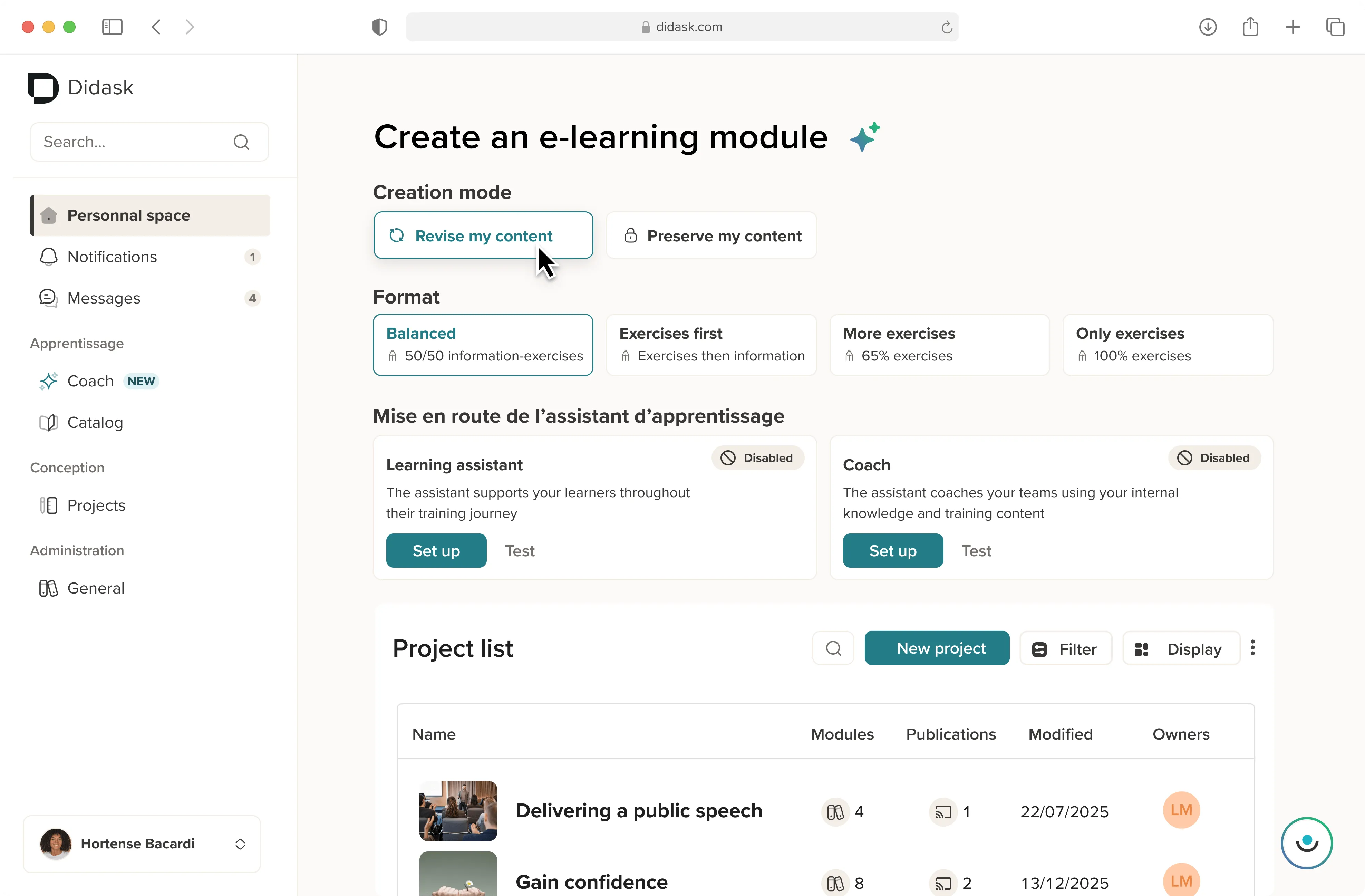
Thanks to this approach, the Didask training platform supports both training organizations and companies in the design and deployment of MOOCs efficient, promoting online learning, skills development and the adherence of participants.
The MOOC is much more than just a trend in online education: it is a real opportunity for companies and training organizations to disseminating knowledge on a large scale, at a lower cost and with unprecedented flexibility.
.webp)
.webp)
.webp)

.webp)



.png)