


Gamification transforms passive training into a fun and interactive experience, boosting engagement and memory through badges, points and challenges. Born in the 1980s, it emerged with the rise of e-learning, promoting cooperation, healthy competition and real-time monitoring. But be careful: the cognitive science reveal that commitment alone does not guarantee learning. To be truly effective, gamification must be based on validated pedagogical mechanisms — situations, explanatory feedback, learning by error. Discover how to combine the best of fun and cognitive science with tools like Didask.
What is gamification?
Definition: turning training into a game for interactive learning
Gamification, or gamification in French, refers to the use of game mechanics in other contexts, and in particular in professional training.
The objective? Transform a theoretical or passive learning process into an engaging, interactive and motivating experience.
Concretely, this involves the introduction into a program of elements that are usually found in video games or board games (badges, points, challenges, rankings, and others) in order to boost participation and maximize knowledge retention.
This educational approach focused on the user experience is based on a simple idea: learning becomes more effective when the learner has fun at the same time!
History and evolution of gamification in learning
Although it has grown in popularity in recent years, the concept of gamification is not that recent. In fact, it found its origins in the 1980s, with the appearance of the first educational games.
But it was in the early 2010s that the term really came into being in the world of business and training. In question, the evolution of digital technologies, the digital transformation of the world and the rise of e-learning, among others.
Today, gamification is used by organizations of all sizes to boost the training programs offered to employees while meeting real needs in terms of efficiency.
Gamification: more than a game, a driver of engagement and performance
The elements of gamification go far beyond the simple game. A real driver of performance and sustainable teaching, gamification acts as a driver for teams. Learners are more involved, training completion rates are increasing, and companies are seeing better results over time!
Why is gamification an asset for your training?
Boosting learners' motivation and engagement
In a professional world where training time is often experienced as obligations, maintaining the motivation of employee-learners is essential.
The principles of gamification nourish and encourage active participation. By including the spirit of play in educational paths, we give new meaning to learning.
Improving knowledge retention with fun mechanisms
The brain remembers what it experiences better. It is a scientific fact. If role-playing games, video games and other simulations promote knowledge retention so much, it's because they allow learners to mobilize their knowledge in a concrete setting.
This fun approach transforms training into a lively and interactive process, conducive to long-term memory.
Create an immersive and interactive learning experience
One of the major advantages of gamification is its ability to transform the world of classical training by offering a truly immersive learning experience.
Learners are no longer just reading or listening: they interact, make choices, and immediately see the results of their actions.
This immersion reinforces concentration and anchors the content processed, whether read, seen or heard, in memory.
In both real and virtual environments, games, scenarios and other challenges seem to be much more effective than the usual transmission of knowledge.
The benefits of gamification for businesses and training organizations
For your company or for your training organization, the advantages of gamification are multiple. Let's take a closer look at it!
An approach focused on goals and results
The game is used to serve specific goals to be achieved.
Gamification or gamification helps trainers to direct their programs towards achieving sustainable and measurable results: acquisition of skills, improvement of knowledge retention, or even the validation of specific knowledge.
Promote cooperation and healthy competition between employees
Most of the training courses offered in companies are followed individually. Gamification, for its part, reinforces group dynamics.
By integrating shared play time, collective challenges or caring rankings, it encourages cooperation and stimulates healthy competition. Employees learn to work together while seeking to surpass themselves on a personal level.
Real-time monitoring of performance and progress
Gamification tools provide access to accurate data on learners' progress. Success rate, time spent, points obtained, levels reached... everything can be calculated in real time.
This transparency allows trainers, on the one hand, to adjust the content offered, and for learners, on the other hand, to better visualize their progress.
The limits and challenges of gamification in vocational training
While gamification in business offers many advantages, it also has some limitations and disadvantages...
Managing the complexity of designing educational games
Setting up gamified training requires real thought at the outset.
The mechanisms chosen must be consistent with the educational objectives and adapted to the target audience.
Too much complexity or poor program structure can greatly affect the overall effectiveness of the system.
Avoid over-bidding games at the expense of learning objectives
As part of the gamification of a learning path, we must not forget that the game is a tool and not an end in itself.
It must remain at the service of skills development. Finding and maintaining the right balance between the fun and the educational side can be difficult, but it is essential to ensure the quality and relevance of the training.
Ensure the inclusiveness and adaptability of gamified training
Last point to highlight: not all learners have the same level or the same sensitivity to the game. It is therefore important to design programs that are flexible and accessible to everyone!
What cognitive science really says about gamification
Engagement and learning: beware of confusion
Gamification is often praised for its ability to increase learner engagement. But cognitive science invites us to be careful: commitment is not synonymous with learning.
Sometimes learners are even more engaged by ineffective methods (passively watching videos) than by methods that are effective but require effort (practice regularly, confront mistakes).
This phenomenon has a name: The illusion of mastery. The learner has the impression of having understood, but this pleasant feeling does not translate into skills that can be really mobilized in the field.
Badges and awards: mixed results
Extrinsic rewards such as badges or points are at the heart of many gamified devices. However, research identifies “rewards that have no intrinsic value or connection to learning” among the false ideas of training.
Why? Because they activate extrinsic motivation (getting the reward) rather than intrinsic motivation (understanding why I need to learn). However, it is this intrinsic motivation that allows the learner to persevere in the face of difficulties.
The solution: to show the concrete benefits of learning, to show the consequences of non-learning, to propose a well-calibrated challenge.
What really works: learning by doing
While “cosmetic” gamification (badges, points, rankings) shows its limits, other fun mechanisms are particularly effective because they respect the cognitive principles of learning:
- Contextualized scenarios — Place the learner in front of realistic scenarios where he must make choices. This is the core of pedagogical effectiveness: the learner is no longer a spectator, he acts.
- Learning by error — Instead of rewarding good answers, let the learner make mistakes and then provide explanatory feedback. This trial-error-feedback approach is much more effective than simply transmitting information.
- Personalized feedback — Good feedback doesn't just say “Wrong.” It explains why the reasoning was wrong and how to avoid it in the future.
- The recovery effort — Flashcards and revision quizzes, by asking the learner to actively recall information, anchor knowledge much better than simple proofreading.
What types of games are used in the gamification of training courses?
Games are available for all tastes! Also, to gamify your courses, several options are available to you:
Serious games and simulations: practical and scripted training
Serious games, or “serious games” in French, are a type of game that allows you to reproduce realistic situations in a fictional environment.
The learner acts, makes decisions and observes the consequences in real time, promoting learning by doing (or what we also call Learning by Doing).
Quizzes and challenges: encouraging active participation
Quizzes, mini-games, and other challenges are generally enjoyed by everyone. In addition to testing your knowledge and stimulating memory, this type of gamification is ideal for encouraging employee participation.
Beyond these advantages, quizzes and challenges are also simple tools for trainers to set up.
Ranking tables and badges: strengthening the competitive aspect
Rankings, a system of rewards and points, and badges create a dynamic of recognition. These small elements value effort and encourage persistence.
Gamification vs serious gaming: what is the difference in training?
Gamification introduces game mechanics into an existing training program, without making it a complete game. The aim? Learn in a fun way.
It is a lever for motivation, commitment and a great monitoring tool.
For its part, the serious game, or serious game in French, is a game in its own right designed especially to learn one or more specific skills.
It allows for more immersive teaching through contextualized scenarios, concrete scenarios and engaging storytelling. This type of functioning immerses learners in environments close to their professional reality, thus helping them to develop reflexes that are directly and easily applicable in the world of work.
The 5 best practices for successful gamification of your training
Successfully integrating gamification into your training journey is based on five key practices:
- Define clear and measurable learning goals — Before introducing fun elements, it is essential to know what they should allow you to achieve. At Didask, we recommend starting from the mistakes that untrained learners make: where there is a possible error, there is a challenge to train.
- Create a group dynamic with collective challenges — Strengthen motivation, team spirit and facilitate social interaction between employees.
- Give priority to explanatory feedback over simple rewards — Rather than handing out badges, offer the learner personalized feedback that allows him to understand his mistakes and to progress. Cognitive science shows that it is much more effective in anchoring learning.
- Integrate concrete scenarios — Exercises based on the learner's daily professional life, with a logic of trial and error, create a much deeper commitment than superficial game mechanics.
- Use appropriate tools to facilitate engagement and analysis — Platforms like Didask make it possible to monitor learners' progress and adapt the educational content accordingly, while integrating cognitive science principles.
How to assess the effectiveness of gamification in training?
Assessing the effectiveness of your gamification strategy should not be limited to engagement indicators (completion rate, satisfaction).
To measure the real impact on skills, focus on:
- The observable change in behavior — Does the learner really apply what he has learned in a work situation?
- The acquisition of skills — Before/after evaluations make it possible to measure real progress.
- The rate of correct responses to scenarios — More revealing than just the time spent or the points accumulated.
The analysis of this data provides a concrete vision of the impact of training on the performance of employees, beyond the mere fun dimension.
How to set up gamified training with Didask?
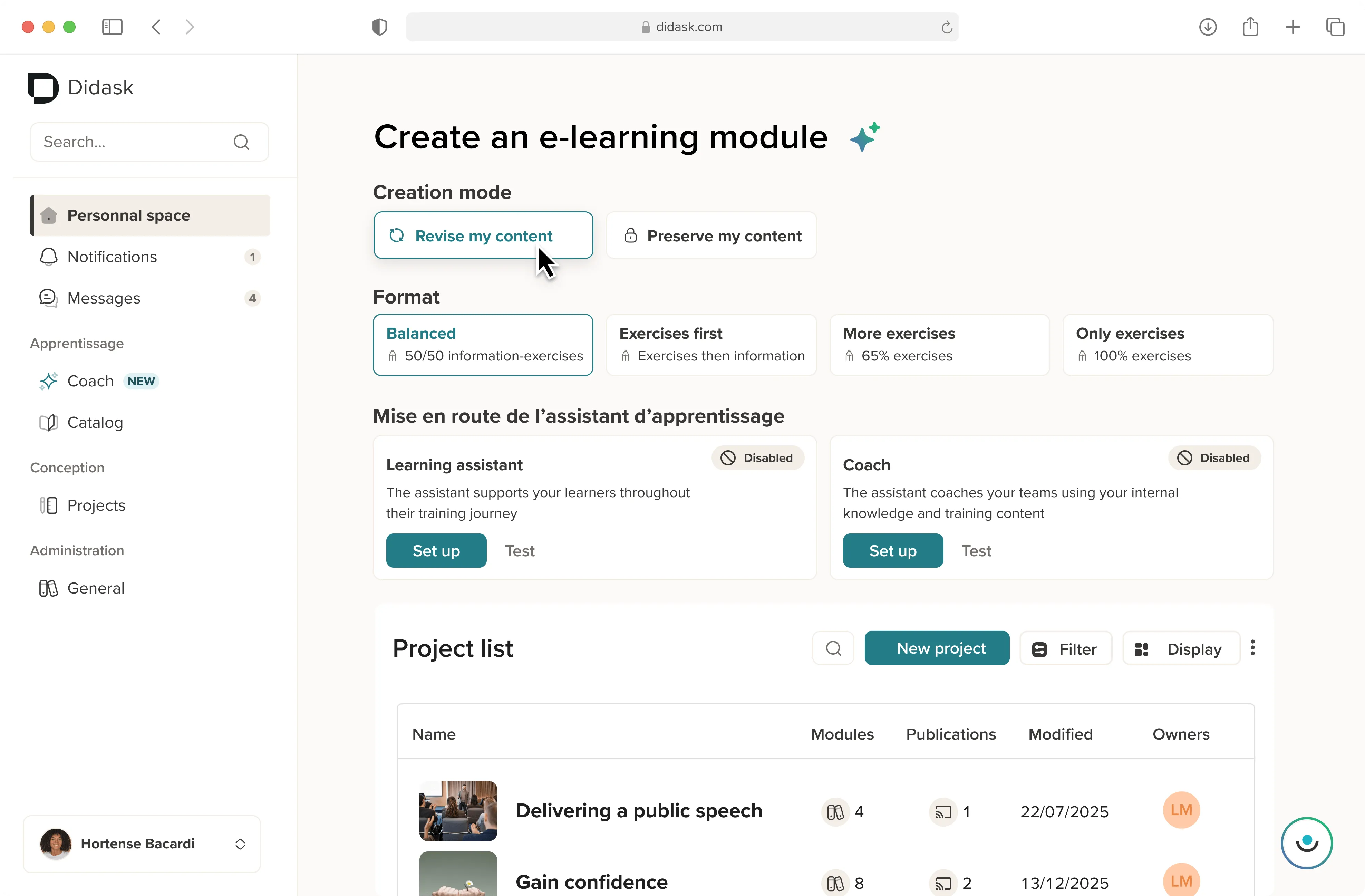
Do you want to use gamification for your professional training? Didask offers an approach that goes beyond classical gamification, by combining the engaging mechanics of the game with the principles of cognitive science.
Our conviction: true effective gamification is one that places the learner in a position to act, to make mistakes and to receive personalized feedback. It is this approach that we integrate into our platform.
Concretely, Didask allows you to:
- Create contextualized scenarios — Educational AI automatically generates concrete scenarios with plausible choices and explanatory feedback.
- Integrate quizzes and flashcards — To promote the effort of recovery and memory anchoring, much more effective than decorative badges.
- Personalize the courses — Thanks to adaptive learning, each learner follows a course adapted to his level and his real needs.
- Measuring real efficiency — Beyond the completion rate, monitor skills acquisition and behavior change.
This approach ensures effective, engaging and sustainable skills development, aligned with your educational and strategic goals.
FAQS
What are the main psychological mechanisms activated by gamification to improve learning?
Gamification activates several psychological mechanisms such as intrinsic motivation through a sense of competence (via rewards such as badges), autonomy through choice in the actions offered to learners, and socialization through the sharing of group experiences. Be careful though: cognitive science shows that extrinsic rewards (badges, points) are less effective than intrinsic motivation. For a lasting impact, favor scenarios that allow the learner to concretely understand the usefulness of learning.
How can we prevent gamification from becoming a source of distraction for learners?
To prevent gamification from being a source of distraction, it is essential to design game mechanisms that are closely linked to educational goals. Give priority to contextualized scenarios and explanatory feedback rather than the accumulation of badges or points. The fun element should serve learning, not divert it. Progressive integration and regular monitoring also make it possible to maintain the focus on what matters most.
Can gamification adapt to all types of learners, including those who are not very sensitive to the game?
Yes, as long as you design programs that are flexible and inclusive. This involves the diversity of the types of activities offered (serious games, quizzes, simulations), the possibility of adapting the levels of difficulty, and the integration of motivational levers other than pure play. Adaptive learning makes it possible to personalize the course according to the profile of each learner, ensuring that even those who are less receptive to the game remain engaged through relevant learning experiences.
What key indicators make it possible to precisely measure the impact of gamification on the effectiveness of a training course?
Beyond the classical indicators (completion rate, satisfaction), the most revealing indicators are: the observable change in behavior in a real situation, the progress in the acquisition of skills measured before and after, and the rate of good responses to contextualized scenarios. These quantitative and qualitative data provide a detailed assessment of the real impact of training on skills, not only on engagement.
.webp)
.webp)
.webp)





.png)