


While 70% of companies struggle to effectively identify and develop the critical skills of their teams, cognitive science reveals a completely new approach: the adaptive personalization of learning paths. Discover how to transform your internal expertise into performance drivers using educational artificial intelligence.
What is a business skill? Definition and challenges for your organization
A business competence refers to all the know-how, interpersonal skills and knowledge that your employees mobilize to effectively exercise their specific job. It combines technical skills, relational skills and a thorough understanding of the challenges of your sector of activity.
Business skills determine the collective ability to solve business challenges, innovate, and maintain your competitive edge.
What are the three categories of business skills to be developed in your teams?
Your employees mobilize three types of complementary skills that your training strategy must integrate.
The specific technical skills of each profession: software expertise for your developers, commercial techniques for your sales teams, regulatory knowledge for your lawyers.
Transversal skills create organizational fluidity: project management, internal communication, collaborative problem solving, data analysis. These skills facilitate internal mobility and reinforce the versatility of your teams.
Behavioral skills determine collective effectiveness: leadership, emotional intelligence, adaptability, team spirit, change management. They become strategic in a business environment that is constantly changing.
Why are business skills a strategic issue in 2025?
Digital transformation accelerates the obsolescence of technical skills in your teams. Artificial intelligence automates certain traditional tasks while new needs are emerging: data science, cybersecurity, eco-design, AI management.
This evolution is intensifying the competition to attract and retain talent that masters the skills of the future. Your training investments are becoming decisive in maintaining your competitiveness and avoiding the flight of critical skills.
Hybrid work and new ways of collaboration are transforming managerial expectations: autonomy, remote communication, digital leadership are becoming essential to maintain the performance of your distributed teams.
How do you map the business skills of your organization?
Skills mapping requires a methodical approach to obtain a comprehensive vision of your human capital. This approach reveals your strengths, identifies the risks of shortages and guides your training investments.
Start with an inventory of the skills present: analysis of CVs, interviews with operational managers, observation of field practices. This diagnostic phase often reveals unknown expertise and informal skills developed through experience.
The intersection with your future business challenges identifies critical gaps: what skills will be essential for your strategic projects? Which are at risk of disappearing with retirements? This prospective analysis guides your HR planning.
- Audit of existing skills : Extensive inventory by profession and level
- Assessment of future needs : Prospective analysis of sectoral developments
- Identifying critical gaps : Discrepancies between available and required
- Risk mapping : Rare or endangered skills
- Prioritizing investments : Expected ROI by area of expertise
Structuring your organization's competency framework
An organizational framework structures your skills by job families and levels of mastery. This architecture facilitates the predictive management of jobs and optimizes your internal mobility paths.
Organize your skills into three levels: core competencies (essential to the job), differentiating skills (competitive advantage) and emerging skills (anticipating changes). This classification guides your development priorities.
Define mastery scales adapted to your context: novice, autonomous, expert, internal referent, recognized expert. These levels facilitate objective assessment and planning for individual progress.
Tools for assessing business skills
Digital assessment platforms automate assessment on a large scale. These solutions offer standardized tests by business area with sectoral benchmark to locate the level of your teams.
The 360° assessment collects the perceptions of peers, managers and collaborators about each individual. This collaborative approach reveals the relational and behavioral skills that are crucial for your collective performance.
How to optimize business skills management? HR and business challenges
GPEC (Predictive Management of Jobs and Skills) structures your approach by combining the foreseeable evolution of jobs with your strategic challenges. This prospective analysis guides your recruitments, training and reorganizations.
Individualized development plans align the aspirations of your employees with your organizational needs. This personalization reinforces commitment, reduces turnover and optimizes the return on investment of your training actions.
- Strategic mapping : Consolidated vision of your skills capital
- Predictive analytics : Anticipation of future needs and risks
- Succession plans : Securing critical skills
- Internal mobility : Optimization of career paths and talent retention
- External partnerships : Access to complementary expertise
Effectively assess the business skills of your employees
The assessment of business skills requires objective and regular processes integrated into your daily management. Professional interviews are evolving towards a skills approach that goes beyond quantitative objectives alone.
Assessment centers reveal skills in action through realistic business simulations. This method identifies your internal potentials and guides your promotion or mobility decisions.
Field managerial observation complements these formal evaluations by analysing daily practices. Your local managers become key evaluators of the skills development of their teams.
Measuring the ROI of your investments in business skills
Measuring the impact of your training is based on specific business indicators: improving operational performance, reducing errors, increasing productivity, customer satisfaction. These metrics demonstrate the value created by skills development.
The Kirkpatrick model structures your assessment into four levels: learner satisfaction, knowledge acquisition, change in professional behaviors, impact on business results. This global approach reveals the real effectiveness of your investments.
Also measure indirect benefits: team motivation, employer attractiveness, capacity for innovation, organizational agility. These qualitative gains reinforce your long-term competitiveness and justify your training budgets.
The future of business skills management: educational AI
Educational artificial intelligence is revolutionizing the traditional approach to skills development. This technology goes beyond standardized training to personalize the experience according to the profile, level and business goals of each employee.
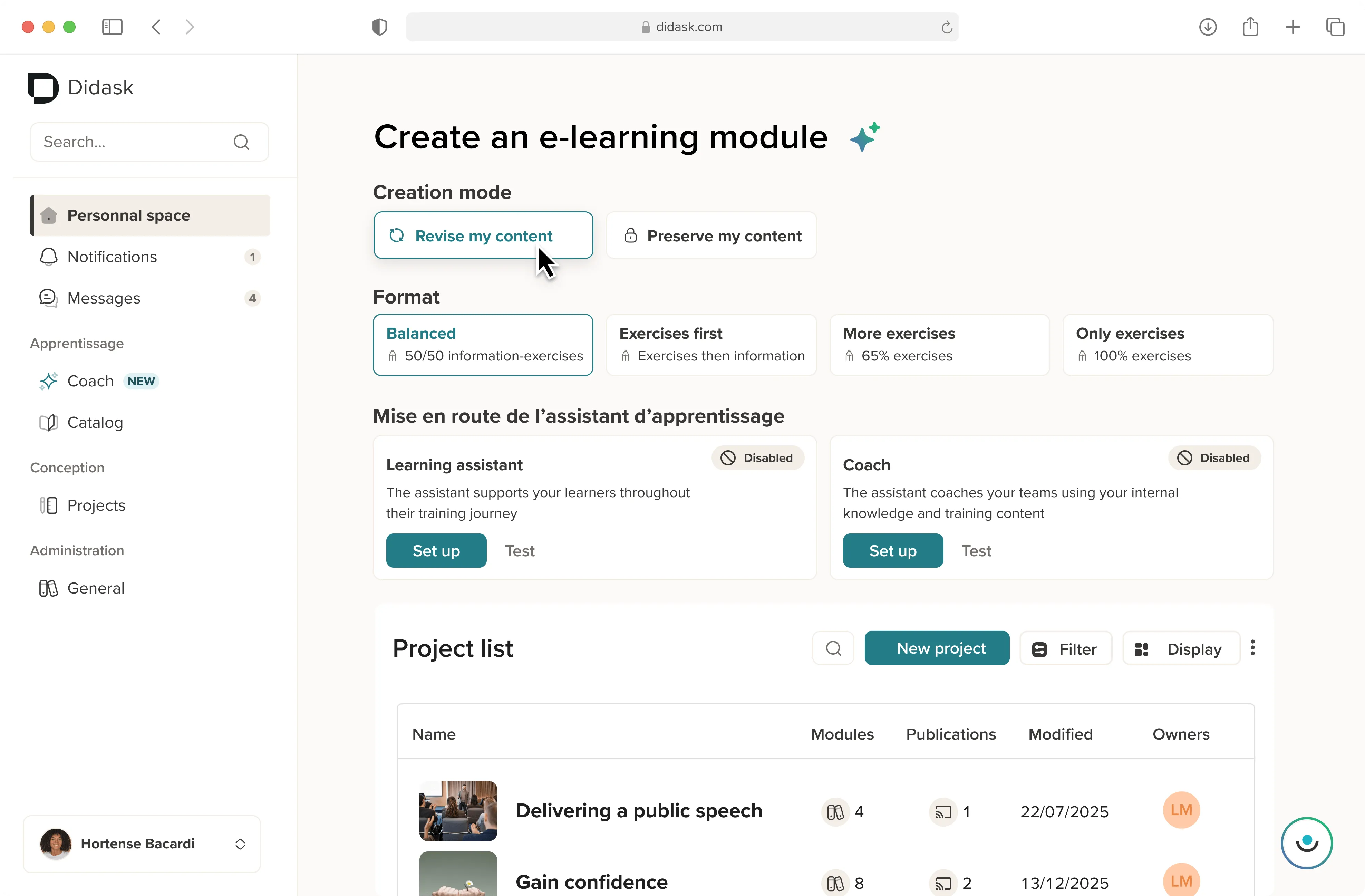
Didask's educational AI turns your internal experts into effective trainers: they upload their raw business content and the algorithm automatically generates an optimized learning experience. This automation reduces creation times by ten while relying on cognitive science to ensure educational effectiveness.
Learning is integrated directly into the daily workflow: micro-training courses contextualized in business tools, personalized training sessions before customer appointments, updated procedures integrated into work interfaces.
This data-driven approach allows you to continuously optimize your training investments and to obtain a precise vision of ROI by skill developed.
Truly Develop Professional Skills with Didask
- 30 minutes to discover our LMS
- Discover the power of Instructional AI
- Personalized demo with an expert
- Free demo with no commitment

Business skills are no longer a training cost but a differentiating strategic investment for your organization. Companies that know how to combine the intelligence of their experts with educational artificial intelligence will create adaptive learning ecosystems that will give them a decisive head start. The future belongs to organizations that will transform their experts into augmented trainers and their employees into autonomous actors in their skills development.
.webp)
.webp)
.webp)




.png)