.webp)
.webp)

SIG and the Eco21 program: training Geneva energy actors in the energy transition
The Geneva Industrial Services (SIG) is an autonomous public law agency. They provide the entire canton with electricity, drinking water, renewable thermal energy, gas, as well as waste recovery and wastewater treatment.
In 2007, SIG created the ECO21 program with a clear ambition: to support customers and partners in reducing their environmental footprint and energy consumption. Training is rapidly becoming a strategic pillar of the program.
Each year, SIG Eco21 organizes approximately 80 training sessions And formed More than 6,000 people Since the launch of the program. The audiences are varied and very technical: architects, engineers, installers of heat pumps or photovoltaic power plants, energy managers in companies or communities.
.webp)
Context
ECO21's training activity covers building energy efficiency, facility optimisation, circular economy, and waste recovery. These are technical, regulatory topics that are often complex to communicate in accessible terms.
The challenge: to transform experts into training designers
The ECO21 program is based on a pool of trainers who are experts in their field. But this technical expertise has a downside: The Majority of Them Are Not Professional Trainers.
The process of creating the training modules was time and energy consuming. The experts first had to transmit their material to the training managers, who then took care of the instructional design. A constant round trip and a source of information loss.
The question asked to SIG Eco21 was therefore twofold: how to involve experts directly in the creation of content, while guaranteeing the educational quality of the modules produced?
Why Didask? The promise of creation accessible to experts
It was this promise that first convinced Sophie Schönenberger, then ECO21 Training Manager:
.png)
Sophie Schönenberger, Training Manager at SIG Eco21
"The promise that experts could create content without any particular pedagogical knowledge really caught my attention. We needed a tool that was easy to use, fast, and allowed us to create content remotely."
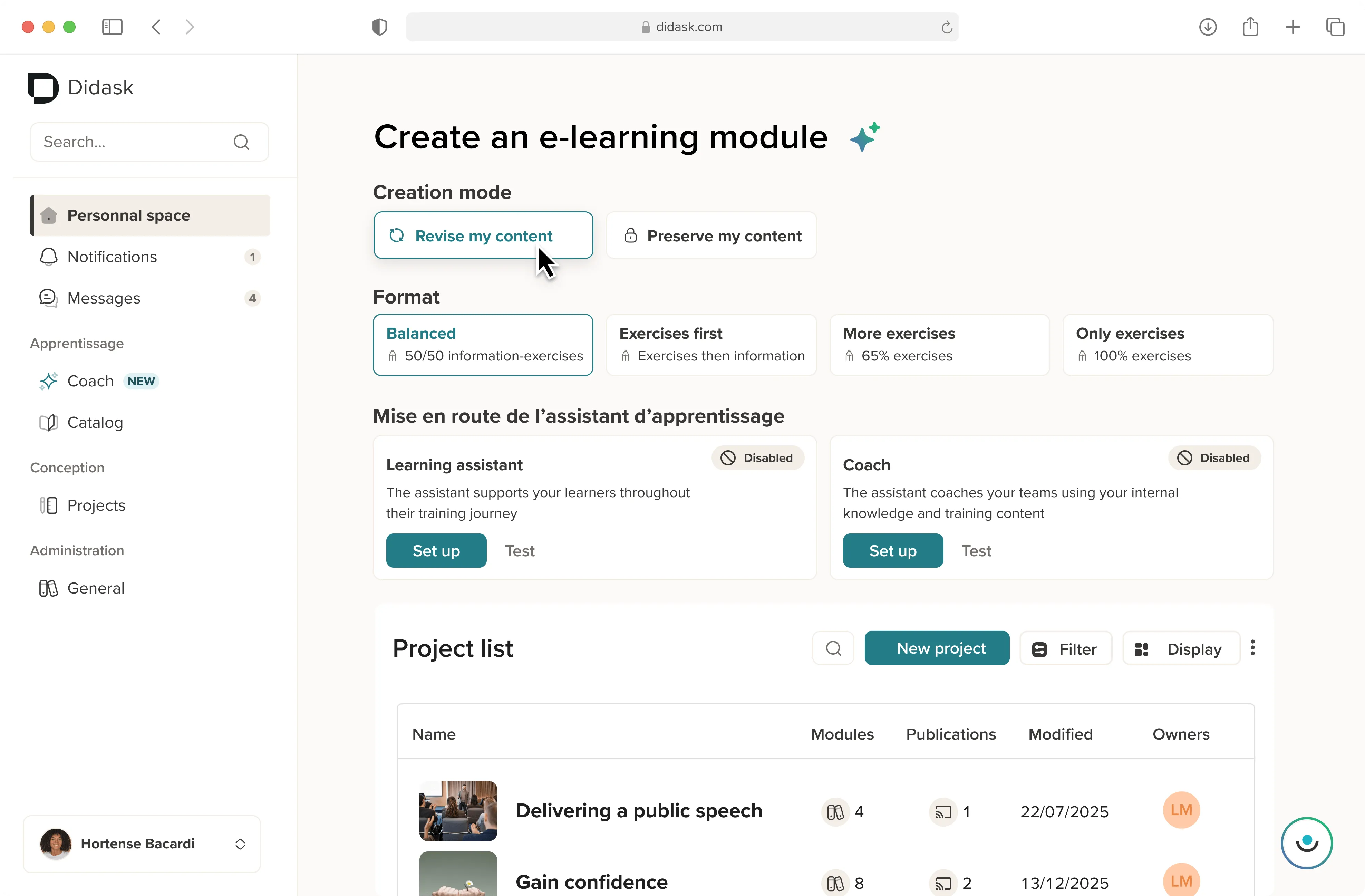
Didask puts precisely this need: a guided interface, an educational AI that helps structure the content, and native formats (flashcards, memos, summaries) that integrate good cognitive practices without the designer having to master them.
Deployment: a day of getting started, immediate autonomy
SIG opted for a structured start. A day of support with the Didask teams made it possible to co-build a Toolkit : internal documentation to guide experts in getting started with the tool and creating remote modules.
The result exceeded expectations: All the experts succeeded in creating their first modules independently, without the intervention of the training managers.
For Sophie Schönenberger, the success criterion was simple: experts had to be able to create their modules on their own. The result: 100% of them succeeded. “For us, it was a real success.”
The experience of Laetitia Rapin, a photovoltaic expert and project manager, illustrates this accessibility well:
Laetitia Rapin, Project Manager at SIG Eco21
"As someone without a training background, I was quickly able to create my first Didask modules. Thanks to the toolkit and an interface I found very intuitive and very clear."
Features that made the difference
Three elements particularly impressed the Eco21 GIS teams.
Guided design Is the most cited feature. The Didask interface structures the creation process step by step, which compensates for the lack of formal pedagogical training among experts.
Educational AI Played a key role in avoiding blank page syndrome. It supports experts in sequencing their training based on their raw content, without them having to master the principles of educational engineering.
The Wealth of Interactive Formats (flashcards, memos, end-of-module summaries) made it possible to make subjects deemed arid attractive: regulations, installation safety, technical standards.
The results: commitment, homogeneity, efficiency
More Engaged and Effective Learners
The introduction of Didask modules transformed the dynamics of sessions. Learners who took the first online module were significantly more likely to engage in the following ones. This trend was immediately visible in the evaluation questionnaires, whose scores improved significantly.
For Laetitia Rapin, the most significant impact is the clarity of the messages transmitted:
Laetitia Rapin, Project Manager at SIG Eco21
"Learners are no longer overwhelmed by a flood of information. They come out of the online module with the key messages we want them to retain and understand."
A More Homogeneous Level and Enriched Face-to-Face Sessions
On the part of the trainers, the observation is just as positive. Thanks to the upgrade provided by the online modules, participants arrived in person with a common base of knowledge. The level of participants has become much more homogeneous. The trainers were able to go further in the face-to-face games, without wasting time getting part of the group up to speed.
An accelerated process and parallel projects
The organizational impact is also major. By eliminating the knowledge transfer stage between experts and training managers, SIG Eco21 was able to Parallelize several projects simultaneously and accelerate its digitalization.
Sophie Schönenberger, Training Manager at SIG Eco21
"Being able to directly involve our experts so they can create modules autonomously allows us to run projects in parallel and move faster in our digitalisation efforts."
What SIG Eco21 learned from Didask support
Beyond the platform, the SIG Eco21 teams highlight the quality of the monitoring offered by Didask: a good understanding of the needs at the outset, and a constant reactivity of the support throughout the project.
Eric Schmit, Training Manager at SIG Eco21
"Didask means a gain in efficiency. A solution that supports our subject-matter experts, that will truly allow them to invest in their training and improve the quality of the learning experience."
Conclusion: what if your experts became your best designers?
The SIG Eco21 case illustrates a reality that is often underestimated: The Best Course Designers Are Not Always Pedagogical Professionals. Experts are the ones who deal with the subjects on a daily basis, as long as they are given the right tools.
Didask Training Allows them to create engaging and effective training courses, without prior educational training, by relying on an AI that automatically structures content according to cognitive science principles.
.png)
Sophie Schönenberger, final word
"I would definitely recommend Didask. Choosing this solution means saving time and involving subject-matter experts to create remote training that is engaging, effective, and truly meets learners' real needs."
Do you want to discover how Didask can transform your business experts into autonomous training designers?
Book a demo now
.webp)
How our customers turn learning
into measurable impact







Get a demo!
We’d love to know how to help you
made scalable
Authoring Tools
Platform
.png)